Joseph Smith — "And behold, how oft you have transgressed the commandments and the laws of God, …"
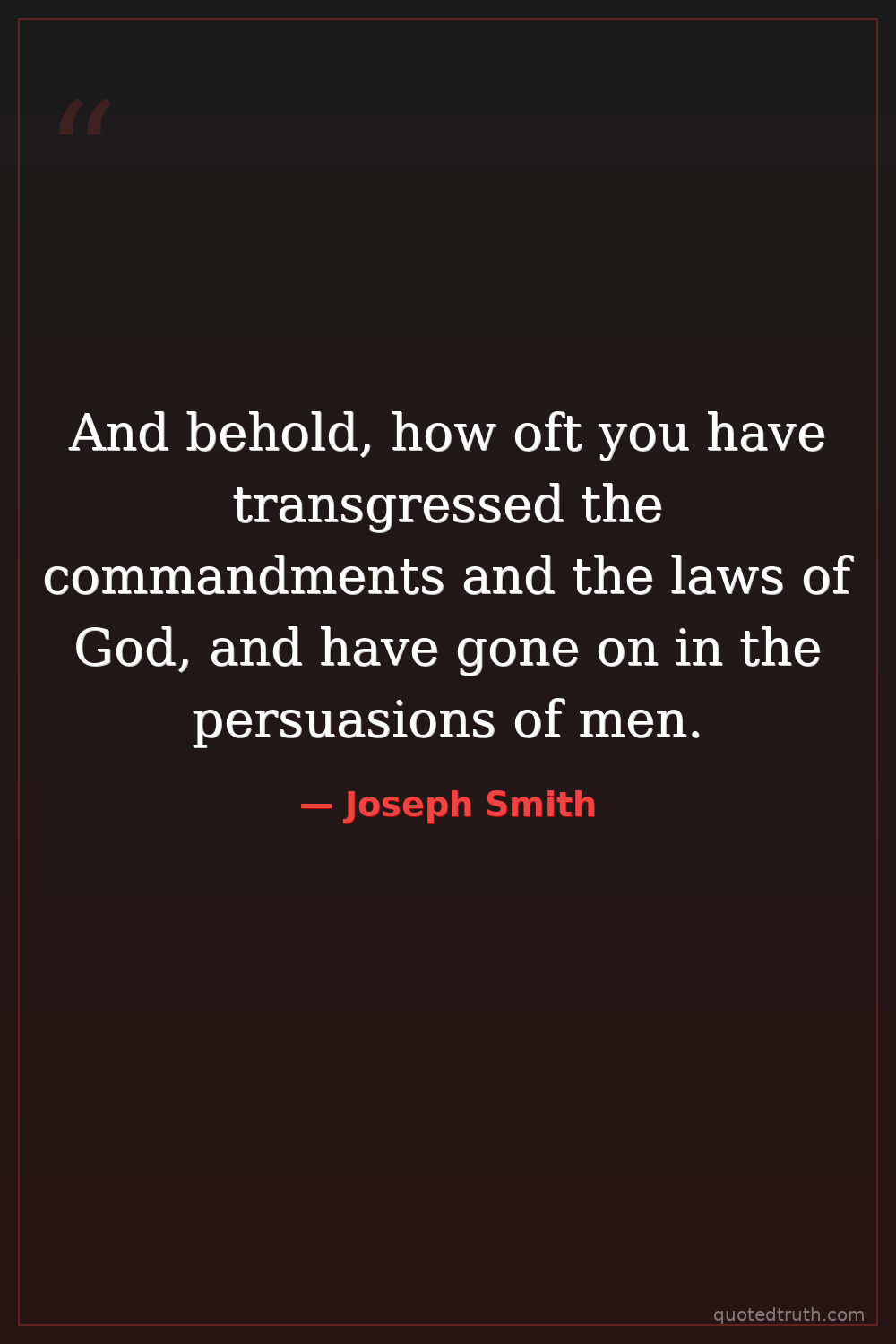
And behold, how oft you have transgressed the commandments and the laws of God, and have gone on in the persuasions of men.
And behold, how oft you have transgressed the commandments and the laws of God, and have gone on in the persuasions of men.
Click any product to generate a realistic preview. Up to 3 at a time.
* Initial load can take up to 90 seconds — revising the preview in another color is nearly instant.
"It is the first principle of the Gospel to know for a certainty that we have a right to expect to see God, and that he will converse with us as one man converses with another."
"I am a man of integrity, and I will maintain my integrity to the end."
"For behold, the Lord shall curse the land with much heat, and the barrenness thereof shall go forth forever; and there was a blackness came upon all the children of Canaan, that they were despised amo…"
"The greatest responsibility in this world that God has laid upon us is to seek after our dead."
"I never told you I was perfect; but there is no error in the revelations which I have taught."
Doctrine and Covenants 3:6–7, 9, a rebuke to Joseph Smith himself after the loss of the 116 manuscript pages.
Date: 1828
GeneralFound in 1 providers: gemini
1 source checked
The quote confronts a recurring human failure: abandoning God's commands in favor of what other people urge or expect. 'Persuasions of men' means social pressure, peer approval, and human reasoning that overrides divine instruction. The word 'oft' signals this isn't a single lapse but a pattern. It demands self-examination — how often do we compromise convictions to satisfy others rather than honor a higher moral or spiritual standard?
This verse from Doctrine & Covenants Section 3 was directed at Smith himself after he allowed Martin Harris to take 116 manuscript pages of the Book of Mormon translation — against earlier divine warning. Harris's repeated pleas wore Smith down. The pages were lost, likely stolen. This revelation was a direct rebuke of Smith's capitulation to social pressure over prophetic duty, illustrating the central tension of his life: divine calling versus human loyalty.
The 1820s-1830s Second Great Awakening created fierce religious competition and skepticism in upstate New York. Anyone claiming new revelation faced crushing social and legal pressure to conform to established Protestant norms. Smith's followers were mobbed, expelled from states, and murdered. The phrase 'persuasions of men' carried real weight in a frontier society where community opinion could mean safety or violent exile — making doctrinal independence an act of physical as well as spiritual courage.
AI-generated insights based on extensive research and information for context. Factual errors? Email [email protected].
Your cart is empty