Guru Nanak — "There is but One God, His Name is Truth, He is the Creator, Fearless, without ha…"
There is but One God, His Name is Truth, He is the Creator, Fearless, without hatred, Immortal, Unborn, Self-existent, by the Guru's Grace.
There is but One God, His Name is Truth, He is the Creator, Fearless, without hatred, Immortal, Unborn, Self-existent, by the Guru's Grace.
Click any product to generate a realistic preview. Up to 3 at a time.
* Initial load can take up to 90 seconds — revising the preview in another color is nearly instant.
"Be the wisdom your support. Be the compassion your guide and listen to the Divine Music that beats in every heart."
"May peace prevail on Earth. And may my noisy neighbors finally get some headphones."
"Those who have loved are those that have found God."
"He who regards all men as equals is religious."
"The Lord is neither male nor female, neither does He have any form or color."
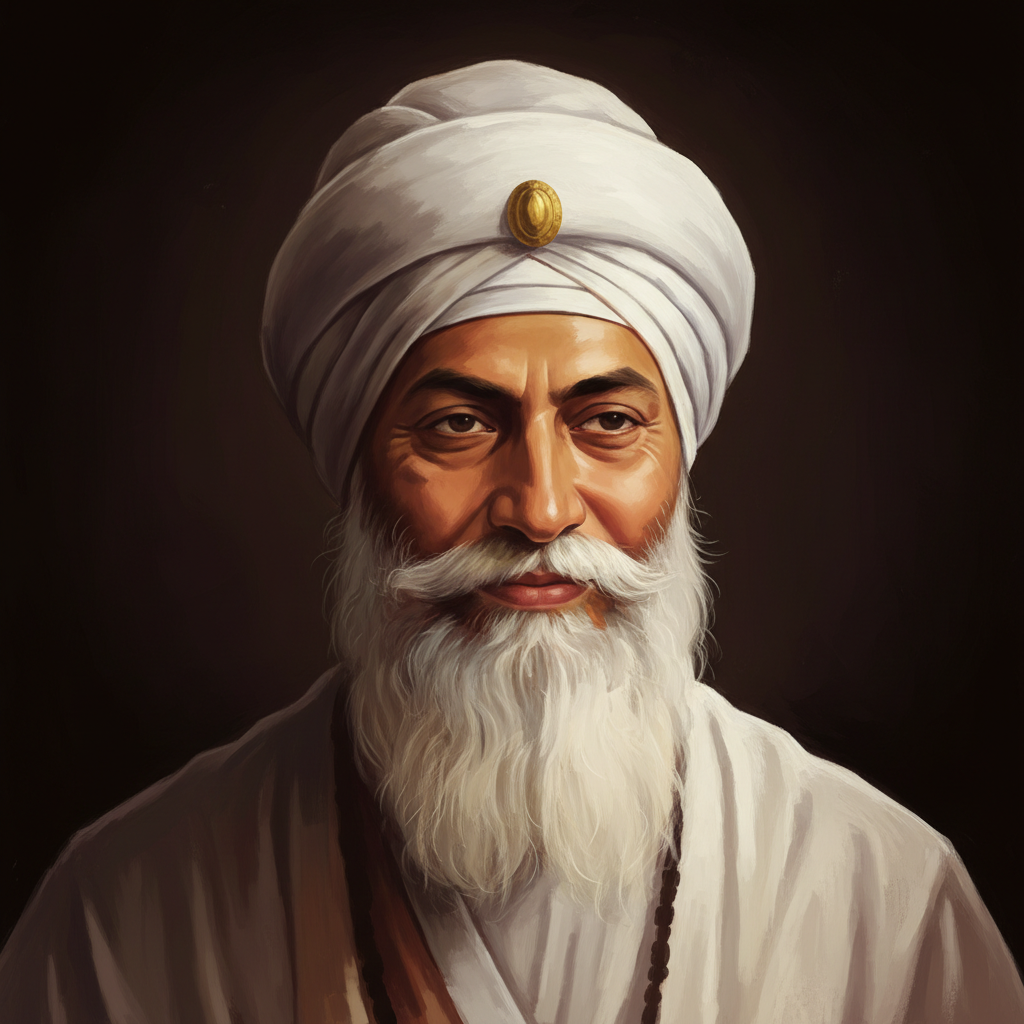
Founder of Sikhism and the first of the Ten Sikh Gurus, whose teachings of one universal God and rejection of caste shaped Punjab. Closely associated with Kabir (mystical poet whose verses appear in the Sikh Guru Granth Sahib). For an intellectual contrast, see Brahmanical orthodoxy, the Hindu caste-and-ritual establishment of his era — Sikhism was founded as a deliberate alternative to both Hindu ritual hierarchy and Islamic exclusivism — Nanak's universalism was a structural rejection of caste and priestly mediation.
Found in 1 providers: grok
1 source checked
This statement declares that only one divine reality exists, and its essential nature is truth itself. That one being made everything, fears nothing, holds no enmity toward anyone, never dies, was never born, and depends on nothing outside itself to exist. A person cannot grasp this reality through cleverness or ritual; it becomes known only when a true teacher opens the door, turning abstract theology into lived experience.
These words open the Mul Mantar, the opening verse Guru Nanak composed to launch Sikh scripture around 1499 after his river vision at Sultanpur. A former accountant turned wandering teacher, he rejected caste priests, idol worship, and empty ritual in both Hindu and Muslim practice. The emphasis on one formless Creator known through a Guru's grace distills his life mission: replacing inherited religious machinery with direct, egalitarian devotion accessible to farmers, women, and untouchables alike.
Early sixteenth-century Punjab sat on a violent fault line between the declining Delhi Sultanate and the arriving Mughals under Babur, whose 1526 invasion Nanak personally witnessed and condemned. Hindu-Muslim tension, rigid caste hierarchy, Brahmin ritualism, and Sufi mysticism all competed for ordinary people's loyalty. Declaring one universal, casteless, formless God cut across every sectarian boundary at once, offering a third path that belonged to neither the mosque nor the temple during an era defined by religious coercion.
AI-generated insights based on extensive research and information for context. Factual errors? Email [email protected].
Your cart is empty