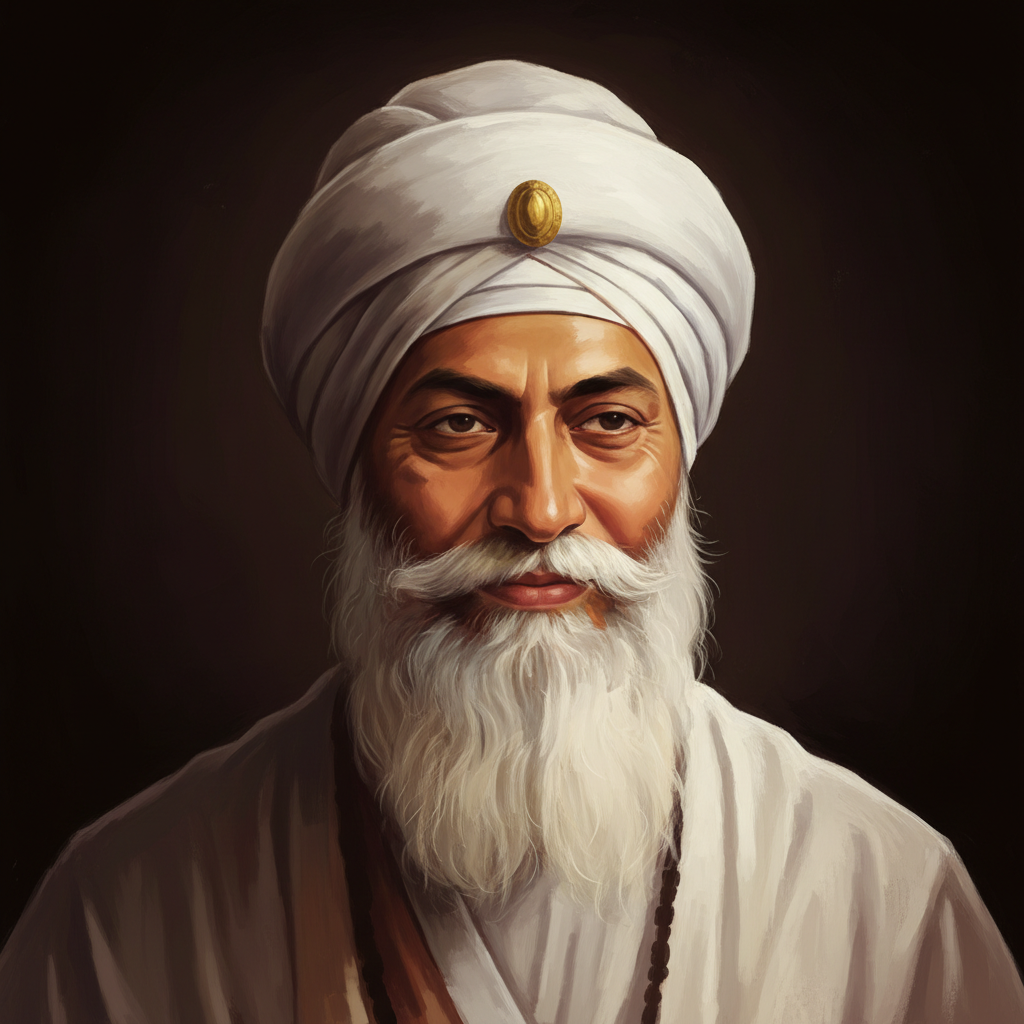
Guru Nanak — "He who regards all men as equals is religious."
He who regards all men as equals is religious.
He who regards all men as equals is religious.
Click any product to generate a realistic preview. Up to 3 at a time.
* Initial load can take up to 90 seconds — revising the preview in another color is nearly instant.
"Whatever is in the universe is in the body of the devotee."
"There is but one God. And sometimes, He has a very subtle sense of humor."
"The Lord is the ocean, and we are the fish in it."
"Caste has no power in the hereafter; the only judge is truth."
"Make compassion the cotton, contentment the thread, modesty the knot and truth the twist. This is the sacred thread of the soul; if you have it, then go ahead and put it on me."
Founder of Sikhism and the first of the Ten Sikh Gurus, whose teachings of one universal God and rejection of caste shaped Punjab. Closely associated with Kabir (mystical poet whose verses appear in the Sikh Guru Granth Sahib). For an intellectual contrast, see Brahmanical orthodoxy, the Hindu caste-and-ritual establishment of his era — Sikhism was founded as a deliberate alternative to both Hindu ritual hierarchy and Islamic exclusivism — Nanak's universalism was a structural rejection of caste and priestly mediation.
Found in 1 providers: gemini
1 source checked
True religiosity isn't defined by rituals, prayers, or institutional belonging — it's measured by how you treat other people. Seeing every human being as fundamentally equal, regardless of caste, background, or status, is what makes someone genuinely spiritual. This reframes religion from external observance to ethical action: your relationship with the divine is expressed directly through your relationship with fellow humans.
Guru Nanak (1469–1539) founded Sikhism on the premise that no person stands higher than another before God. He openly challenged the caste hierarchy, traveled across South Asia, the Middle East, and Central Asia preaching universal brotherhood, and instituted the langar — a community kitchen where people of every caste ate together as equals. His entire ministry was a living demonstration of this principle.
Guru Nanak lived in 15th–16th century Punjab, rigidly stratified by the Hindu caste system, where Brahmins monopolized religious authority and lower castes faced systemic exclusion. The early Mughal consolidation also stoked Hindu-Muslim tension. His declaration that equality is religion directly challenged priestly privilege and sectarian division simultaneously, offering a radical third path at a moment when both hierarchies were violently enforced.
AI-generated insights based on extensive research and information for context. Factual errors? Email [email protected].
Your cart is empty