Charles Darwin — "One day, on looking at an orchid, I was struck with the idea that the structure …"
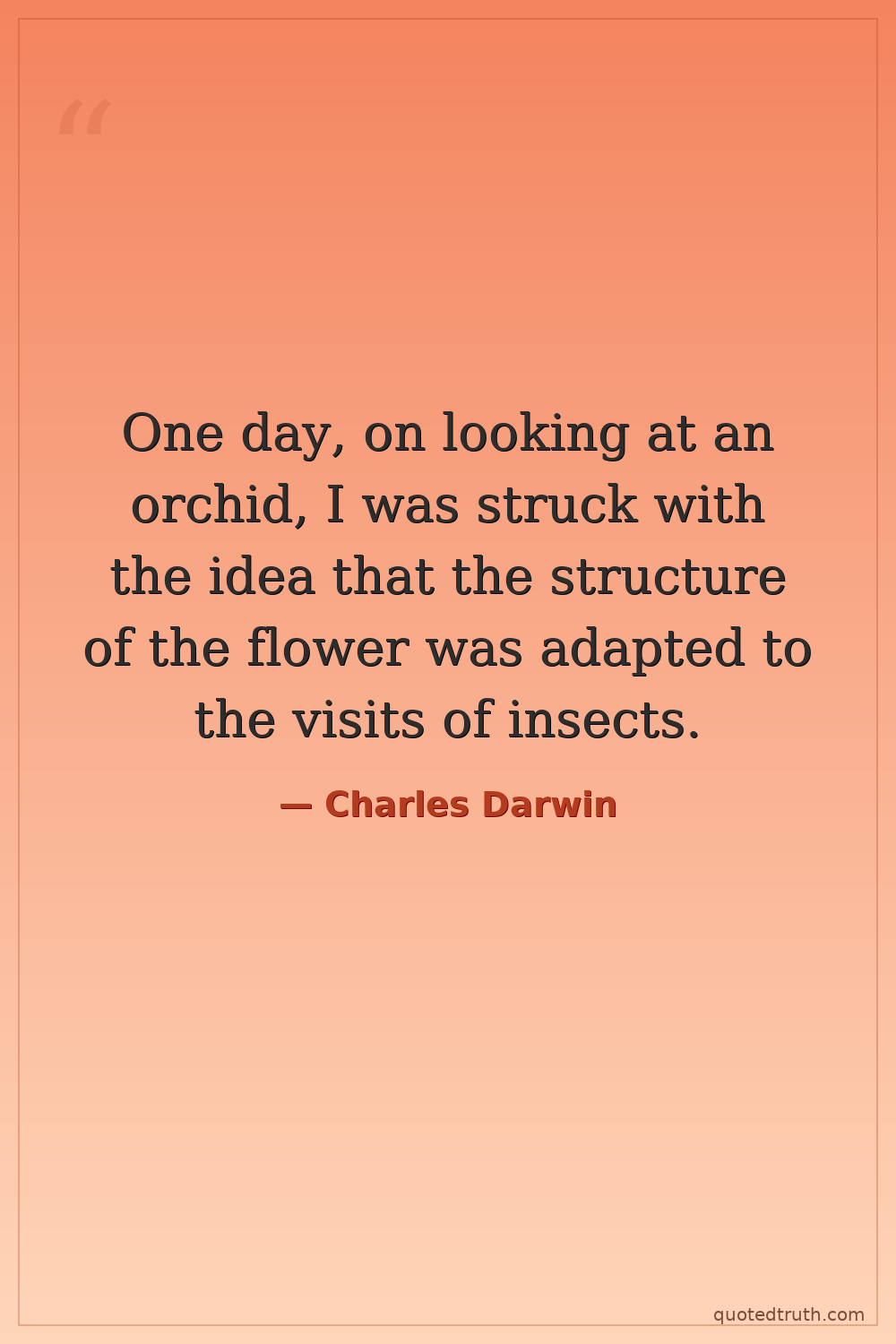
One day, on looking at an orchid, I was struck with the idea that the structure of the flower was adapted to the visits of insects.
One day, on looking at an orchid, I was struck with the idea that the structure of the flower was adapted to the visits of insects.
Click any product to generate a realistic preview. Up to 3 at a time.
* Initial load can take up to 90 seconds — revising the preview in another color is nearly instant.
"Man tends to increase at a greater rate than his means of subsistence."
"Man is descended from a hairy, tailed quadruped, probably arboreal in its habits, and an inhabitant of the Old World."
"I could show fight on natural selection having done and doing more for the progress of civilization than you seem inclined to admit."
"A scientific man ought to have no wishes, no affections – a mere heart of stone."
"The more civilized so-called Caucasian races have beaten the Turkish hollow in the struggle for existence."
British naturalist whose On the Origin of Species (1859) established evolution by natural selection — the unifying theory of modern biology. Closely associated with Thomas Henry Huxley (his 'bulldog' public defender) and Alfred Russel Wallace (independent co-discoverer of natural selection). For an intellectual contrast, see William Paley, Anglican theologian and Natural Theology author (1743-1805) — Origin of Species is structurally a 400-page reply to Paley — Darwin admired Paley's watchmaker-argument as an undergraduate at Cambridge and then spent 20 years building the empirical machinery to displace him. The cleanest 'design argument vs natural selection' founding rebuttal in science.
The standard scholarly entry points to Charles Darwin's work: Janet Browne (Harvard, history of science) — Charles Darwin: Voyaging (1995) and The Power of Place (2002); Adrian Desmond (UCL, biographer) — Darwin: The Life of a Tormented Evolutionist (1991, with James Moore). These are the works graduate seminars cite when teaching Charles Darwin.
Found in 1 providers: grok
1 source checked
Darwin describes a flash of observational insight — an orchid's physical structure isn't decorative or random but functionally shaped by its relationship with insect pollinators. Petals, nectar guides, and flower form evolved to attract and accommodate specific insects over generations. What looks like elegant natural beauty has a functional explanation: mutual adaptation between species driven by natural selection across vast stretches of time.
Darwin published an entire book on orchids in 1862 using them as showcase evidence for natural selection. This moment typifies his method: patient, detail-obsessed study of specimens others overlooked. He spent years corresponding with botanists and cultivating orchids at Down House. For Darwin, these weren't merely pretty flowers but evolutionary puzzles whose bizarre structures revealed the power of adaptation — coevolution between plants and pollinators made visible through careful, sustained observation.
Darwin's era was dominated by natural theology — the belief that nature's complexity proved divine craftsmanship. William Paley's watchmaker argument was standard intellectual currency when Darwin trained at Cambridge. Seeing orchid structure as shaped by insect visits rather than God's design quietly dismantled the era's central argument for a creator. His 1862 orchid book provided meticulous counter-evidence that complexity arises from ecological pressure, not intention — arriving as Victorian society wrestled with industrialization, geological deep time, and biblical authority.
AI-generated insights based on extensive research and information for context. Factual errors? Email [email protected].
Your cart is empty