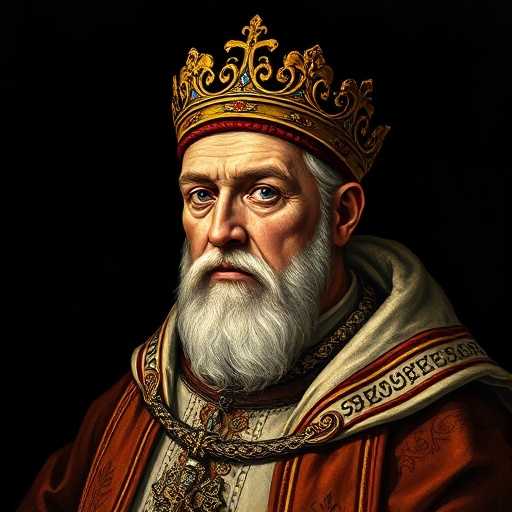
Pope Urban II — "This land which you inhabit is too narrow for your large population... The land …"
This land which you inhabit is too narrow for your large population... The land is as it were your prison.
This land which you inhabit is too narrow for your large population... The land is as it were your prison.
Click any product to generate a realistic preview. Up to 3 at a time.
* Initial load can take up to 90 seconds — revising the preview in another color is nearly instant.
"The land which you inhabit is too narrow for your large population; it scarcely furnishes food enough for its cultivators. Hence it is that you murder and devour one another."
"Let those who have been robbers, now become soldiers of Christ."
"I, Urban, wearing the pontifical vestments, and by the authority of God, confirm to those who undertake this holy journey a full remission of all their sins."
"The land of the Lord is now held by the infidels."
"Therefore, I exhort and implore you—not I, but the Lord—to go as soldiers of Christ."
Pope (1088-1099) whose Council of Clermont speech (November 1095) launched the First Crusade — the founding event of nine centuries of Christian-Muslim military conflict. Closely associated with Pope Gregory VII (his predecessor on papal-imperial reform). For an intellectual contrast, see Saladin, Kurdish-Muslim Sultan of Egypt and Syria (1138-1193) — Saladin recaptured Jerusalem in 1187, undoing the First Crusade Urban II launched 92 years earlier. Saladin's chivalrous treatment of Christian prisoners became the canonical Muslim counter-image to Crusader brutality. The cleanest before/after pairing of the Crusades' moral arc.
Found in 1 providers: deepseek
1 source checked
The quote argues that Western Europe is too crowded and resource-scarce to sustain its population — the land itself has become a constraint, almost a cage. Urban uses this economic logic to justify expansion eastward: not merely as religious duty, but as practical necessity. The implication is that the Holy Land offers space, freedom, and opportunity unavailable at home — framing the Crusade as both spiritual liberation and material escape from grinding scarcity.
Pope Urban II, a French Benedictine monk turned pope, delivered this at the Council of Clermont in 1095. He understood European feudal pressures intimately — landless knights, warring nobles, scarce inheritance. His Gregorian reform background made him a pragmatic institution-builder who knew persuasion required multiple angles. By combining material grievance with religious mission, Urban demonstrated his mastery of political theology: channeling domestic instability into a holy enterprise that would simultaneously relieve destructive Church-internal violence.
In 1095, primogeniture left younger noble sons landless and restless, fueling feudal conflict the Church was actively suppressing through the Peace of God movement. The medieval warm period had enabled population growth that outpaced arable land. Simultaneously, Seljuk Turks had seized Jerusalem, blocking Christian pilgrimage routes. Byzantine Emperor Alexios I called for Western military aid. Urban's speech fused these converging pressures — social, economic, religious — into a single mobilizing narrative: march east or remain imprisoned here.
AI-generated insights based on extensive research and information for context. Factual errors? Email [email protected].
Your cart is empty