What it means
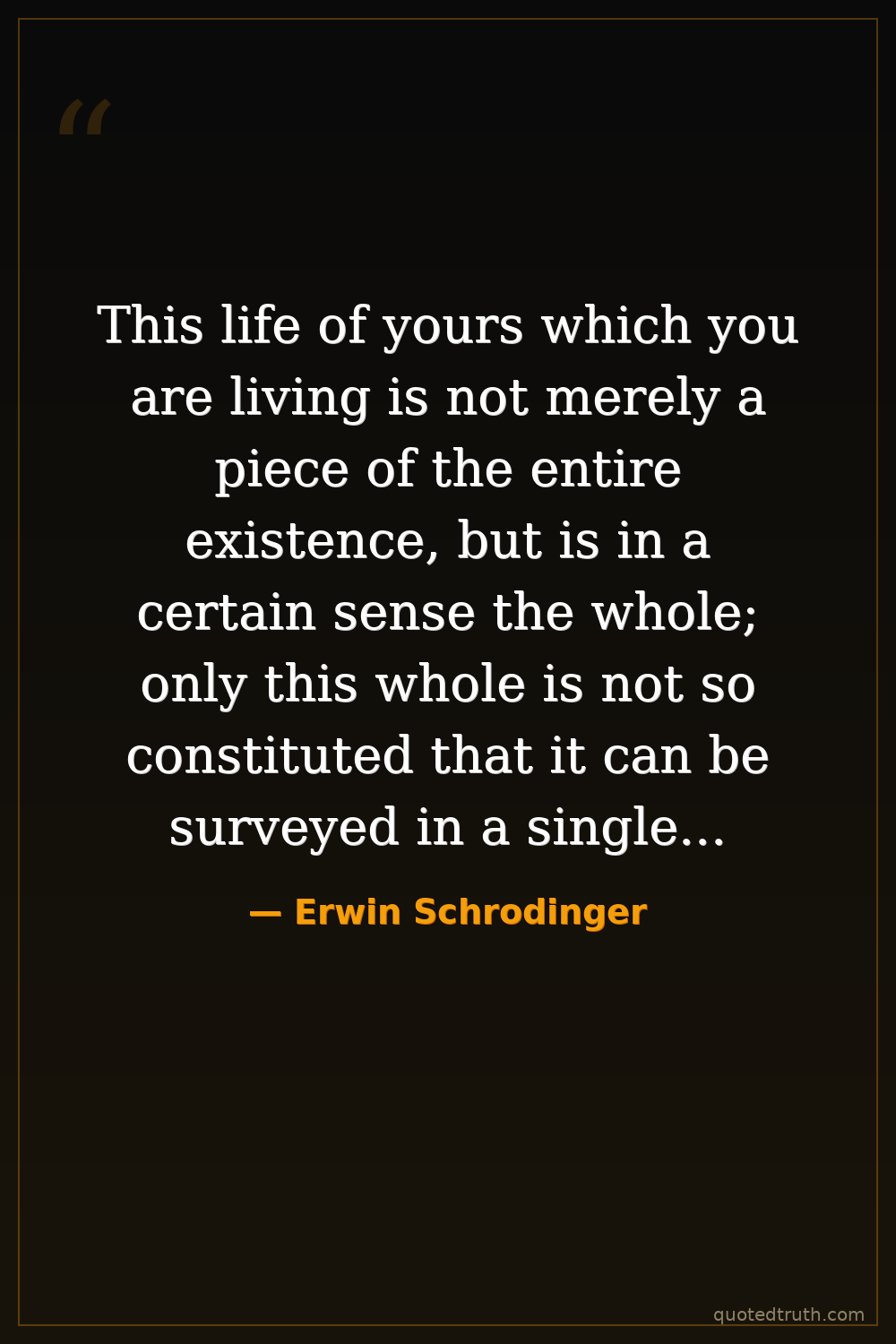
Your individual life is not just a small fragment of reality but somehow contains the whole of existence itself. The catch is that this wholeness cannot be perceived all at once from a single perspective. Ancient Hindu sages captured this paradox in three Sanskrit words, Tat tvam asi, meaning 'that is you', pointing to a hidden identity between the personal self and the totality of being.
Relevance to Erwin Schrodinger
Schrodinger pioneered wave mechanics in 1926, then spent decades pondering consciousness and unity in works like What Is Life? and My View of the World. He read the Upanishads obsessively, kept a Sanskrit notebook, and concluded that the multiplicity of minds is illusory. His quantum equations described smeared, non-local wholes, mirroring his metaphysical conviction that one consciousness underlies every observer.
The era
Writing mid-twentieth century amid quantum revolution, two world wars, and rising atomic anxiety, Schrodinger watched physics dissolve classical certainties about separate objects. Western intellectuals were discovering Eastern philosophy through Schopenhauer, the Theosophists, and translations of Vedantic texts. After fleeing Nazi Austria to Dublin, he sought a unifying worldview that reconciled scientific reductionism with the felt unity of life, resisting both materialism and sectarian religion.
AI-generated insights based on extensive research and information for context. Factual errors? Email [email protected].