What it means
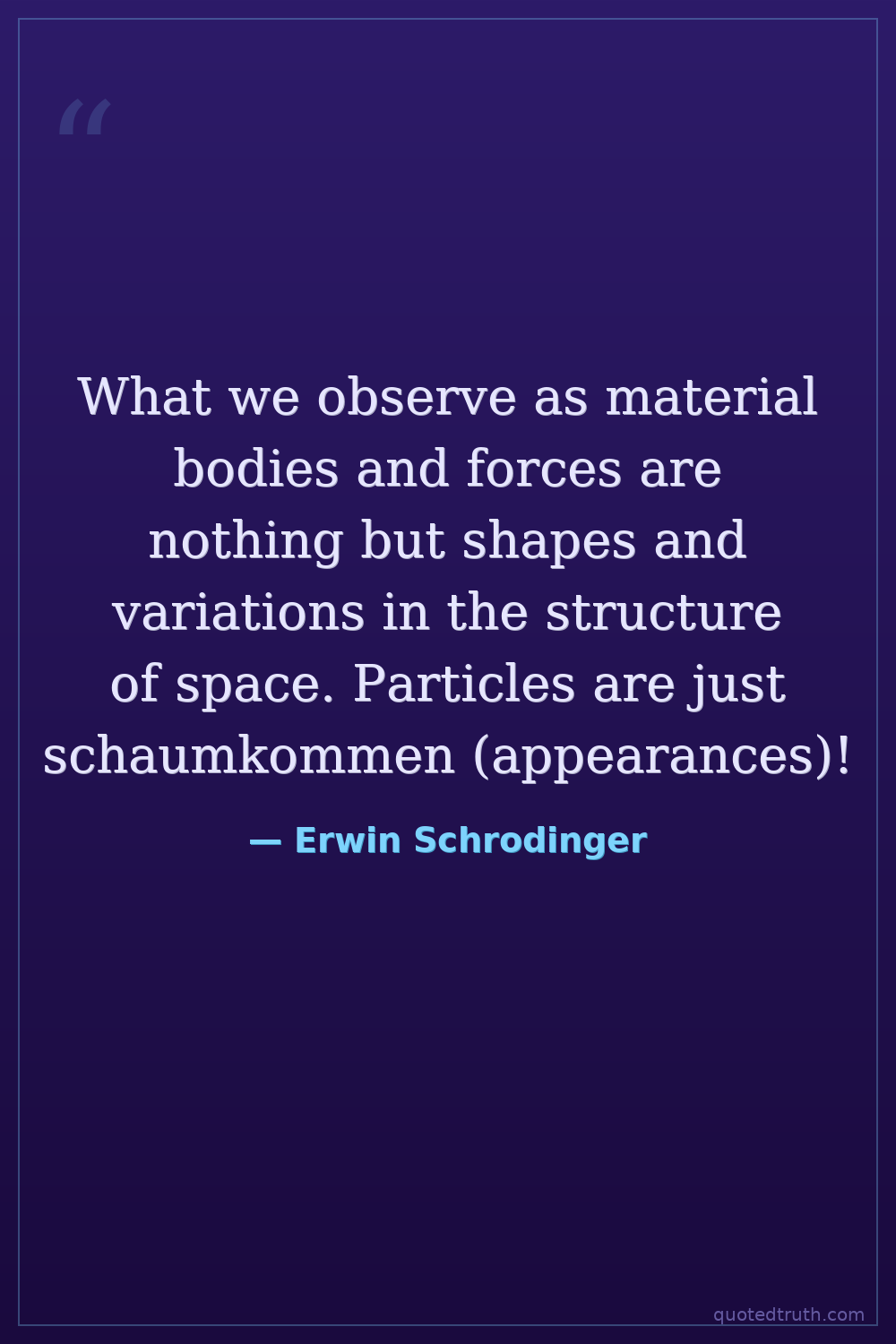
Physical matter and forces aren't fundamental realities but rather patterns and distortions within the fabric of space itself. What we call particles aren't solid objects but fleeting appearances, temporary structures that emerge from underlying geometry. Reality at its core is not made of things but of relationships and forms — a radical reframing that dissolves the boundary between substance and structure.
Relevance to Erwin Schrodinger
Schrödinger developed wave mechanics in 1926, replacing point-particle physics with wave functions describing probability distributions across space. His famous cat paradox challenged naive realism. This quote reflects his lifelong philosophical conviction, shaped by Vedantic Hindu philosophy, that individual particles are illusory manifestations of a unified underlying field — consistent with his book 'What is Life?' and 'Mind and Matter.'
The era
The 1920s-30s saw quantum mechanics overturn classical Newtonian physics entirely. Einstein's general relativity had already geometrized gravity, showing mass curves spacetime. Heisenberg's uncertainty principle and Bohr's Copenhagen interpretation sparked fierce debates about what physical reality actually means. Schrödinger's wave equation gave physics a new mathematical language while philosophers scrambled to reinterpret what matter, observation, and existence fundamentally are.
AI-generated insights based on extensive research and information for context. Factual errors? Email [email protected].