What it means
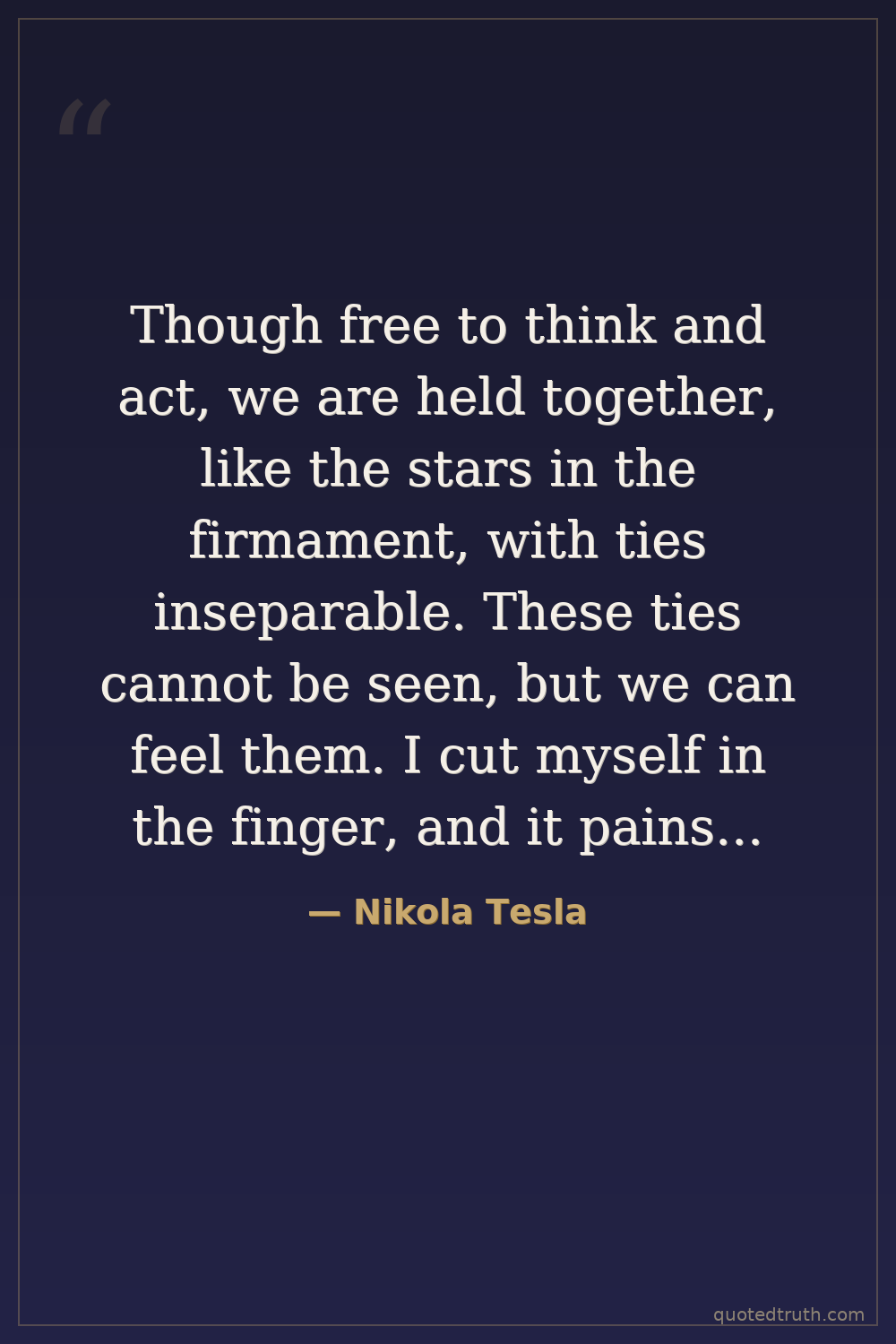
Tesla argues that beneath apparent freedom lies an invisible web binding all humans together. Using three escalating examples—cutting his own finger, seeing a friend hurt, grieving even an enemy's fall—he shows that our pain transcends self-interest. The fact that we grieve even those we dislike proves we cannot be truly separate. We are not isolated individuals but interdependent parts of one greater, unified whole.
Relevance to Nikola Tesla
Tesla's career was defined by invisible forces—electromagnetic fields, alternating current, radio waves—things unfelt yet undeniably real. His AC power grid literally bound cities through unseen electrical ties, perfectly mirroring this philosophy. Betrayed by Edison and abandoned by Morgan, he knew personal enmity firsthand, yet transcended it. His lifelong dream of wireless global energy—transmitting power freely to all humanity—makes this quote his deepest creed: universal connection over ruthless competition.
The era
Tesla wrote during the Gilded Age and early Progressive Era—a period of brutal industrial competition, labor violence, and Social Darwinism casting existence as zero-sum struggle. Robber barons hoarded resources while workers died in factories. Nationalism was fracturing Europe toward World War I. Tesla's insistence that invisible bonds unite even enemies was a direct philosophical rebuke to the era's atomistic individualism and the fashionable survival-of-the-fittest ideology corrupting public thought.
AI-generated insights based on extensive research and information for context. Factual errors? Email [email protected].