What it means
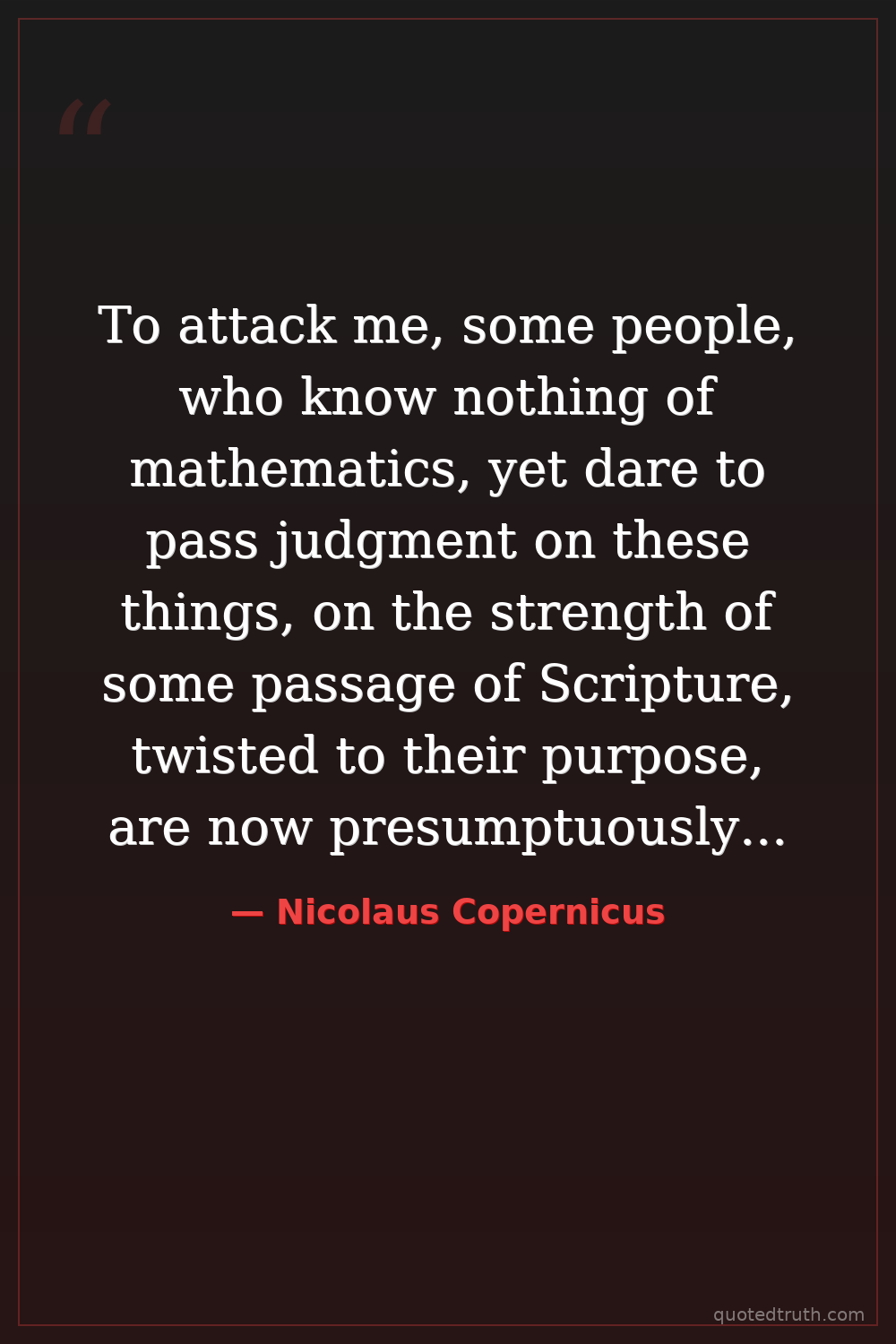
Copernicus expresses frustration that people lacking any mathematical training are using Bible passages—twisted to serve their agenda—to attack and condemn his astronomical work. He argues that such critics have no competence to judge a rigorous mathematical discipline. The statement defends the autonomy of scientific reasoning against religiously-motivated censure wielded by those who neither understand the mathematics involved nor engage honestly with the evidence.
Relevance to Nicolaus Copernicus
Copernicus was himself a Catholic canon who understood the Church's power intimately. He delayed publishing De Revolutionibus until 1543—the year he died—partly fearing this exact backlash, and strategically dedicated the book to Pope Paul III seeking protection. His heliocentric model contradicted Earth-centered cosmology implied by Scripture, making him personally vulnerable. His frustration is the cry of a churchman whose own rigorous mathematics forced him toward conclusions that threatened religious orthodoxy.
The era
The Protestant Reformation had fractured Christianity, intensifying battles over scriptural authority and interpretation. Martin Luther reportedly called Copernicus a fool for contradicting Scripture. Biblical literalism was deployed as a weapon across doctrinal disputes everywhere. Simultaneously, humanism and nascent scientific thinking were challenging Aristotelian cosmology. The Catholic Church would formally ban Copernicus's book in 1616, confirming his fears. This collision between emerging empirical science and entrenched theological authority made publishing scientific discoveries genuinely dangerous.
AI-generated insights based on extensive research and information for context. Factual errors? Email [email protected].