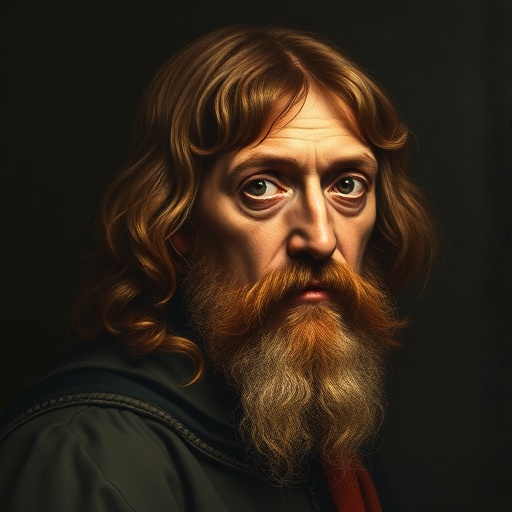
Nicolaus Copernicus — "Therefore, let us not be afraid to follow truth wherever it may lead us, even if…"
Therefore, let us not be afraid to follow truth wherever it may lead us, even if it contradicts our preconceived notions.
Therefore, let us not be afraid to follow truth wherever it may lead us, even if it contradicts our preconceived notions.
Click any product to generate a realistic preview. Up to 3 at a time.
* Initial load can take up to 90 seconds — revising the preview in another color is nearly instant.
"For the motion of the earth is a fact, and the apparent change of position of the fixed stars is due to the earth's motion and not to any motion of the stars themselves."
"Therefore, when I perceived that these and similar doubts arose concerning the order of the parts of the universe and the symmetry of its structure, I began to be vexed that no more definite explanati…"
"For these I care nothing, and I shall even despise their judgment as reckless."
"Finally we shall place the Sun himself at the center of the Universe."
"We are thus brought to a standstill by the realization that our previous theories were not only complicated but also inconsistent."
Attributed, general sentiment but not a direct quote from his major work.
Date: 16th Century (approx.)
WisdomFound in 1 providers: grok
1 source checked
This quote urges intellectual courage — the willingness to pursue evidence and reasoning even when conclusions overturn deeply held beliefs. Truth-seeking demands setting aside comfortable assumptions and following wherever evidence leads, no matter how disruptive. It defends honest inquiry over dogma, arguing that clinging to preconceived ideas blocks genuine understanding. Real intellectual progress requires accepting uncomfortable truths rather than protecting familiar but incorrect frameworks of thought.
Copernicus spent decades building his heliocentric model while serving as a Catholic canon — a role that made his findings especially dangerous to publicize. He delayed publishing De revolutionibus orbium coelestium until 1543, the year of his death. His entire career embodied following astronomical evidence over 1,400 years of accepted Ptolemaic geocentrism, overturning a cosmology embedded in Church doctrine despite knowing the institutional resistance he would inevitably face.
In early modern Europe, the Catholic Church held near-absolute authority over cosmology — Earth at the universe's center was theological doctrine, not merely scientific consensus. The Reformation was fracturing religious authority and the Renaissance was reviving classical inquiry, but challenging 1,400-year-old Ptolemaic orthodoxy still risked charges of heresy. Copernicus wrote amid Inquisitions, book burnings, and intense institutional pressure to conform to inherited cosmological and theological frameworks.
AI-generated insights based on extensive research and information for context. Factual errors? Email [email protected].
Your cart is empty