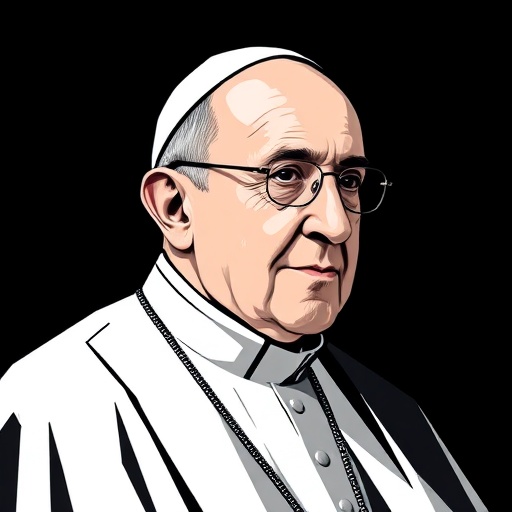
Pope Francis — "To be a Christian is to be a revolutionary."
To be a Christian is to be a revolutionary.
To be a Christian is to be a revolutionary.
Click any product to generate a realistic preview. Up to 3 at a time.
* Initial load can take up to 90 seconds — revising the preview in another color is nearly instant.
"It is not true that the poor are a burden. The poor are a resource."
"Don't forget to pray for me. I need it. Seriously."
"The Church must be a poor Church for the poor."
"The biggest problem is that we don’t feel the problems of others."
"This economy kills."
First Latin American and Jesuit pope (2013-), who has steered the Catholic Church toward pastoral inclusion on LGBTQ pastoral care, divorced Catholics, and climate. Closely associated with Pope John XXIII (the Vatican II reformer pope) and Cardinal Walter Kasper (his theological ally on pastoral reform). For an intellectual contrast, see Cardinal Raymond Burke, American traditionalist cardinal, former head of the Vatican Apostolic Signatura — Burke is the public face of Catholic traditionalism that views Francis's pastoral approach as doctrinally dangerous — he has formally challenged Amoris Laetitia and other Francis reforms.
Found in 1 providers: grok
1 source checked
Authentic Christianity demands more than private piety or Sunday ritual — it requires actively overturning unjust systems, challenging indifference, and living by values that disrupt the prevailing order. Mercy, solidarity, and care for the poor aren't polite additions to a comfortable life; they fundamentally contradict how most societies distribute power and wealth. A real Christian cannot stay neutral. The faith itself is a call to transform the world, not accommodate it.
Bergoglio grew up in Buenos Aires during brutal military dictatorship, shaped by liberation theology's insistence that faith must confront injustice. He chose the name Francis — evoking radical poverty and social upheaval — and immediately broke Vatican norms: forgoing the papal palace, washing prisoners' feet, condemning unfettered capitalism as a 'new tyranny.' His entire papacy is an argument that institutional Christianity had drifted from its disruptive origins and must reclaim them.
Francis became Pope in 2013 as record inequality, the Arab Spring's aftermath, and Catholic abuse scandals eroded institutional credibility globally. Populist nationalism was rising, climate crisis demanded systemic change, and millions were displaced by war and poverty. Christianity was shrinking in the Global North while surging in the poorer Global South. His framing of faith as revolution directly challenged both secular indifference and the Church's own tendency toward self-preservation over prophetic witness.
AI-generated insights based on extensive research and information for context. Factual errors? Email [email protected].
Your cart is empty