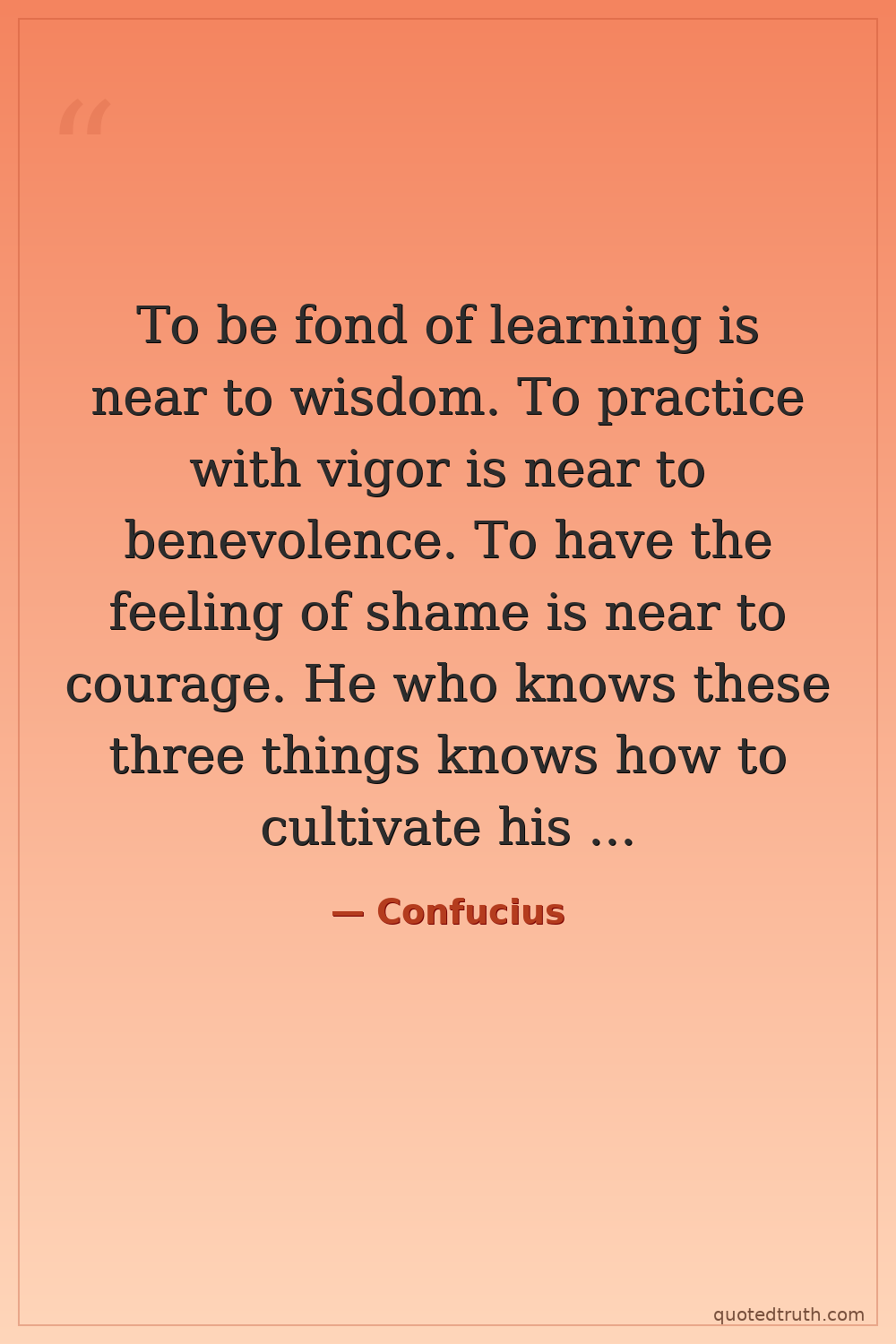
Confucius — "To be fond of learning is near to wisdom. To practice with vigor is near to bene…"

To be fond of learning is near to wisdom. To practice with vigor is near to benevolence. To have the feeling of shame is near to courage. He who knows these three things knows how to cultivate his own character. He who knows how to cultivate his own character knows how to govern other men. He who knows how to govern other men knows how to govern the kingdom with all its States and families.
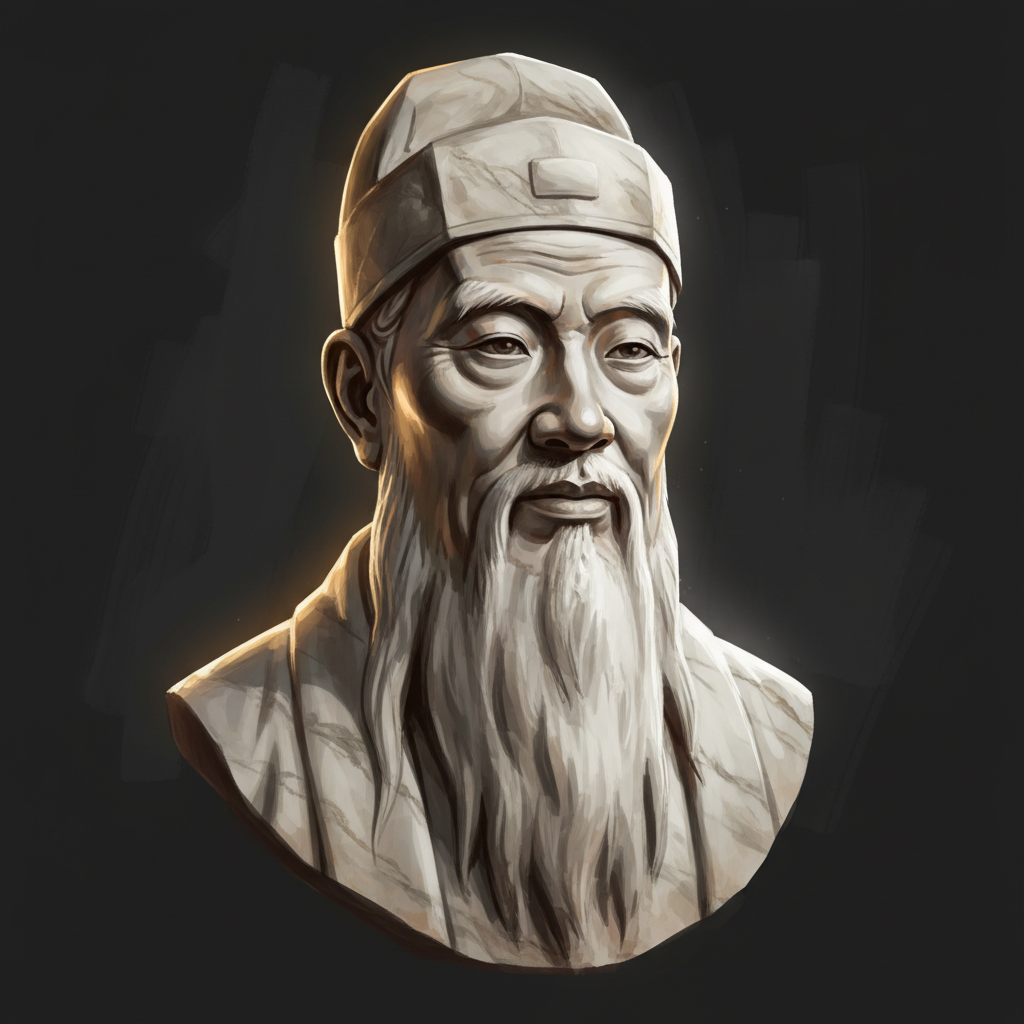
Confucius — Confucius Ancient · Chinese philosopher, founder of Confucianism

Get This Quote & Author's Image Illustrated On:

Click any product to generate a realistic preview. Up to 3 at a time.
* Initial load can take up to 90 seconds — revising the preview in another color is nearly instant.

Kitchen

Apparel

Other

About Confucius (551-479 BCE)

Chinese philosopher and teacher whose teachings (compiled by his students in the Analects) became the foundational ethical framework of East Asian civilization for 2,500 years. Closely associated with Mencius (his most-influential follower a century later). For an intellectual contrast, see Laozi, near-contemporary Chinese sage and Tao Te Ching author — Confucius systematized social order through ritual and family hierarchy; Laozi's Taoist effortless-action philosophy argued such systems were the disease, not the cure. The two founding poles of Chinese moral philosophy — every East Asian moral tradition since has positioned itself between them.

The standard scholarly entry points to Confucius's work: Philip J. Ivanhoe (Georgetown, Chinese philosophy) — Confucian Moral Self Cultivation (2000); Edward Slingerland (UBC, Asian Studies) — Effortless Action: Wu-wei as Conceptual Metaphor (2003); Tu Weiming (Harvard, Confucian scholar) — Confucian Thought: Selfhood as Creative Transformation (1985). These are the works graduate seminars cite when teaching Confucius.

Details

Doctrine of the Mean, Chapter XX

Date: c. 5th century BCE

General

Verification

Unverifiable

Found in 1 providers: grok

1 source checked

Understanding this quote

What it means

Three simple habits build moral character: loving to learn, working hard at doing good, and feeling shame when you fall short. Mastering yourself through these habits is the foundation for leading others. Leading a family or team well scales up to leading a whole society. Personal growth and public leadership are not separate projects; they are the same project at different sizes, built one habit at a time.

Relevance to Confucius

Confucius spent his life teaching that ethical self-cultivation, not birthright or force, qualified a person to govern. He traveled between warring states trying to advise rulers, was often ignored, and turned to teaching roughly 3,000 students instead. The chain from self to family to state is the signature Confucian move, and his emphasis on learning, diligence, and shame as moral anchors reflects his own disciplined, humble persona.

The era

Confucius lived roughly 551 to 479 BCE during the late Spring and Autumn period, as the Zhou dynasty's authority collapsed and rival states fought constantly. Rulers gained power through warfare, intrigue, and inherited rank, not virtue. Ordinary people suffered under unstable, corrupt governance. Against this backdrop, Confucius's insistence that leaders must first master themselves was radical, proposing character and education as the real credentials for power rather than bloodline or military success.

AI-generated insights based on extensive research and information for context. Factual errors? Email [email protected].
Your Cart

Your cart is empty