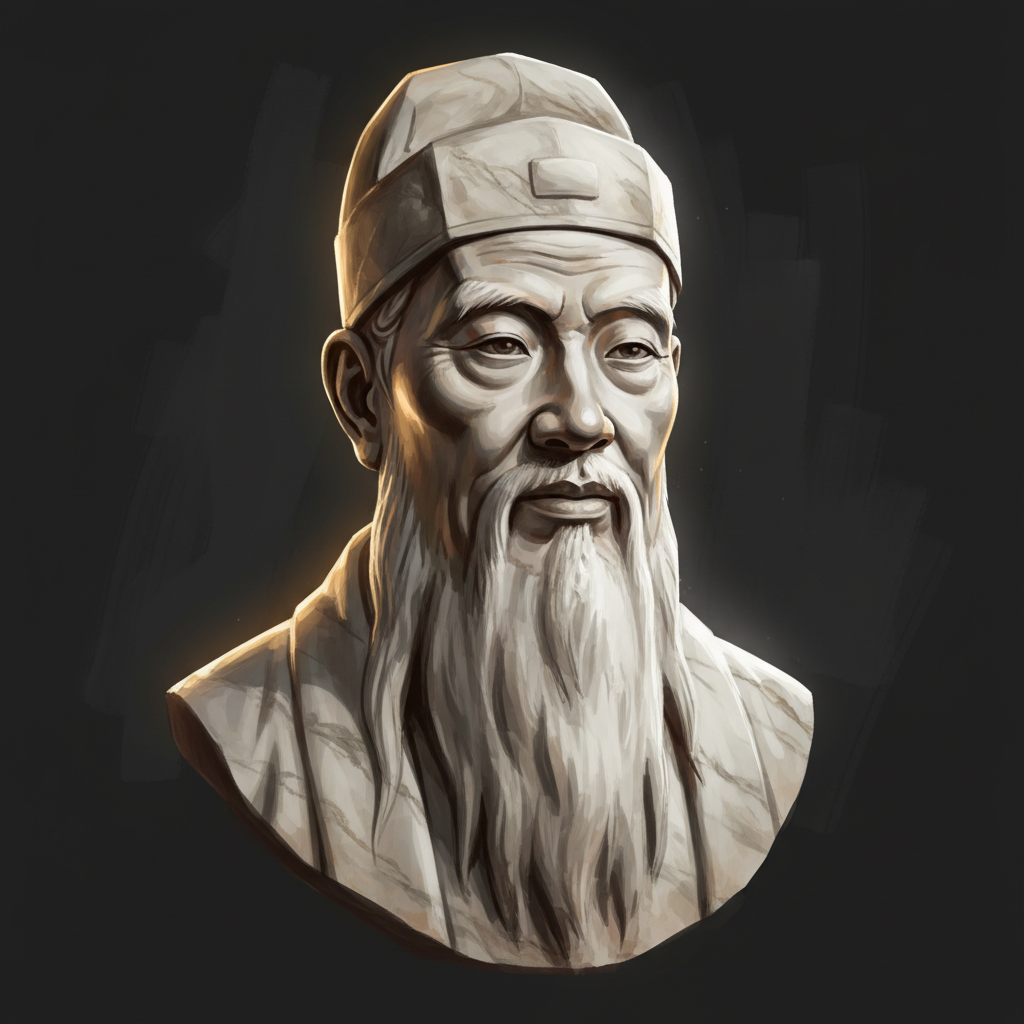
Confucius — "Learning without thought is labor lost; thought without learning is perilous."
Learning without thought is labor lost; thought without learning is perilous.
Learning without thought is labor lost; thought without learning is perilous.
Click any product to generate a realistic preview. Up to 3 at a time.
* Initial load can take up to 90 seconds — revising the preview in another color is nearly instant.
"The gentleman considers righteousness to be essential. He performs it according to the rules of propriety. He brings it forth in humility. He completes it with sincerity. This is indeed a gentleman."
"He who learns but does not think, is lost! He who thinks but does not learn is in great danger."
"The noble-minded are calm and steady. Little people are forever fussing and fretting."
"The funniest thing is that I am often asked to arbitrate disputes, but I am no judge. I just make people agree to disagree. It works surprisingly often."
"The Master said, 'He who is not concerned about the distant future will find trouble right at hand.'"
Chinese philosopher and teacher whose teachings (compiled by his students in the Analects) became the foundational ethical framework of East Asian civilization for 2,500 years. Closely associated with Mencius (his most-influential follower a century later). For an intellectual contrast, see Laozi, near-contemporary Chinese sage and Tao Te Ching author — Confucius systematized social order through ritual and family hierarchy; Laozi's Taoist effortless-action philosophy argued such systems were the disease, not the cure. The two founding poles of Chinese moral philosophy — every East Asian moral tradition since has positioned itself between them.
The standard scholarly entry points to Confucius's work: Philip J. Ivanhoe (Georgetown, Chinese philosophy) — Confucian Moral Self Cultivation (2000); Edward Slingerland (UBC, Asian Studies) — Effortless Action: Wu-wei as Conceptual Metaphor (2003); Tu Weiming (Harvard, Confucian scholar) — Confucian Thought: Selfhood as Creative Transformation (1985). These are the works graduate seminars cite when teaching Confucius.
Found in 2 providers: grok,gemini
2 sources checked
Absorbing information without reflecting on it wastes your effort, because facts alone don't create understanding. But trying to reason things out without studying what others have discovered is dangerous, since you'll build conclusions on ignorance and bias. Real growth requires both: actively engaging with knowledge from outside yourself, and critically processing it through your own mind. Neither memorization nor pure speculation works alone; they must operate together to produce genuine wisdom and sound judgment.
Confucius spent his life as a teacher and lifelong student, traveling between states to advise rulers and training disciples in the classics, rituals, and ethics. He famously described himself as someone who loved learning above all, yet constantly pressed students to question, apply, and internalize lessons rather than parrot them. This balance between rigorous study of tradition and independent moral reflection sits at the core of his pedagogy and his vision of the cultivated gentleman, the junzi.
Confucius lived during the late Spring and Autumn period (551-479 BCE), when the Zhou dynasty's authority had collapsed and rival states waged constant war. Traditional rituals and social order were eroding, and competing schools of thought scrambled to explain the chaos. Literacy was expanding beyond aristocrats, and itinerant scholars sold advice to ambitious lords. In this unstable climate, Confucius argued that reviving society required disciplined study of ancient wisdom paired with personal moral reasoning, not mere imitation or reckless innovation.
AI-generated insights based on extensive research and information for context. Factual errors? Email [email protected].
Your cart is empty