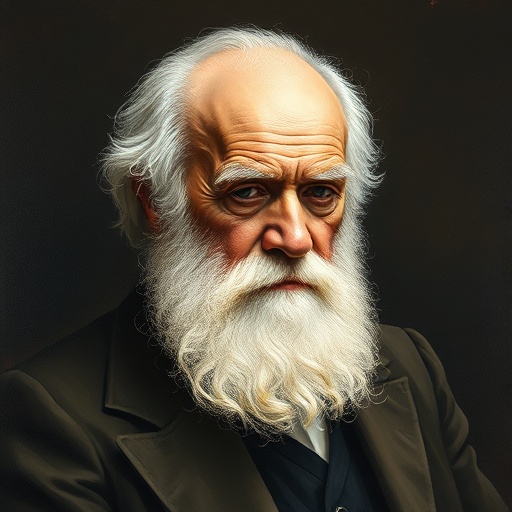
Charles Darwin — "To kill an error is as good a service as to establish a new truth."
To kill an error is as good a service as to establish a new truth.
To kill an error is as good a service as to establish a new truth.
Click any product to generate a realistic preview. Up to 3 at a time.
* Initial load can take up to 90 seconds — revising the preview in another color is nearly instant.
"It is not the strongest of the species that survives, nor the most intelligent, but the one most responsive to change."
"But I am very poorly today and very stupid and hate everybody and everything."
"The love for all living creatures is the most noble attribute of man."
"It is not the strongest of the species that survives, nor the most intelligent that survives. It is the one that is most adaptable to change."
"A scientific man ought to have no wishes, no affections – a mere heart of stone."
British naturalist whose On the Origin of Species (1859) established evolution by natural selection — the unifying theory of modern biology. Closely associated with Thomas Henry Huxley (his 'bulldog' public defender) and Alfred Russel Wallace (independent co-discoverer of natural selection). For an intellectual contrast, see William Paley, Anglican theologian and Natural Theology author (1743-1805) — Origin of Species is structurally a 400-page reply to Paley — Darwin admired Paley's watchmaker-argument as an undergraduate at Cambridge and then spent 20 years building the empirical machinery to displace him. The cleanest 'design argument vs natural selection' founding rebuttal in science.
The standard scholarly entry points to Charles Darwin's work: Janet Browne (Harvard, history of science) — Charles Darwin: Voyaging (1995) and The Power of Place (2002); Adrian Desmond (UCL, biographer) — Darwin: The Life of a Tormented Evolutionist (1991, with James Moore). These are the works graduate seminars cite when teaching Charles Darwin.
Found in 1 providers: grok
1 source checked
Correcting a false belief is just as valuable as discovering something new. Progress doesn't only come from adding knowledge—it also comes from removing what's wrong. A field riddled with errors is hobbled even if new truths accumulate alongside them. Clearing out misinformation clears the path for genuine understanding, making error-correction an act of intellectual courage equal to original discovery.
Darwin spent decades meticulously building the case for evolution, but equally important to him was dismantling competing theories—catastrophism, special creation, Lamarckian inheritance. He corresponded relentlessly with scientists to correct misinterpretations of his own work. His notebooks show obsessive self-correction before publication. The Origin of Species itself was structured partly as a systematic demolition of creationist assumptions before presenting his alternative.
Victorian science in the 1850s–1880s was crowded with confidently held errors: spontaneous generation, phlogiston remnants, fixed species, Lamarck's acquired-characteristics theory. Scientific societies treated established names as authorities, making error-correction politically risky. Darwin's era also saw the professionalization of science, creating formal peer review—the institutional mechanism for exactly this kind of error-killing—making the sentiment both timely and culturally necessary.
AI-generated insights based on extensive research and information for context. Factual errors? Email [email protected].
Your cart is empty