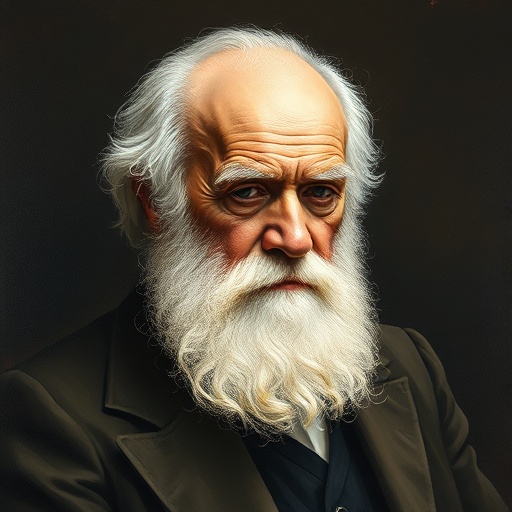
Charles Darwin — "A scientific man ought to have no wishes, no affections – a mere heart of stone."
A scientific man ought to have no wishes, no affections – a mere heart of stone.
A scientific man ought to have no wishes, no affections – a mere heart of stone.
Click any product to generate a realistic preview. Up to 3 at a time.
* Initial load can take up to 90 seconds — revising the preview in another color is nearly instant.
"Thus, from the war of nature, from famine and death, the most exalted object which we are capable of conceiving, namely, the production of the higher animals, directly follows."
"The greatest discovery of all time is that a person can change his future by merely changing his attitude."
"I confess I am not much interested in the future, for I am too much occupied with the present."
"We are not here concerned with the first origin of life."
"Ignorance more frequently begets confidence than does knowledge: it is those who know little, and not those who know much, who so positively assert that this or that problem will never be solved by sc…"
British naturalist whose On the Origin of Species (1859) established evolution by natural selection — the unifying theory of modern biology. Closely associated with Thomas Henry Huxley (his 'bulldog' public defender) and Alfred Russel Wallace (independent co-discoverer of natural selection). For an intellectual contrast, see William Paley, Anglican theologian and Natural Theology author (1743-1805) — Origin of Species is structurally a 400-page reply to Paley — Darwin admired Paley's watchmaker-argument as an undergraduate at Cambridge and then spent 20 years building the empirical machinery to displace him. The cleanest 'design argument vs natural selection' founding rebuttal in science.
The standard scholarly entry points to Charles Darwin's work: Janet Browne (Harvard, history of science) — Charles Darwin: Voyaging (1995) and The Power of Place (2002); Adrian Desmond (UCL, biographer) — Darwin: The Life of a Tormented Evolutionist (1991, with James Moore). These are the works graduate seminars cite when teaching Charles Darwin.
Reflecting on the ideal detached mindset for scientific inquiry.
Date: Approximate
Love & RelationshipsFound in 3 providers: gemini,grok,deepseek
3 sources checked
Genuine scientific inquiry demands total emotional detachment — no personal wishes, no sentimental attachments that cloud judgment. A true scientist must follow evidence wherever it leads, even toward conclusions that are unwelcome or destabilizing. Darwin frames objectivity as nearly inhuman: a heart of stone. Human emotion becomes science's greatest enemy when it shields comfortable beliefs from hard, contradictory evidence that demands the world be seen differently.
Darwin lived this tension acutely. His evolution theory contradicted the Christian creation doctrine his devoutly religious wife Emma held deeply — a source of genuine personal anguish. He withheld On the Origin of Species for over 20 years, fearing social and religious fallout. Publishing also meant dismantling his own earlier beliefs. The quote captures his hard-won conviction that scientific integrity requires suppressing even the most personal emotional costs.
Victorian England was a deeply religious society where natural theology — studying nature to reveal God's design — dominated scientific thinking. Darwin published On the Origin of Species in 1859, triggering a defining clash between empirical science and Christian doctrine. His era saw science asserting independence from theological authority for the first time at scale. Emotional detachment was not just personal virtue; it was the weapon scientists needed to make that separation stick.
AI-generated insights based on extensive research and information for context. Factual errors? Email [email protected].
Your cart is empty