Charles Darwin — "But I am very poorly today and very stupid and hate everybody and everything."
But I am very poorly today and very stupid and hate everybody and everything.
But I am very poorly today and very stupid and hate everybody and everything.
Click any product to generate a realistic preview. Up to 3 at a time.
* Initial load can take up to 90 seconds — revising the preview in another color is nearly instant.
"I had no intention of writing an autobiography, but I found myself doing so."
"I have steadily endeavoured to keep my mind free so as to give up any hypothesis, however much beloved, as soon as facts are shown to be opposed to it."
"The world will not be inherited by the strongest, it will be inherited by those most able to change."
"Ignorance more frequently begets confidence than does knowledge."
"The difference in mind between man and the higher animals, great as it is, certainly is one of degree and not of kind."
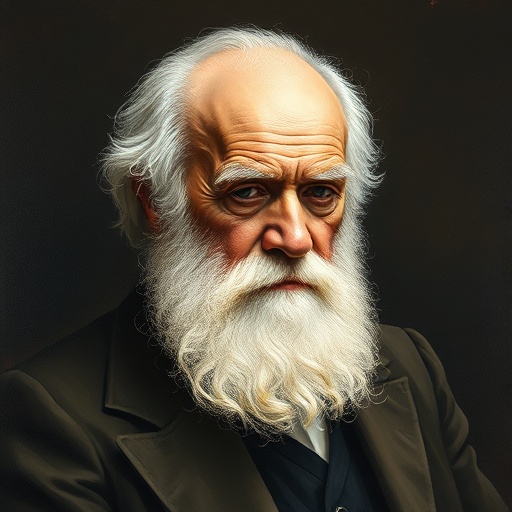
British naturalist whose On the Origin of Species (1859) established evolution by natural selection — the unifying theory of modern biology. Closely associated with Thomas Henry Huxley (his 'bulldog' public defender) and Alfred Russel Wallace (independent co-discoverer of natural selection). For an intellectual contrast, see William Paley, Anglican theologian and Natural Theology author (1743-1805) — Origin of Species is structurally a 400-page reply to Paley — Darwin admired Paley's watchmaker-argument as an undergraduate at Cambridge and then spent 20 years building the empirical machinery to displace him. The cleanest 'design argument vs natural selection' founding rebuttal in science.
The standard scholarly entry points to Charles Darwin's work: Janet Browne (Harvard, history of science) — Charles Darwin: Voyaging (1995) and The Power of Place (2002); Adrian Desmond (UCL, biographer) — Darwin: The Life of a Tormented Evolutionist (1991, with James Moore). These are the works graduate seminars cite when teaching Charles Darwin.
Found in 1 providers: grok
1 source checked
A raw, unfiltered admission of a terrible day — body sick, mind foggy, and patience for humanity gone. Darwin isn't posturing or philosophizing; he's venting with blunt self-awareness and dry humor. The quote resonates because it collapses the distance between a towering historical figure and ordinary human misery. Anyone who has felt simultaneously unwell, mentally useless, and socially done understands exactly what he means. The honesty is almost startling in its completeness.
Darwin endured decades of debilitating chronic illness — likely involving severe gastrointestinal distress, fatigue, and anxiety — spending much of his adult life semi-confined to Down House in Kent. This quote, almost certainly from a private letter, reveals the reality behind his carefully measured published work: long stretches of suffering interrupted his research. His correspondence was famously candid, showing a self-deprecating wit that balanced the gravity of rewriting humanity's understanding of its own origins.
Victorian England prized emotional restraint and public stoicism, especially among educated gentlemen. Open confession of illness, mental dullness, or misanthropy was considered unseemly. Private correspondence was one of the era's few socially acceptable outlets for raw honesty. Darwin wrote during a period when chronic illness had no reliable diagnosis or treatment, and when his evolutionary theory was generating fierce religious and scientific backlash — personal suffering compounded daily by relentless public and ecclesiastical scrutiny.
AI-generated insights based on extensive research and information for context. Factual errors? Email [email protected].
Your cart is empty