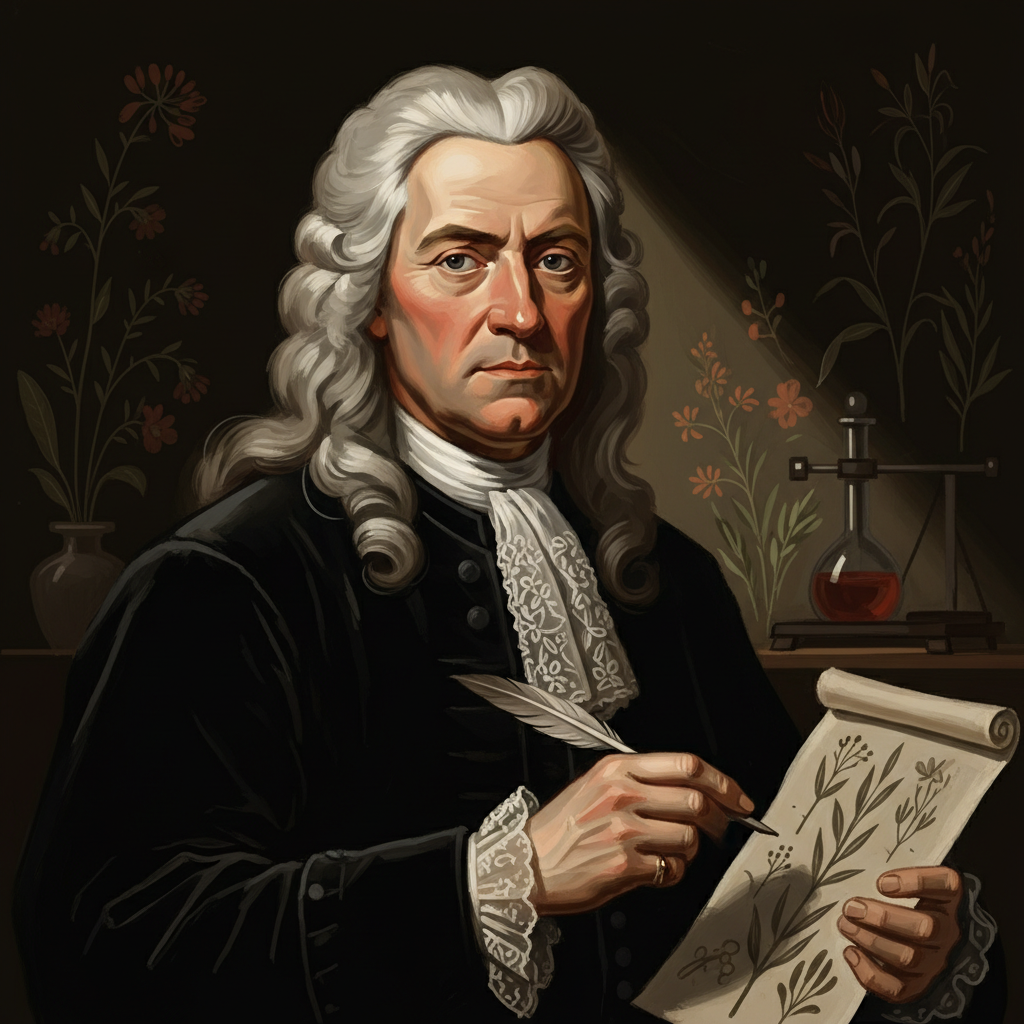
Carl Linnaeus — "To live by medicine is to live horribly."
To live by medicine is to live horribly.
To live by medicine is to live horribly.
Click any product to generate a realistic preview. Up to 3 at a time.
* Initial load can take up to 90 seconds — revising the preview in another color is nearly instant.
"I have done more for the advancement of natural history than anyone else."
"The most beautiful thing in the world is a flower, but it is not so beautiful as a woman."
"I have spent my life in the company of plants, and they have taught me more than men."
"Human beings, having, above all creatures, received the power of reason... need to be aware where nature is unaware. Nature reaches its culmination in humans, but human consciousness has not its essen…"
"The more I collect and examine, the more I marvel at the infinite wisdom of the Creator."
Swedish botanist and the father of modern taxonomy whose Systema Naturae (1735) introduced binomial nomenclature for naming all species. Closely associated with Joseph Banks (British naturalist who carried Linnaean classification on Cook's voyages). For an intellectual contrast, see Comte de Buffon, French naturalist and Histoire Naturelle author (1749-1788) — Buffon explicitly attacked Linnaean fixed-categories taxonomy as artificial and rejected the binomial system; his gradualist, environment-shaped natural history was the explicit alternative. Anticipates the fixed-species-vs-evolution debate Darwin would later resolve.
General philosophical statement, possibly from his writings or lectures.
Date: Undetermined, 18th Century
ShockingFound in 1 providers: gemini
1 source checked
Relying on medicine to sustain life means enduring a wretched existence—trapped in disease, dependency, and suffering rather than thriving. True health is living vigorously without needing constant medical intervention. A life defined by illness and treatment is diminished, stripped of vitality and joy. Better to die naturally than to survive artificially through remedies that merely postpone inevitable decline while reducing existence to a managed misery.
Linnaeus trained as a physician and practiced medicine, yet his passion was nature's order, not clinical treatment. He witnessed 18th-century medicine's brutal limitations—bloodletting, purging, toxic mercury cures. Having himself suffered gout and strokes late in life, requiring constant medical attendance, he experienced firsthand how medicalized existence degrades dignity. His botanical work sought health through natural systems, not intervention.
In Linnaeus's era, medicine was often more dangerous than disease itself. Physicians lacked germ theory, relying on humoral remedies that weakened patients. Smallpox, plague, and typhus swept Europe regularly. The Enlightenment era simultaneously celebrated reason while exposing medicine's failures. Linnaeus, classifying the natural world in Sweden during the 1700s, saw nature as orderly and curative—physicians as often ignorant interlopers disrupting natural processes.
AI-generated insights based on extensive research and information for context. Factual errors? Email [email protected].
Your cart is empty