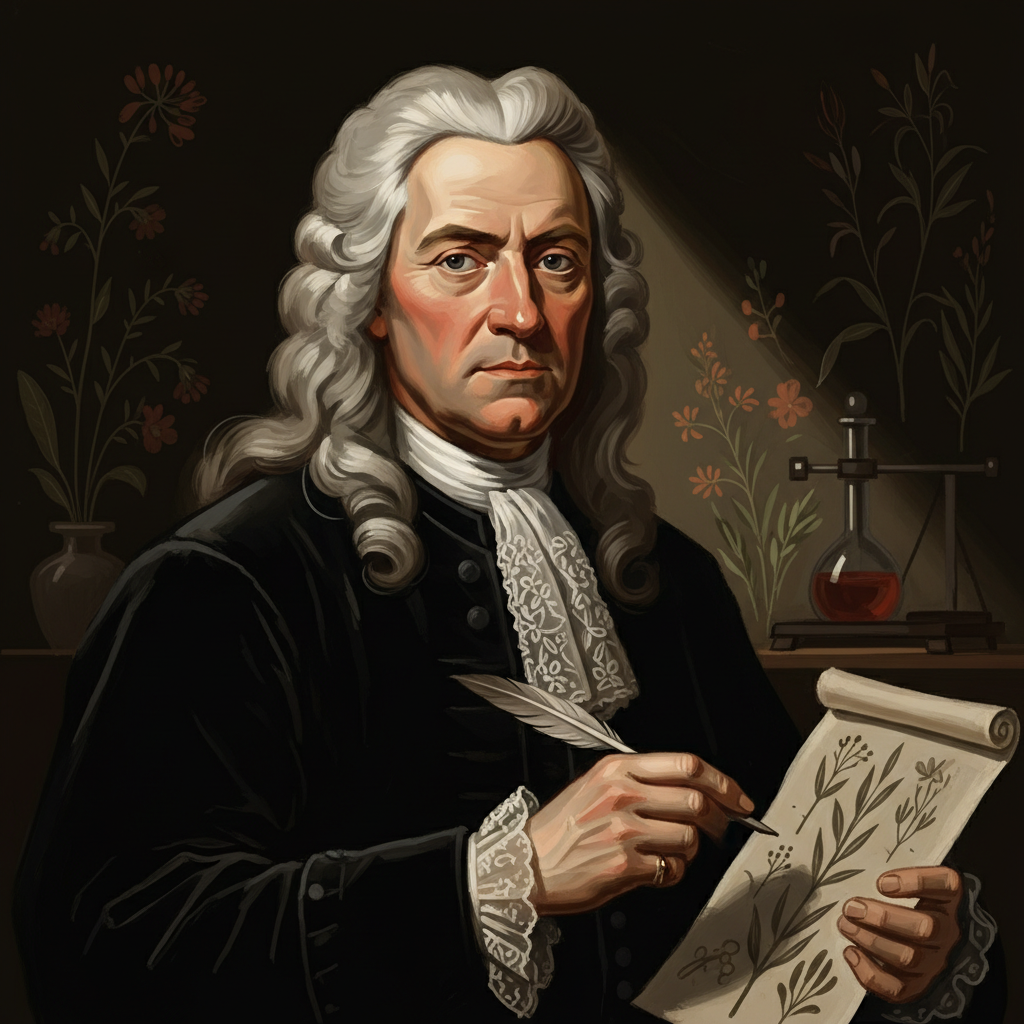
Carl Linnaeus — "I have done more for the advancement of natural history than anyone else."
I have done more for the advancement of natural history than anyone else.
I have done more for the advancement of natural history than anyone else.
Click any product to generate a realistic preview. Up to 3 at a time.
* Initial load can take up to 90 seconds — revising the preview in another color is nearly instant.
"Human beings, having, above all creatures, received the power of reason... need to be aware where nature is unaware. Nature reaches its culmination in humans, but human consciousness has not its essen…"
"The whole world is a museum, and all its inhabitants are specimens."
"The world is full of wonders, but man is the greatest wonder of all."
"I have been called the Prince of Botanists."
"Every plant is a book, which, if we want to understand, we must learn its language."
Swedish botanist and the father of modern taxonomy whose Systema Naturae (1735) introduced binomial nomenclature for naming all species. Closely associated with Joseph Banks (British naturalist who carried Linnaean classification on Cook's voyages). For an intellectual contrast, see Comte de Buffon, French naturalist and Histoire Naturelle author (1749-1788) — Buffon explicitly attacked Linnaean fixed-categories taxonomy as artificial and rejected the binomial system; his gradualist, environment-shaped natural history was the explicit alternative. Anticipates the fixed-species-vs-evolution debate Darwin would later resolve.
Found in 1 providers: grok
1 source checked
The speaker claims unmatched personal contribution to the scientific study of living things. It is a direct, unapologetic assertion of individual greatness—declaring that no contemporary or predecessor has advanced the understanding of nature as significantly. It reflects supreme confidence in one's own legacy and a desire for that legacy to be recognized and recorded accurately by history.
Linnaeus created binomial nomenclature, classifying over 10,000 plant and animal species in works like Systema Naturae. He built the foundational framework biologists still use today. Known for immense self-confidence bordering on arrogance, he openly cultivated his own reputation, calling himself 'the Prince of Botanists.' This quote captures his genuine pride in a system that genuinely transformed science.
The 18th-century Enlightenment prized systematic reason, classification, and human mastery over nature. European explorers were returning with thousands of unknown specimens, creating urgent demand for organizing knowledge. Natural history was prestigious and competitive. Linnaeus worked in an era when individual scholars could reshape entire disciplines, and his ambition matched the era's faith in rational order transforming human understanding of the world.
AI-generated insights based on extensive research and information for context. Factual errors? Email [email protected].
Your cart is empty