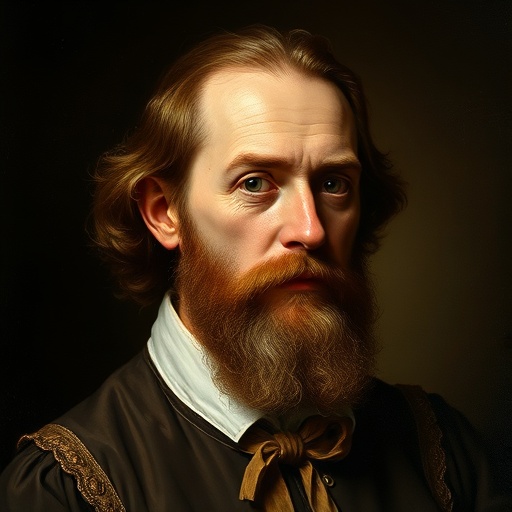
William Harvey — "To search for truth is to search for God."
To search for truth is to search for God.
To search for truth is to search for God.
Click any product to generate a realistic preview. Up to 3 at a time.
* Initial load can take up to 90 seconds — revising the preview in another color is nearly instant.
"The physician's art is to imitate nature."
"The motion of the blood is in a circle, and is in truth perpetual."
"The circulation of the blood is a new doctrine, and I doubt not but it will meet with its opponents."
"It is not by words, but by facts and arguments, that we must seek for truth."
"The greatest discovery is to find the truth."
English physician whose On the Motion of the Heart and Blood in Animals (1628) demonstrated blood circulation, overturning 1,400 years of Galenic medicine. Closely associated with Francis Bacon (his contemporary in the new English empiricism). For an intellectual contrast, see Galenic medicine, the 2nd-century Greek medical tradition (humors, blood-as-consumed-fuel) — Harvey calculated that the heart pumps more blood per hour than the body could possibly produce as fuel — a single quantitative observation that demolished the entire Galenic-Aristotelian medical worldview. The cleanest example in medical history of arithmetic disproving 14 centuries of authority.
A theological statement connecting scientific inquiry with religious pursuit.
Date: Uncertain (attributed)
BiblicalFound in 1 providers: gemini
1 source checked
Pursuing truth is itself a sacred act — not separate from religion but equivalent to it. Understanding how reality works, through observation and reason, is a path toward the divine. This reframes intellectual inquiry as devotion rather than rebellion, making curiosity and rigorous investigation spiritually meaningful rather than heretical.
Harvey spent decades overturning Galenic doctrine on blood circulation through meticulous dissection and experiment, facing fierce institutional resistance. This belief justified his relentless empiricism — he saw anatomical truth as divine revelation. His 1628 'De Motu Cordis' was effectively an act of faith: trusting observation over ancient authority to find God's design in the body.
The early modern period saw violent tension between Church authority and natural philosophy. Galileo's trial (1633) epitomized how scientific inquiry risked charges of heresy. Harvey's framing — that truth-seeking is God-seeking — was a strategic and sincere reconciliation, claiming empirical investigation as devotion rather than defiance, within a world still defining the boundary between science and sacred doctrine.
AI-generated insights based on extensive research and information for context. Factual errors? Email [email protected].
Your cart is empty