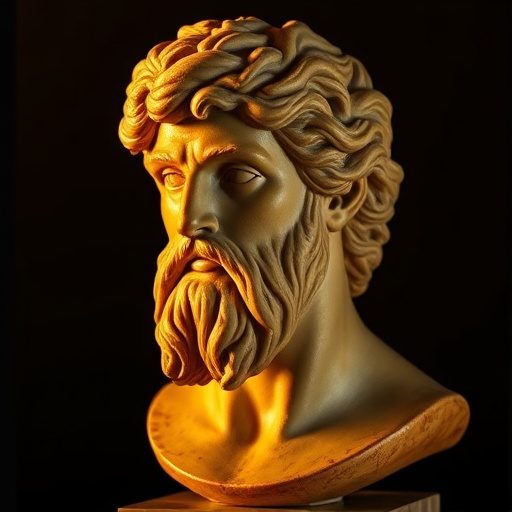
Pythagoras — "Turn sharp blades away from you."
Turn sharp blades away from you.
Turn sharp blades away from you.
Click any product to generate a realistic preview. Up to 3 at a time.
* Initial load can take up to 90 seconds — revising the preview in another color is nearly instant.
"The soul is immortal and undergoes transmigration."
"Reason is immortal, all else mortal."
"Don't mix a fire with a knife."
"Not to speak of Pythagorean beans, from which, it is said, Pythagoras himself abstained."
"There is nothing so easy but that it becomes difficult when you do it reluctantly."
Greek philosopher and mathematician whose school in Croton combined geometry (the Pythagorean theorem), number-mysticism, and a religious-vegetarian way of life. Closely associated with Thales of Miletus (earlier pre-Socratic and the first philosopher). For an intellectual contrast, see Heraclitus, pre-Socratic Greek philosopher of flux — Heraclitus called Pythagoras 'the chief of swindlers' — among the founding insults of the philosophical-rivalry tradition. Their 'all is flux' vs 'all is number' poles still organize the philosophy of mathematics today (Platonist vs anti-realist).
A Pythagorean 'Symbol', possibly practical advice or symbolic of avoiding harm.
Date: c. 570-495 BCE (interpreted later)
WisdomFound in 1 providers: gemini
1 source checked
Keep dangerous things directed away from yourself — both literally and as a life principle. Don't turn destructive forces, toxic habits, or harmful impulses inward. Self-preservation means actively redirecting what can wound you. Whether the threat is a physical blade or a self-sabotaging behavior, the core warning is identical: don't let harm point back at the person holding it. Protect yourself from what you yourself could mishandle.
Pythagoras ran a strict communal brotherhood at Croton governed by dozens of behavioral rules called akousmata — symbolic commandments covering diet, gesture, and daily conduct. He taught that the body housed an immortal soul undergoing reincarnation, making bodily harm a spiritual transgression. This maxim fits his system perfectly: protecting oneself was not mere caution but a sacred obligation tied to the soul's long journey across many lives and rebirths.
In 6th-century BCE Magna Graecia, sharp blades were constant daily companions — knives for cooking, farming, and animal sacrifice. Greek religious ritual involved blade-work regularly, making mishandling a real hazard. Simultaneously, southern Italian city-states were rife with factional violence; Pythagorean communities at Croton faced repeated hostile attacks. Giving followers explicit rules about blade orientation carried immediate practical weight in this physically dangerous, militarized world where accidental and intentional injury were both common realities.
AI-generated insights based on extensive research and information for context. Factual errors? Email [email protected].
Your cart is empty