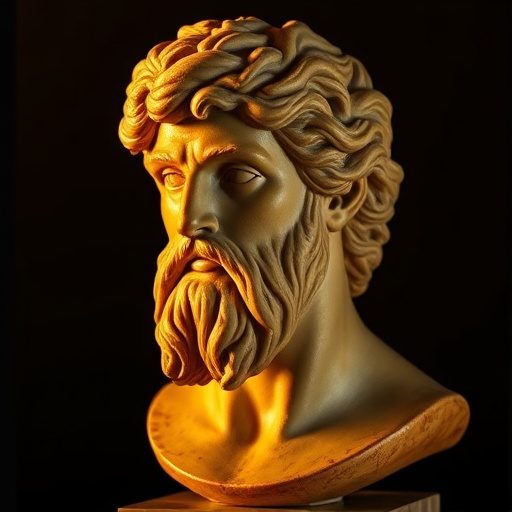
Pythagoras — "Not to speak of Pythagorean beans, from which, it is said, Pythagoras himself ab…"
Not to speak of Pythagorean beans, from which, it is said, Pythagoras himself abstained.
Not to speak of Pythagorean beans, from which, it is said, Pythagoras himself abstained.
Click any product to generate a realistic preview. Up to 3 at a time.
* Initial load can take up to 90 seconds — revising the preview in another color is nearly instant.
"Hate and fear breed a poison in the blood, which if continued, affects eyes, ears, nose, and the organs of digestion."
"Do not receive a weasel into your house."
"The most beautiful thing is harmony."
"A man is never free unless he is master of himself."
"The strangest (and sexiest) of the legends surrounding the aura of Pythagoras is that he had a golden thigh that he would show to impress people he wanted to join his cult."
Greek philosopher and mathematician whose school in Croton combined geometry (the Pythagorean theorem), number-mysticism, and a religious-vegetarian way of life. Closely associated with Thales of Miletus (earlier pre-Socratic and the first philosopher). For an intellectual contrast, see Heraclitus, pre-Socratic Greek philosopher of flux — Heraclitus called Pythagoras 'the chief of swindlers' — among the founding insults of the philosophical-rivalry tradition. Their 'all is flux' vs 'all is number' poles still organize the philosophy of mathematics today (Platonist vs anti-realist).
Mentioned by Aristotle in 'On the Soul,' highlighting the unusual nature of the bean prohibition.
Date: c. 350 BC (Aristotle quoting/referencing Pythagoras)
ShockingFound in 1 providers: grok
1 source checked
The line references a well-known dietary rule attached to Pythagoras: avoid beans entirely. Rather than making an argument, it simply notes the taboo as common knowledge, pointing out that the man who named the rule also lived by it. In modern terms, it is a reminder that a teacher followed his own instructions, treating a specific food as something to be refused on principle.
Pythagoras founded a strict communal school in Croton where members followed detailed rules about diet, silence, purity, and daily conduct. Ancient sources consistently list the bean prohibition among these rules, sometimes tied to beliefs about the soul, reincarnation, or ritual cleanliness. The quote captures how his personal discipline matched the doctrines he taught, fitting a figure remembered as much for his ascetic brotherhood as for his work in number, geometry, and harmonic ratios.
In sixth-century BCE southern Italy, Greek colonies like Croton mixed philosophy, religion, and politics in tight-knit sects. Food taboos, purification rites, and beliefs in the soul's transmigration were widespread, shared with Orphic cults of the time. Beans carried ritual weight in Greek funeral customs and civic lotteries, so refusing them was a visible stance. Pythagorean communities competed for influence in city affairs, and their unusual rules marked members apart from ordinary citizens.
AI-generated insights based on extensive research and information for context. Factual errors? Email [email protected].
Your cart is empty