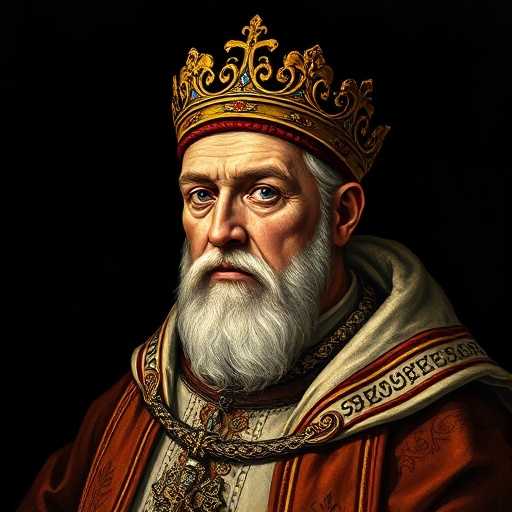
Pope Urban II — "We absolve all who undertake this journey from all penance for their sins."
We absolve all who undertake this journey from all penance for their sins.
We absolve all who undertake this journey from all penance for their sins.
Click any product to generate a realistic preview. Up to 3 at a time.
* Initial load can take up to 90 seconds — revising the preview in another color is nearly instant.
"Let none of you, by any pretext, delay to undertake this journey."
"For your brethren who live in the East are in urgent need of your help... the Turks and Arabs have attacked them."
"Let those who have been for a long time plunderers, now become Christian knights."
"Let none of your possessions detain you, no solicitude for your family affairs, since this land which you inhabit, shut in on all sides by the seas and surrounded by the mountain peaks, is too narrow …"
"Undertake this journey for the remission of your sins, with the assurance of the imperishable glory of the kingdom of heaven."
Pope (1088-1099) whose Council of Clermont speech (November 1095) launched the First Crusade — the founding event of nine centuries of Christian-Muslim military conflict. Closely associated with Pope Gregory VII (his predecessor on papal-imperial reform). For an intellectual contrast, see Saladin, Kurdish-Muslim Sultan of Egypt and Syria (1138-1193) — Saladin recaptured Jerusalem in 1187, undoing the First Crusade Urban II launched 92 years earlier. Saladin's chivalrous treatment of Christian prisoners became the canonical Muslim counter-image to Crusader brutality. The cleanest before/after pairing of the Crusades' moral arc.
Found in 1 providers: grok
1 source checked
Anyone who participates in this military expedition will have all their required religious penances canceled. Medieval Catholic penance meant performing specific acts to atone for sins after confession. This declaration essentially promises spiritual debt forgiveness in exchange for joining the military campaign, making participation a religious act with direct salvific consequences rather than mere military service.
Urban II was a reform-minded pope who understood ecclesiastical power as both spiritual and political. Launching the First Crusade at Clermont in 1095 was his masterstroke: redirecting violent European nobility toward Jerusalem, unifying Christendom under papal authority, and potentially reuniting Eastern and Western churches. Offering absolution weaponized his sacramental power to mobilize armies no secular king could assemble alone.
In 1095, Europe was saturated with knights whose violent lifestyles conflicted with Christian salvation requirements. The penitential system demanded years of fasting and prayer for serious sins like murder. Jerusalem had fallen under Seljuk Turkish control, threatening pilgrimage routes. Urban's offer resolved a genuine theological tension: warriors could now earn salvation through violence rather than despite it, making crusading spiritually rational.
AI-generated insights based on extensive research and information for context. Factual errors? Email [email protected].
Your cart is empty