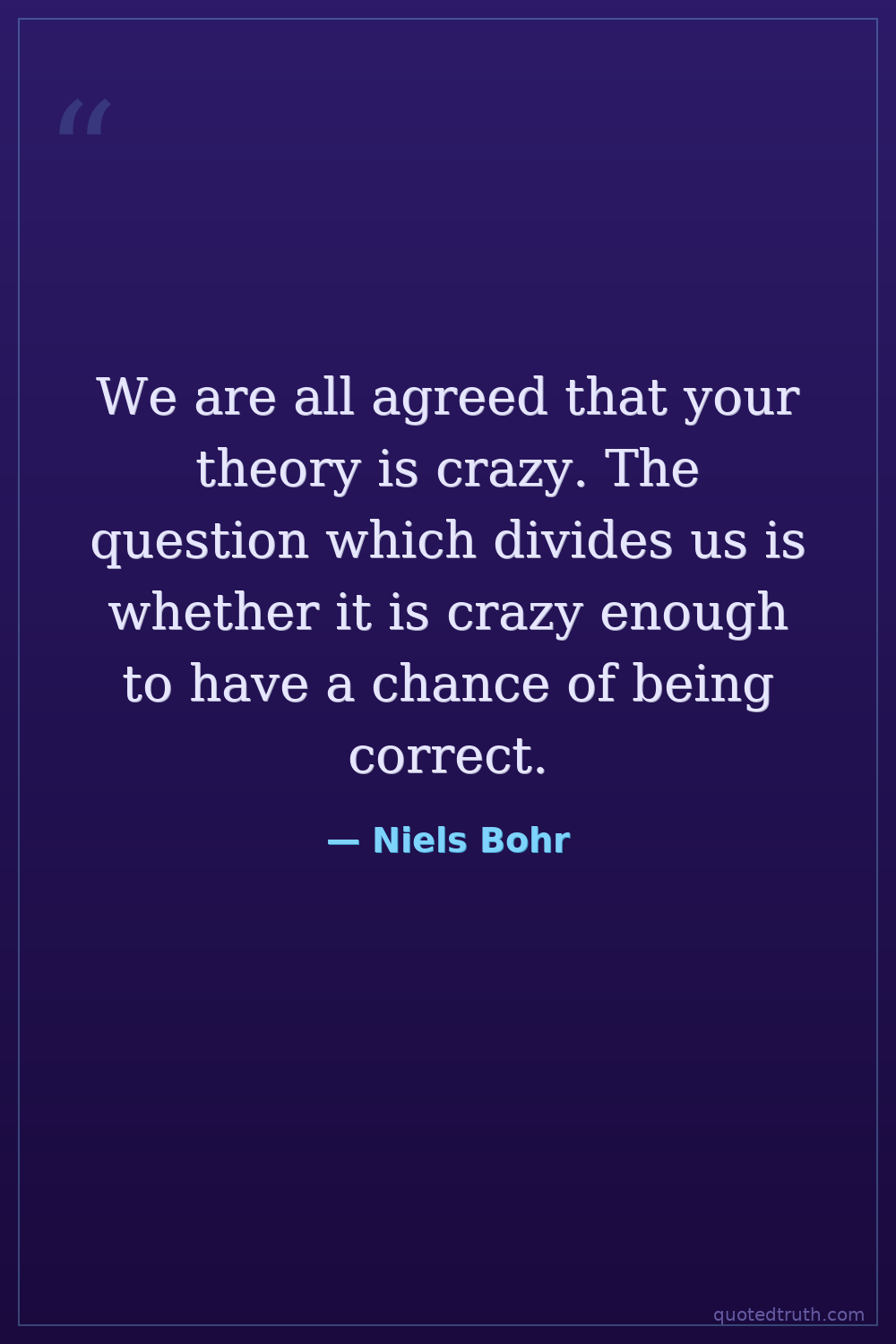
Niels Bohr — "We are all agreed that your theory is crazy. The question which divides us is wh…"
We are all agreed that your theory is crazy. The question which divides us is whether it is crazy enough to have a chance of being correct.
We are all agreed that your theory is crazy. The question which divides us is whether it is crazy enough to have a chance of being correct.
Click any product to generate a realistic preview. Up to 3 at a time.
* Initial load can take up to 90 seconds — revising the preview in another color is nearly instant.
"What is it that we human beings ultimately depend on? We depend on our words. We are suspended in language. Our task is to communicate experience and ideas to others."
"The very act of observing changes the observed."
"We are all in the same boat, in a stormy sea, and we owe each other a terrible loyalty."
"When it comes to atoms, language can be used only as poetry."
"The only way to avoid error is to acquire experience, and the only way to acquire experience is to make errors."
Found in 2 providers: deepseek,grok
2 sources checked
In cutting-edge physics, the most revolutionary discoveries don't just tweak existing ideas — they shatter them entirely. Bohr is saying a theory that only seems mildly unconventional probably isn't bold enough to be true. Real breakthroughs demand ideas so radical they appear absurd at first. The bar isn't simply 'is this crazy?' but 'is it crazy enough to match how genuinely strange reality turns out to be?'
Bohr built his career on theories that violated classical intuition — his 1913 atomic model defied classical electromagnetism yet proved experimentally correct. As a chief architect of quantum mechanics, he championed the Copenhagen Interpretation, a framework so philosophically strange that Einstein spent decades opposing it. Having personally navigated the gap between 'seems wrong' and 'is wrong,' Bohr understood that frontier physics demands ideas radical enough to unsettle everyone, including the proposer.
This quote emerged during the quantum revolution of the 1920s–1940s, when classical Newtonian physics — dominant for centuries — was being dismantled by experimental results nobody could explain classically. At legendary Solvay Conferences, Bohr, Einstein, Heisenberg, and Schrödinger debated theories so counterintuitive they seemed like science fiction. Wave-particle duality, the uncertainty principle, and quantum superposition all initially appeared 'crazy.' This era proved that nature operates on principles so strange that conventional intuition actively misleads physicists.
AI-generated insights based on extensive research and information for context. Factual errors? Email [email protected].
Your cart is empty