What it means
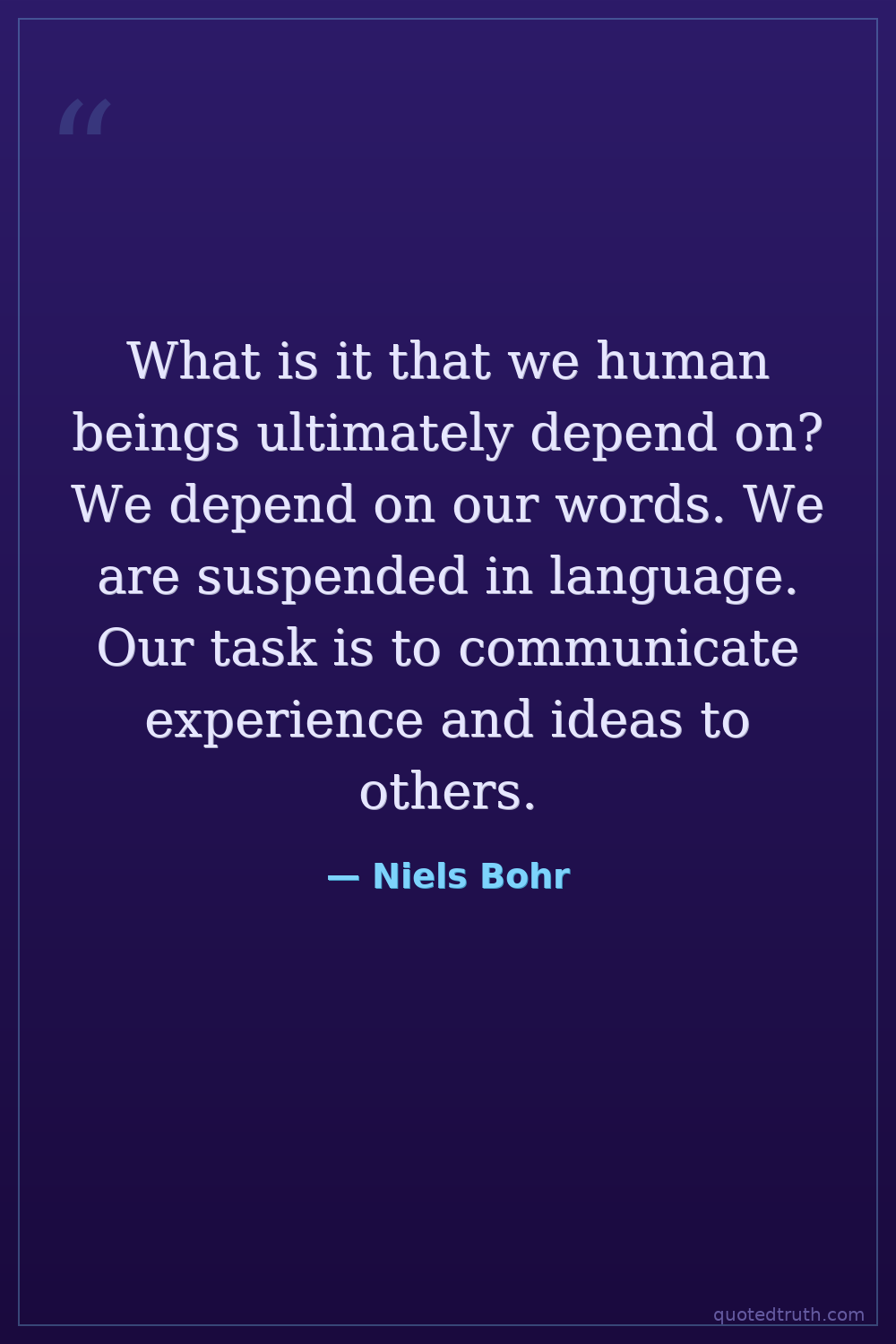
Humans rely on language to make sense of reality and share what they know. We do not stand outside words looking in; we are immersed in them, using them to translate inner experience into something another mind can grasp. Communication is not a side activity but the central job of being human, because without shared language, individual experience and ideas remain locked away and cannot become collective understanding or knowledge.
Relevance to Niels Bohr
Bohr wrestled lifelong with how to describe quantum reality, where particles defy ordinary intuition. He insisted physicists could only ever speak of nature using classical language, since human concepts were forged in the everyday world. This shaped his complementarity principle and his famous Copenhagen debates with Einstein. Known for painfully slow, precise speech, Bohr revised manuscripts dozens of times, treating word choice as central to physics itself, not mere packaging for equations.
The era
Bohr worked through the early 20th-century quantum revolution, when discoveries about atoms shattered classical physics and forced scientists to confront phenomena no existing vocabulary described. Logical positivism dominated philosophy, debating whether language could meaningfully refer to unobservable entities. Wittgenstein argued the limits of language were the limits of thought. Bohr's Copenhagen Institute became a global hub where physicists from many nations struggled, often across language barriers, to articulate a reality that seemed to resist plain description.
AI-generated insights based on extensive research and information for context. Factual errors? Email [email protected].