Alan Turing — "We are not interested in the fact that a machine can do something, but in the fa…"
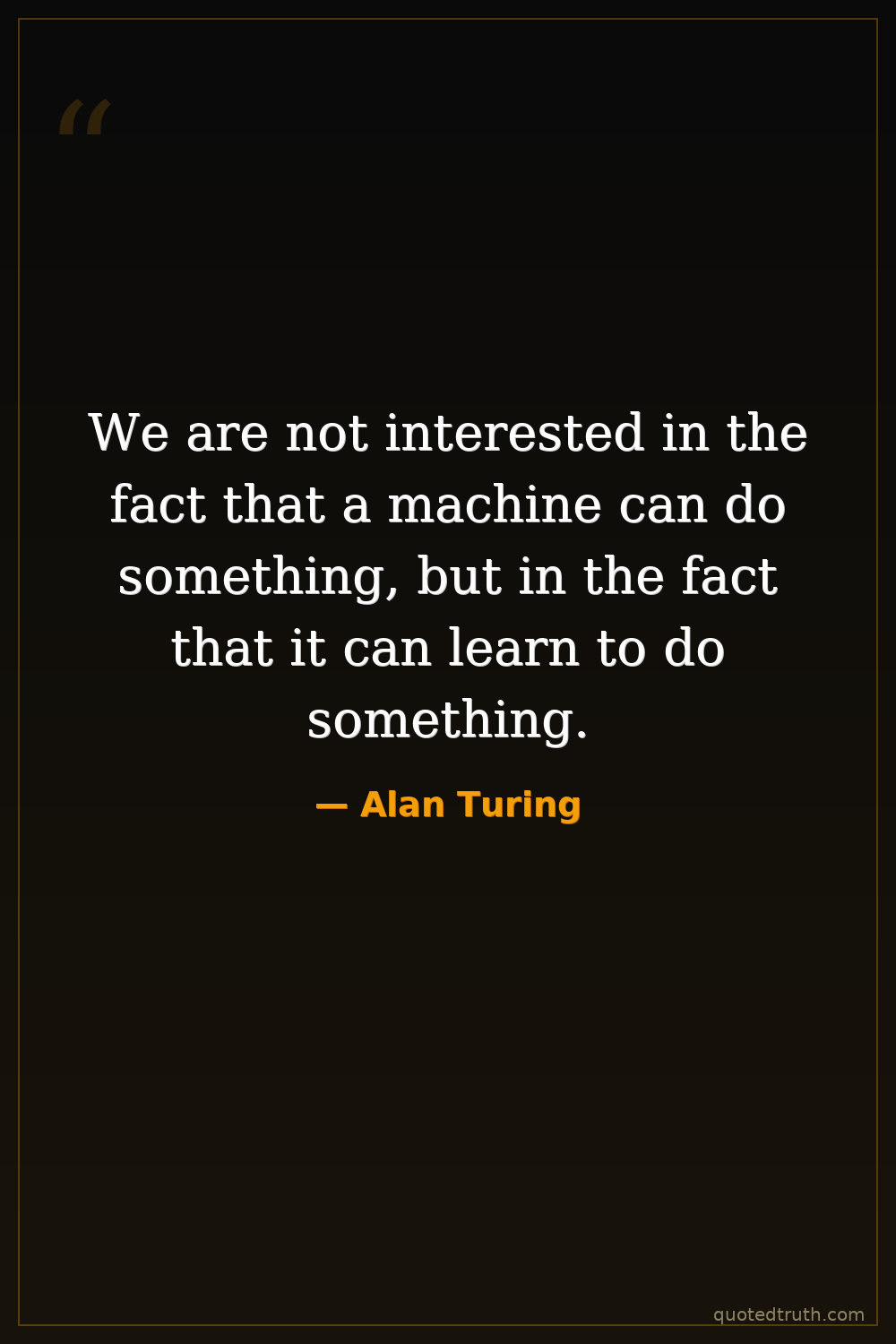
We are not interested in the fact that a machine can do something, but in the fact that it can learn to do something.
We are not interested in the fact that a machine can do something, but in the fact that it can learn to do something.
Click any product to generate a realistic preview. Up to 3 at a time.
* Initial load can take up to 90 seconds — revising the preview in another color is nearly instant.
"If the man were to try and pretend to be the machine he would clearly make a very poor showing. He would be given away at once by slowness and inaccuracy in arithmetic."
"The human brain is an electrical machine."
"I don't think that human beings are the be-all and end-all of creation."
"The activity of the intuition consists in making spontaneous judgements which are not the result of conscious trains of reasoning. These judgments are often but by no means invariably correct…"
"I see no reason why a machine should not be able to have emotions."
Attributed, general implication from his writings on machine learning, but exact quote is elusive.
Date: Approx. 1950
ShockingFound in 1 providers: grok
1 source checked
A machine that executes fixed instructions is far less remarkable than one that can acquire new skills through experience. This quote draws a sharp line between static capability — doing what you were built to do — and adaptive intelligence — learning to do something new. It is the core premise of modern machine learning: a system's value lies not in hard-coded functions but in its capacity to generalize, improve, and surprise.
Turing's landmark 1950 paper 'Computing Machinery and Intelligence' proposed the Turing Test to evaluate learned behavior, not rote execution. He explicitly theorized a 'learning machine' that starts with incomplete rules and improves through experience — a direct ancestor of neural networks. His Bletchley Park work showed him that adaptive, probabilistic reasoning cracks hard problems where brute enumeration fails. He wanted machines that could genuinely think, not merely calculate.
In the late 1940s and early 1950s, the first electronic computers — ENIAC, the Manchester Mark 1, Turing's own ACE design — were celebrated as fast calculators, nothing more. The dominant view held that machines were deterministic tools, incapable of anything beyond explicit programming. The Cold War accelerated interest in automation and cryptanalysis. Turing's insistence that machines could learn directly challenged this orthodoxy and founded artificial intelligence as a discipline.
AI-generated insights based on extensive research and information for context. Factual errors? Email [email protected].
Your cart is empty