What it means
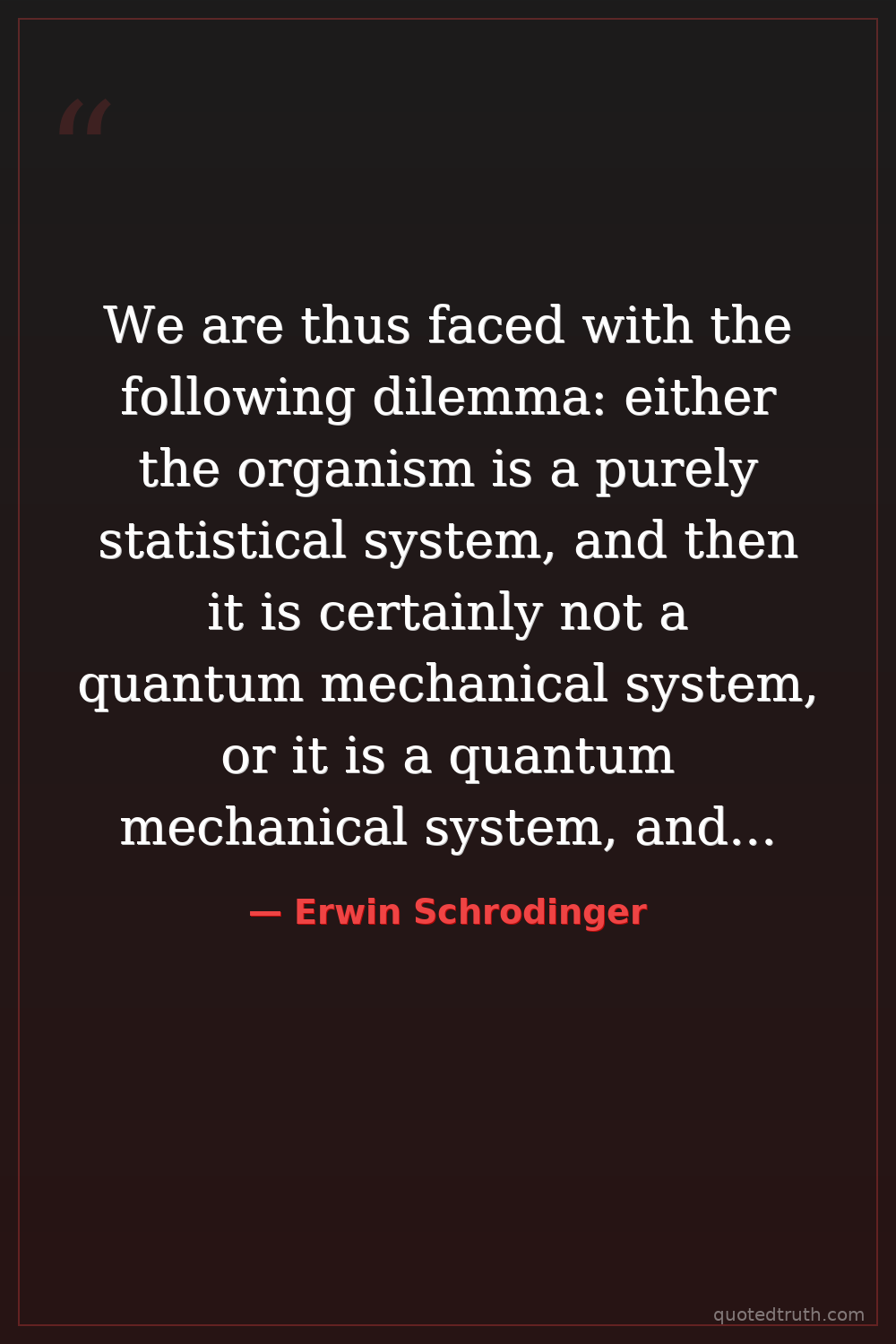
Living organisms present a logical trap: treat them as purely statistical systems governed by probability and averages, and quantum mechanics cannot apply. Treat them as quantum mechanical systems, and pure statistical descriptions break down. Schrödinger identifies that life occupies a paradoxical middle ground—biological precision demands something stricter than statistics, yet organisms resist reduction to clean quantum systems. He is probing whether physics, as then understood, could ever fully explain life.
Relevance to Erwin Schrodinger
Schrödinger pioneered wave mechanics and the equation bearing his name, uniting particle behavior with wave mathematics. His 1944 book 'What is Life?' extended quantum thinking into biology, arguing chromosomes must be 'aperiodic crystals' encoding hereditary information—directly inspiring Watson and Crick's DNA discovery. This quote reflects his lifelong refusal to accept comfortable boundaries between physics and biology, or animate and inanimate matter.
The era
Written in 1944 amid World War II, physics was split between quantum triumphs and deep biological mystery. DNA's structure remained unknown until 1953; heredity was understood statistically but unexplained mechanically. Classical thermodynamics handled inert matter but couldn't account for life's astonishing reproductive precision. Schrödinger's challenge galvanized physicists to enter biology, seeding molecular biology as a discipline and reframing life as an information problem rather than merely a chemical one.
AI-generated insights based on extensive research and information for context. Factual errors? Email [email protected].