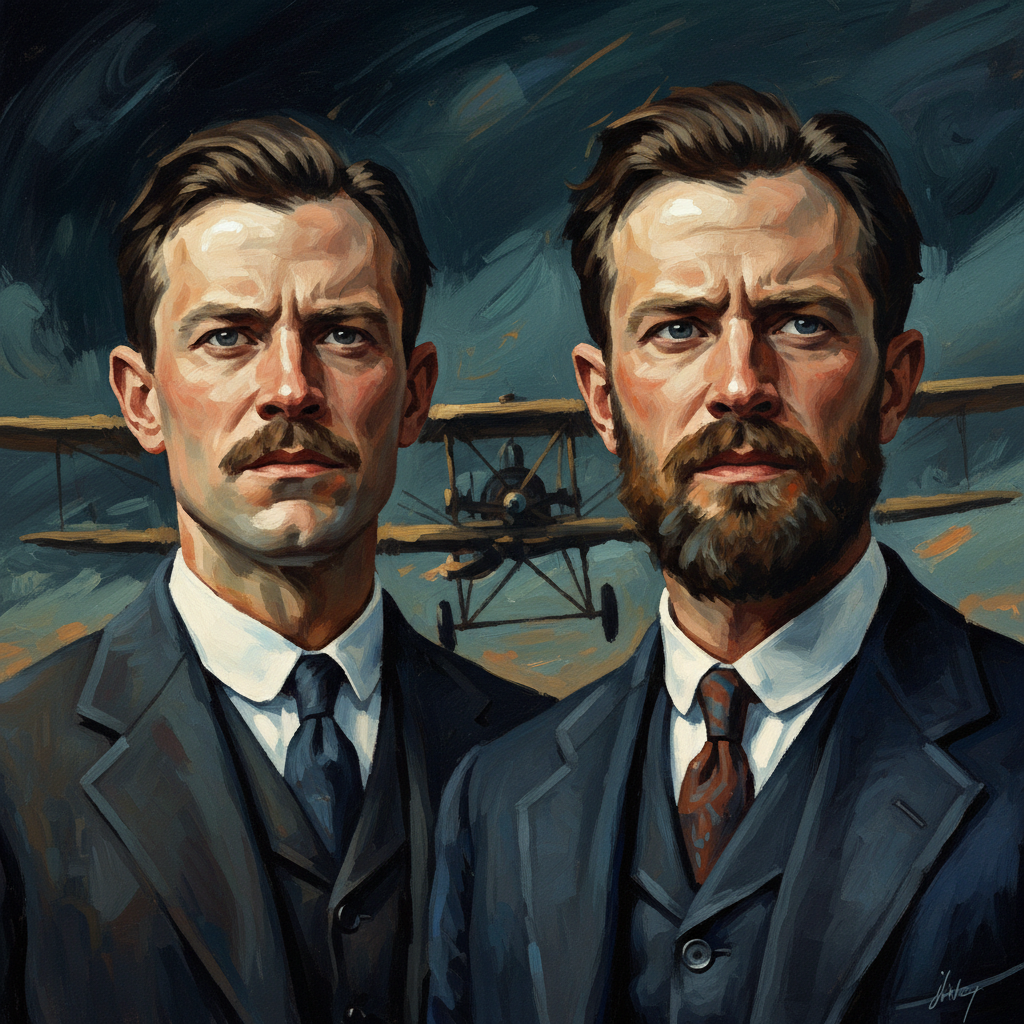
Wright Brothers (Orville & Wilbur) — "We could not understand why the calculation of Lilienthal and others were so muc…"
We could not understand why the calculation of Lilienthal and others were so much in error.
We could not understand why the calculation of Lilienthal and others were so much in error.
Click any product to generate a realistic preview. Up to 3 at a time.
* Initial load can take up to 90 seconds — revising the preview in another color is nearly instant.
"The machine is a triumph of human ingenuity."
"I have not the time for both a wife and an airplane."
"The time will come when man will fly."
"The only bird that could speak told us what it knew, but we didn’t understand its language."
"We have not yet fully solved the problem of balance in high winds."
American aviation pioneers who achieved the first sustained powered controlled airplane flight at Kitty Hawk, NC, on December 17, 1903. Closely associated with Octave Chanute (their gliding mentor and aeronautical correspondent). For an intellectual contrast, see Samuel Pierpont Langley, Smithsonian Institution Secretary and government-funded aviation researcher — Langley's Aerodrome crashed twice into the Potomac in October-December 1903 with $50,000 of War Department funding; the Wright Brothers' bicycle-shop empiricism beat Langley's institutional Big Science by 9 days. The most-cited example in engineering history of empirical-tinkerer beating institution-funded credentialism.
Found in 1 providers: grok
1 source checked
The Wrights were baffled that published aeronautical data from respected predecessors, especially Otto Lilienthal's lift and drag tables, did not match what they observed in their own gliding experiments. They could not figure out why trusted numbers produced wings that underperformed, forcing them to question whether the established science itself was wrong rather than assuming their own work was flawed.
This captures the Wrights' defining instinct: trust measured results over authority. When their 1901 glider badly underperformed Lilienthal's predictions, they built their own wind tunnel in Dayton and tested roughly 200 wing shapes, producing corrected lift coefficients. That refusal to accept inherited data is precisely what let two bicycle mechanics leapfrog funded rivals like Langley and achieve controlled powered flight at Kitty Hawk in 1903.
Around 1900, aeronautics was a field of passionate amateurs working from inconsistent data. Lilienthal had died gliding in 1896, Langley was burning federal money on failed launches, and Smeaton's century-old air-pressure coefficient was still widely used despite being wrong. Science was transitioning from gentleman-experimenter tradition toward rigorous measurement, and the Wrights' willingness to audit the field's foundational numbers exemplified that shift.
AI-generated insights based on extensive research and information for context. Factual errors? Email [email protected].
Your cart is empty