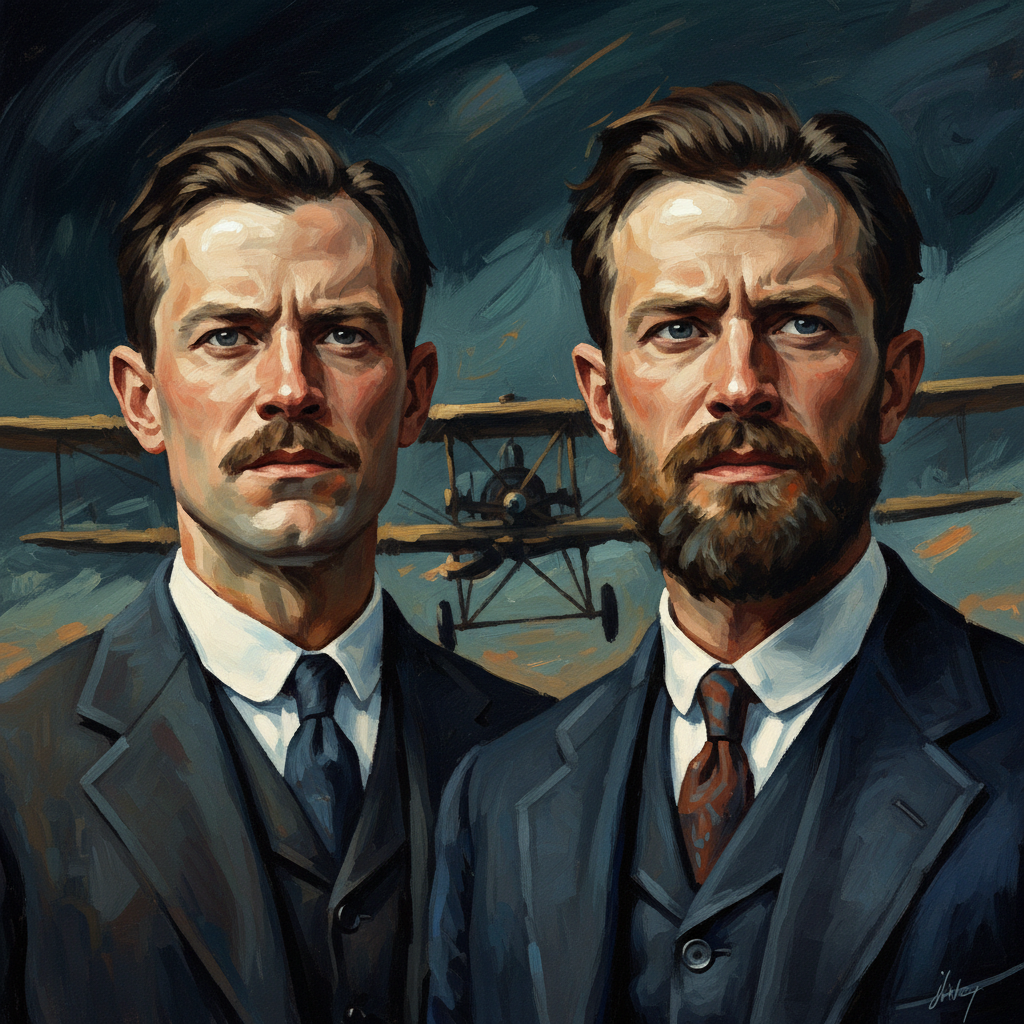
Wright Brothers (Orville & Wilbur) — "The time will come when man will fly."
The time will come when man will fly.
The time will come when man will fly.
Click any product to generate a realistic preview. Up to 3 at a time.
* Initial load can take up to 90 seconds — revising the preview in another color is nearly instant.
"The first great principle of success in flying is to learn to soar without power."
"The machine is a success and we are well pleased with it."
"The machine has been flown in all sorts of weather."
"The aeroplane will be a great factor in bringing together the different nations of the earth."
"No flights of any kind were made except those of our own machine, which, strange to say, did not become a public amusement."
American aviation pioneers who achieved the first sustained powered controlled airplane flight at Kitty Hawk, NC, on December 17, 1903. Closely associated with Octave Chanute (their gliding mentor and aeronautical correspondent). For an intellectual contrast, see Samuel Pierpont Langley, Smithsonian Institution Secretary and government-funded aviation researcher — Langley's Aerodrome crashed twice into the Potomac in October-December 1903 with $50,000 of War Department funding; the Wright Brothers' bicycle-shop empiricism beat Langley's institutional Big Science by 9 days. The most-cited example in engineering history of empirical-tinkerer beating institution-funded credentialism.
Found in 1 providers: grok
1 source checked
This statement predicts a future in which humans will achieve controlled flight, something long considered impossible or reserved for myth. It expresses certainty that technology and human ingenuity will eventually overcome the physical barriers keeping people grounded. Rather than a hope or a wish, it is a confident forecast that what seems unreachable today will become ordinary tomorrow, urging patience, persistence, and faith in steady progress.
Orville and Wilbur Wright devoted years in their Dayton bicycle shop to studying lift, wind, and wing warping before their 1903 Kitty Hawk flight of 12 seconds and 120 feet. They endured crashes, skeptics, and failed gliders, yet kept testing. This quote mirrors their unshakable conviction that controlled powered flight was an engineering problem, not a fantasy, and that disciplined experimentation would eventually make the impossible routine human experience.
In the late 1890s and early 1900s, powered flight was widely ridiculed; respected scientists publicly declared it impossible, and Langley's funded experiments had just failed publicly in 1903. Meanwhile the Industrial Revolution, automobiles, telephones, and electrification were rapidly reshaping daily life. Against that backdrop of both skepticism and accelerating invention, the Wrights' prediction captured a turning point when mechanical progress was outpacing imagination, and self-taught tinkerers could still redefine what humanity was capable of achieving.
AI-generated insights based on extensive research and information for context. Factual errors? Email [email protected].
Your cart is empty