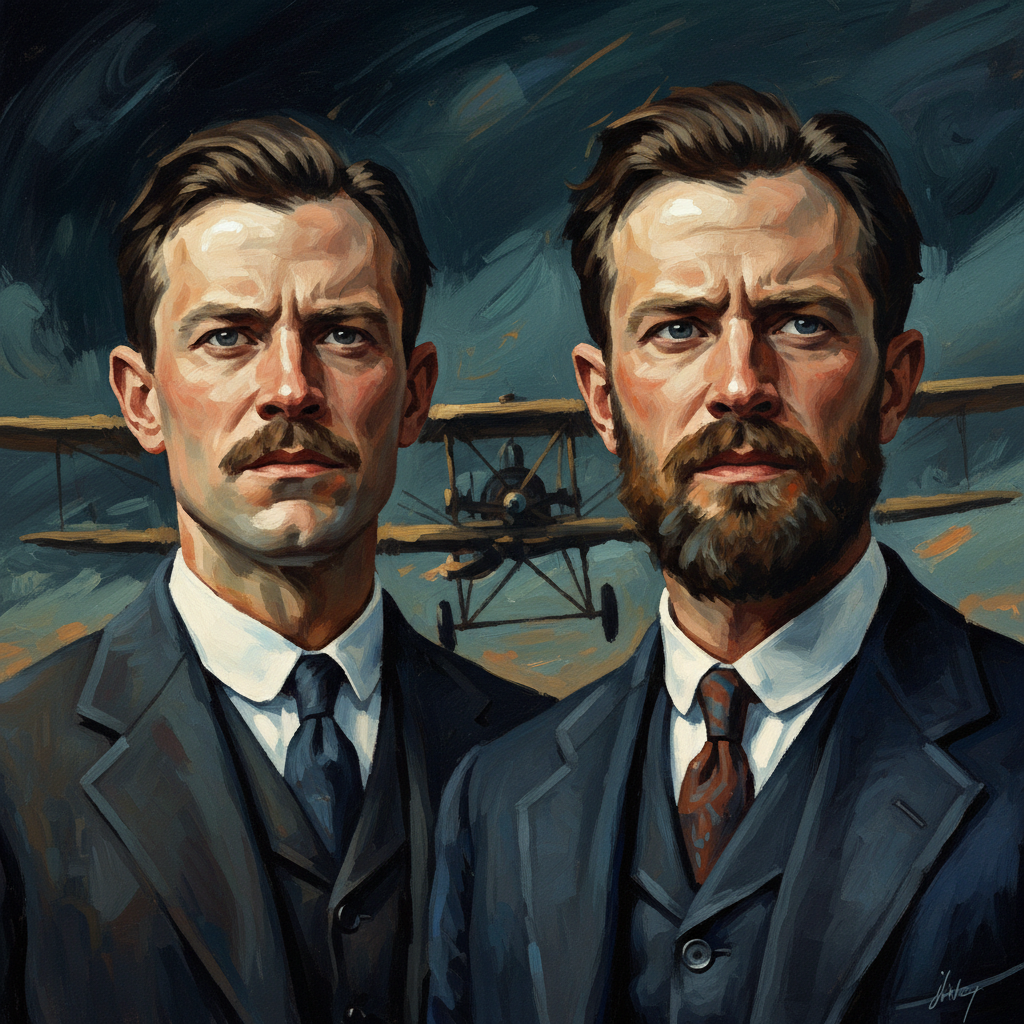
Wright Brothers (Orville & Wilbur) — "The problem of flight was not one of power, but of control."
The problem of flight was not one of power, but of control.
The problem of flight was not one of power, but of control.
Click any product to generate a realistic preview. Up to 3 at a time.
* Initial load can take up to 90 seconds — revising the preview in another color is nearly instant.
"The machine is a thing of life, and will respond to the touch of the hand."
"Our confidence in the ability of men to fly has not been shaken."
"We were not looking for a fortune, but we were looking for a solution."
"No airship will ever fly from New York to Paris. That seems to me to be impossible. What limits the flight is the motor. No known motor can run at the requisite speed for four days without stopping, a…"
"I confess that in 1901 I said to my brother Orville that man would not fly for 50 years. Ever since I have distrusted myself and every time I think that a particular thing will not be done, I recall t…"
American aviation pioneers who achieved the first sustained powered controlled airplane flight at Kitty Hawk, NC, on December 17, 1903. Closely associated with Octave Chanute (their gliding mentor and aeronautical correspondent). For an intellectual contrast, see Samuel Pierpont Langley, Smithsonian Institution Secretary and government-funded aviation researcher — Langley's Aerodrome crashed twice into the Potomac in October-December 1903 with $50,000 of War Department funding; the Wright Brothers' bicycle-shop empiricism beat Langley's institutional Big Science by 9 days. The most-cited example in engineering history of empirical-tinkerer beating institution-funded credentialism.
Found in 1 providers: grok
1 source checked
Building a flying machine was not about generating enough thrust to lift off the ground. Plenty of inventors had already managed brief, uncontrolled hops. The real challenge was steering the craft once airborne: keeping it stable, turning it deliberately, and landing safely. Mastery over the aircraft's motion mattered more than brute engine strength, because power without control produces only crashes, not true flight.
The Wrights reached this insight through years of bicycle building and glider experiments at Kitty Hawk from 1900 to 1902. While rivals like Samuel Langley chased bigger engines, Orville and Wilbur obsessed over wing-warping, rudders, and pilot training. Their breakthrough in 1903 came from a modest 12-horsepower motor paired with a three-axis control system they had painstakingly refined, proving their philosophy that the pilot, not the powerplant, wins the sky.
At the turn of the twentieth century, inventors worldwide raced to conquer the air, backed by newspapers, governments, and wealthy patrons. Langley's Aerodrome, funded by the Smithsonian and War Department, crashed into the Potomac just days before Kitty Hawk because it prioritized propulsion. Steam power, electricity, and the internal combustion engine had taught the era to worship horsepower, so the Wrights' quiet emphasis on balance and steering went against the prevailing assumption that raw mechanical force alone would unlock every frontier.
AI-generated insights based on extensive research and information for context. Factual errors? Email [email protected].
Your cart is empty