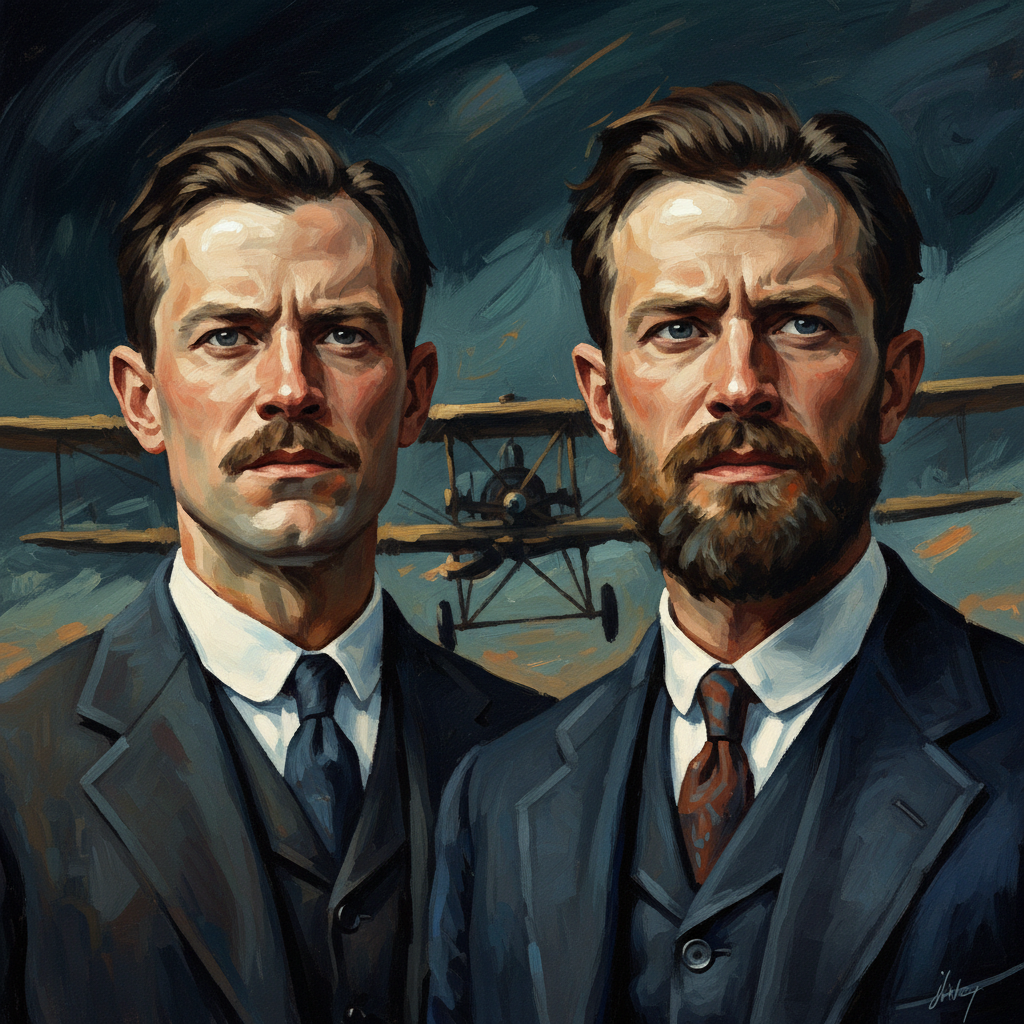
Wright Brothers (Orville & Wilbur) — "The machine was not perfect, but it was a beginning."
The machine was not perfect, but it was a beginning.
The machine was not perfect, but it was a beginning.
Click any product to generate a realistic preview. Up to 3 at a time.
* Initial load can take up to 90 seconds — revising the preview in another color is nearly instant.
"We have been making daily flights, and the machine is working perfectly."
"The aeroplane will be a great factor in bringing together the different nations of the earth."
"The machine itself was a thing of beauty, a marvel of ingenuity and simplicity."
"The time will come when man will fly."
"Success in inventing depends on the close observation of nature."
American aviation pioneers who achieved the first sustained powered controlled airplane flight at Kitty Hawk, NC, on December 17, 1903. Closely associated with Octave Chanute (their gliding mentor and aeronautical correspondent). For an intellectual contrast, see Samuel Pierpont Langley, Smithsonian Institution Secretary and government-funded aviation researcher — Langley's Aerodrome crashed twice into the Potomac in October-December 1903 with $50,000 of War Department funding; the Wright Brothers' bicycle-shop empiricism beat Langley's institutional Big Science by 9 days. The most-cited example in engineering history of empirical-tinkerer beating institution-funded credentialism.
Found in 1 providers: grok
1 source checked
Progress often starts with something flawed rather than finished. The speaker acknowledges their creation had shortcomings yet recognizes its importance as a first step. Instead of waiting for perfection before celebrating, they value the act of starting something new. It captures the idea that every great advancement begins with a rough, imperfect version that can be refined through continued effort, learning, and iteration over time.
The Wright Brothers built and flew the first powered aircraft at Kitty Hawk in 1903, a 12-second flight covering 120 feet. As self-taught bicycle mechanics from Dayton, Ohio, they understood iterative engineering better than most trained scientists. Their Flyer was fragile, hard to control, and crashed often, yet they saw it as a foundation. They spent years refining gliders, wing-warping, and engine design, embodying patient, methodical improvement over dramatic breakthroughs.
In the early 1900s, many scientists and the public believed heavier-than-air flight was impossible or decades away. Samuel Langley's government-funded attempts had publicly failed just days before Kitty Hawk. The era celebrated industrial progress, invention, and tinkerers, with Edison and Ford reshaping daily life. Patents, newspapers, and world's fairs amplified breakthroughs, but skepticism toward self-funded bicycle mechanics meant the Wrights' modest beginning was barely noticed before transforming the twentieth century.
AI-generated insights based on extensive research and information for context. Factual errors? Email [email protected].
Your cart is empty