Werner Heisenberg — "We have to remember that what we observe is not nature in itself but nature expo…"
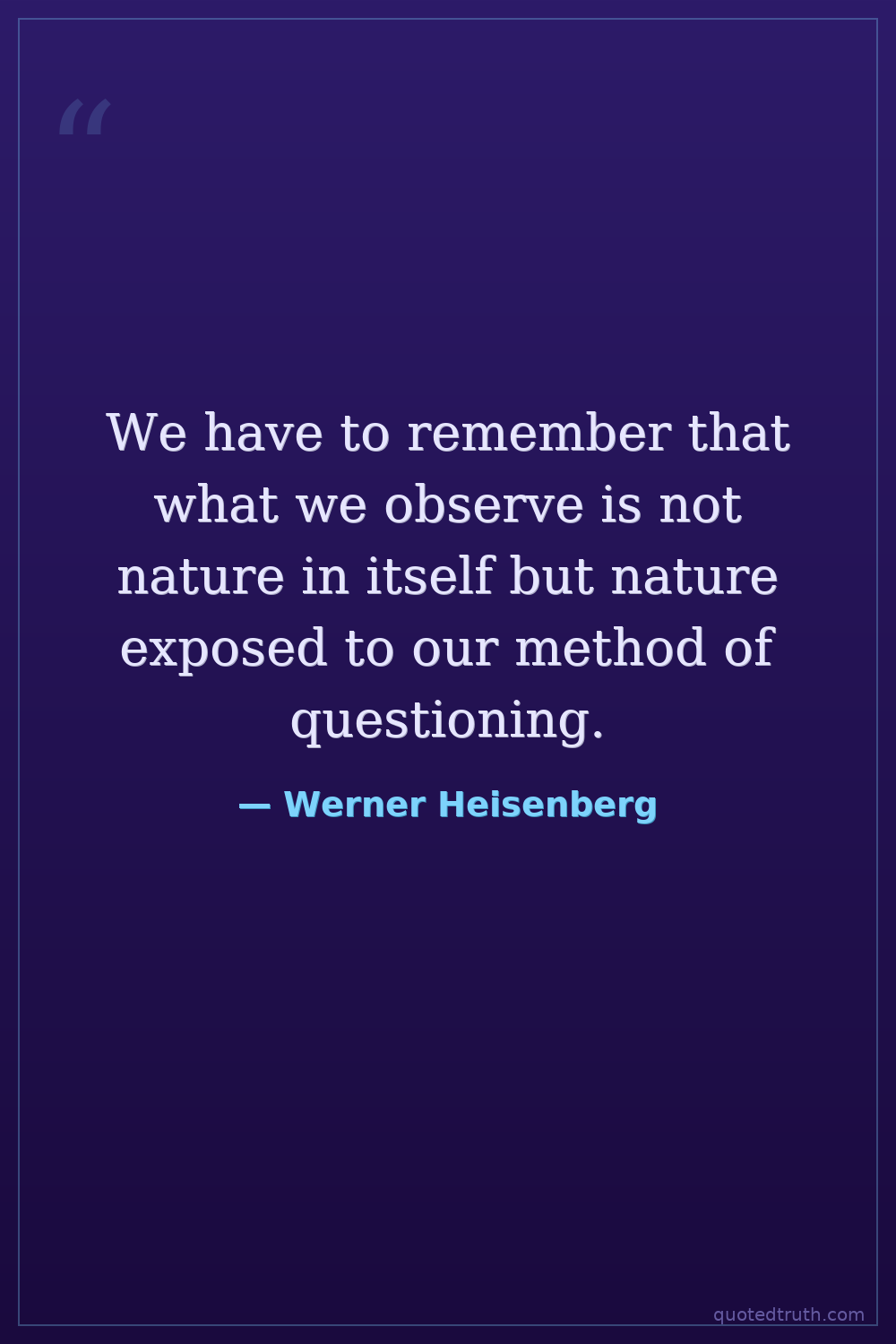
We have to remember that what we observe is not nature in itself but nature exposed to our method of questioning.
We have to remember that what we observe is not nature in itself but nature exposed to our method of questioning.
Click any product to generate a realistic preview. Up to 3 at a time.
* Initial load can take up to 90 seconds — revising the preview in another color is nearly instant.
"The Copenhagen interpretation of quantum mechanics starts from the paradox that we describe our experiments in terms of classical physics, and we describe the elementary particles in terms of quantum …"
"The path to the nucleus is easy to find, but the nucleus itself is hard to reach."
"When we speak of a picture of reality, we always mean a classical picture."
"An expert is someone who knows some of the worst mistakes that can be made in his subject and how to avoid them."
"Natural science does not simply describe and explain nature; it is part of the interplay between nature and ourselves."
Found in 2 providers: grok,deepseek
2 sources checked
Reality as we describe it is never the raw world, but the world filtered through the questions and tools we choose. The instruments, frameworks, and experiments we design shape what answers are even possible. Change the question, and you get a different picture. Observation is not passive recording of an independent truth; it is an active transaction in which our method helps decide what we end up calling a fact.
Heisenberg founded quantum mechanics and discovered the uncertainty principle, which proved you cannot simultaneously pin down a particle's position and momentum. His measurements literally disturbed what he measured, forcing him to abandon classical notions of an observer-independent reality. This line distills decades of wrestling with double-slit experiments, matrix mechanics, and debates with Bohr and Einstein, where he kept finding that the experimental setup itself determined whether electrons behaved as waves or particles.
Writing in the mid-twentieth century, Heisenberg lived through the collapse of classical Newtonian certainty. Relativity, quantum theory, Godel's incompleteness, and the horrors of two world wars shattered Enlightenment faith in objective, mechanical truth. Philosophers like Popper and Kuhn were questioning how science actually works, while physicists at Copenhagen were rewriting reality itself. His remark captured a broader modern shift: from confident spectators of nature to participants whose frameworks shape what counts as knowledge.
AI-generated insights based on extensive research and information for context. Factual errors? Email [email protected].
Your cart is empty