What it means
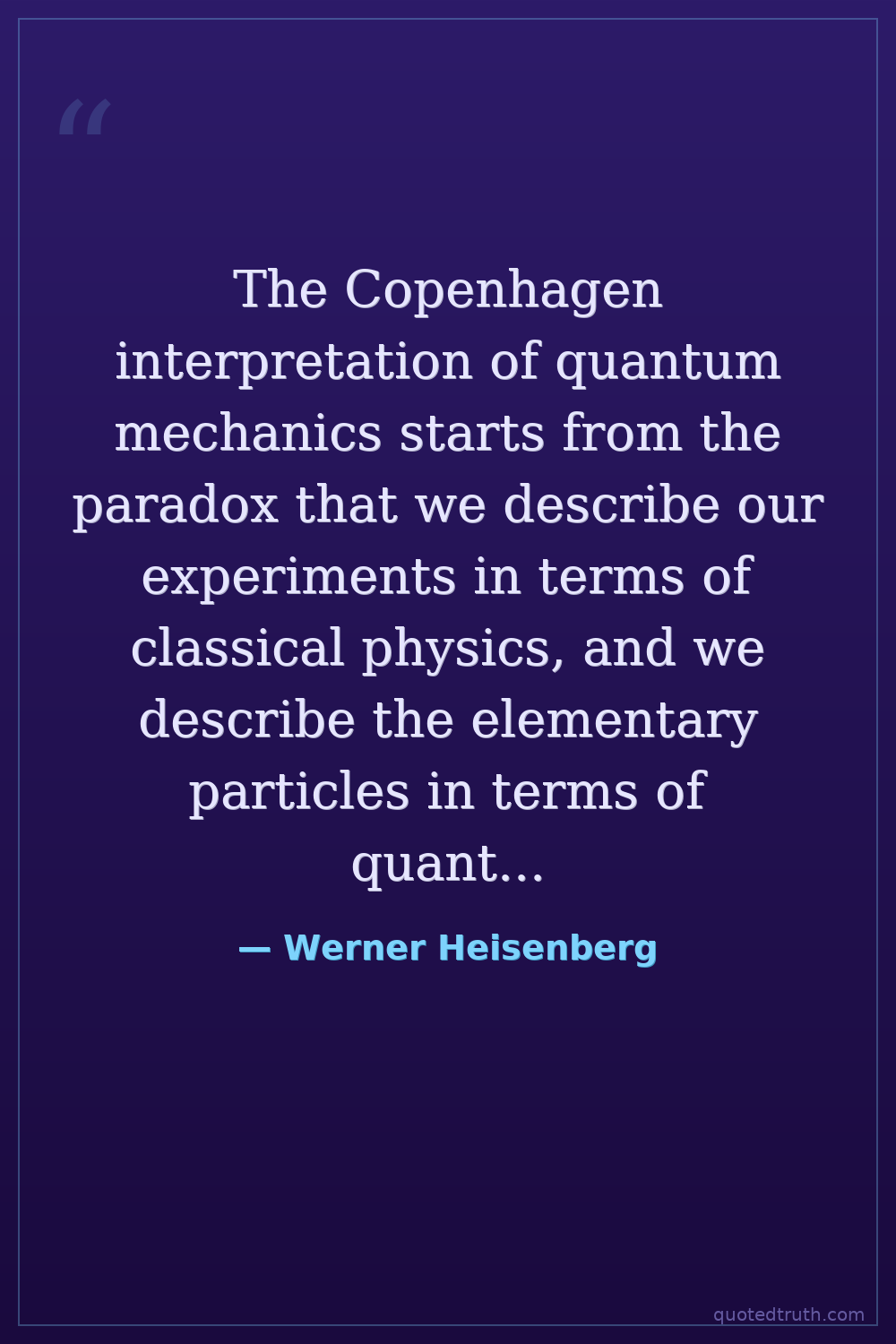
Heisenberg points out a strange split in how physics works. Our laboratory equipment, measurements, and observations are described using classical physics, the familiar science of everyday objects. But the tiny particles we are studying obey quantum rules that defy that classical picture. The Copenhagen interpretation accepts this gap rather than resolving it, treating the boundary between observer and observed as an unavoidable feature of how we gain knowledge about reality.
Relevance to Werner Heisenberg
Heisenberg co-founded the Copenhagen interpretation alongside Niels Bohr in the 1920s, and his 1927 uncertainty principle made the observer-system divide unavoidable. As a theoretical physicist who built matrix mechanics from observable quantities only, he resisted hidden classical realities beneath the math. This quote captures his lifelong philosophical stance: physics describes our knowledge of nature, not nature itself, a view he defended against Einstein, Schrodinger, and later Bohm throughout his career.
The era
The early twentieth century shattered classical physics. Between 1900 and 1930, Planck, Einstein, Bohr, de Broglie, Schrodinger, and Heisenberg overturned Newtonian certainty with quanta, relativity, and wave-particle duality. The 1927 Solvay Conference crystallized the Copenhagen versus realist debate. Heisenberg wrote and spoke about this paradox for decades after, including during postwar reconstruction of German science, when philosophical foundations of quantum theory remained contested amid rising interest from a broader educated public.
AI-generated insights based on extensive research and information for context. Factual errors? Email [email protected].