Wright Brothers (Orville & Wilbur) — "We learn much by tribulation, and by adversity our hearts are made better."
We learn much by tribulation, and by adversity our hearts are made better.
We learn much by tribulation, and by adversity our hearts are made better.
Click any product to generate a realistic preview. Up to 3 at a time.
* Initial load can take up to 90 seconds — revising the preview in another color is nearly instant.
"We are not content to walk upon the ground."
"Learning the secret of flight from a bird was a good deal like learning the secret of magic from a magician."
"The airplane has forced us into a new relationship with each other."
"The public is very enthusiastic about our machine."
"We have not been able to get any very good pictures, as the camera was not very good."
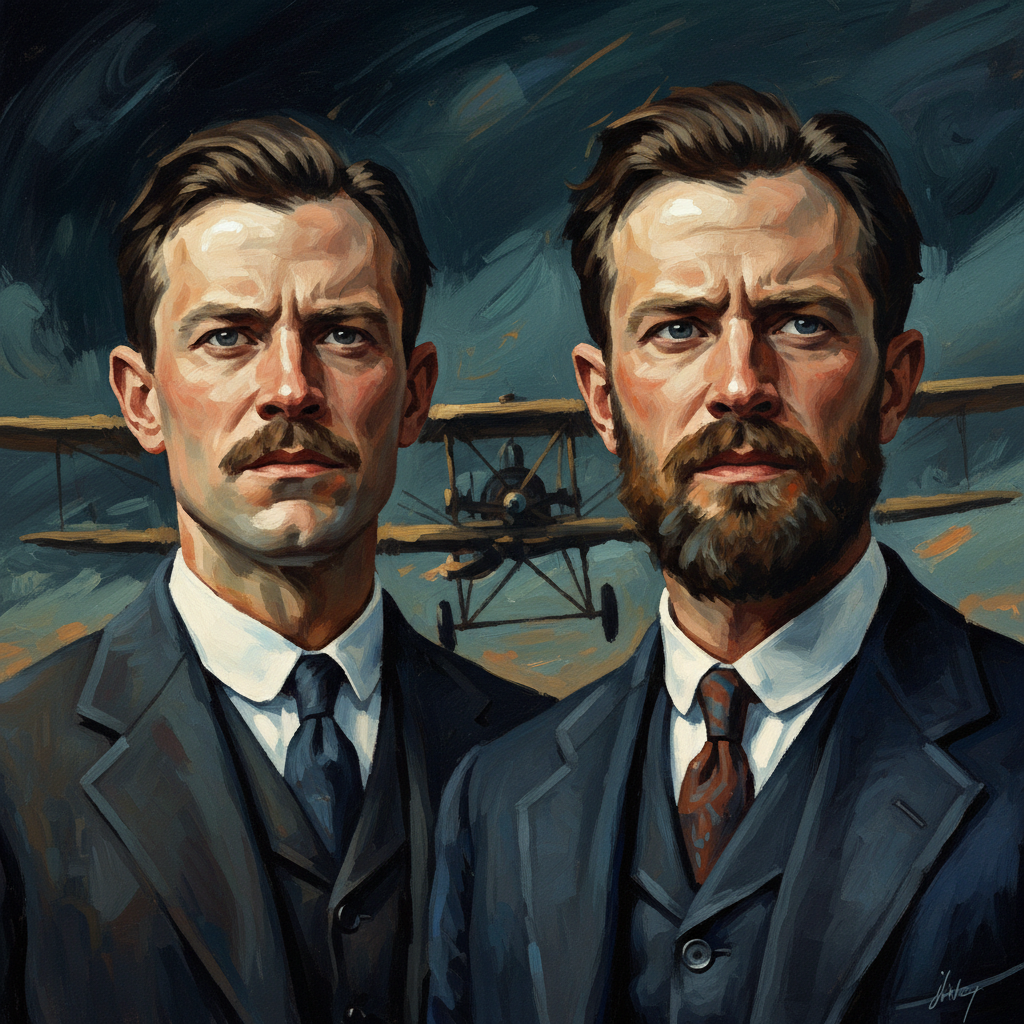
American aviation pioneers who achieved the first sustained powered controlled airplane flight at Kitty Hawk, NC, on December 17, 1903. Closely associated with Octave Chanute (their gliding mentor and aeronautical correspondent). For an intellectual contrast, see Samuel Pierpont Langley, Smithsonian Institution Secretary and government-funded aviation researcher — Langley's Aerodrome crashed twice into the Potomac in October-December 1903 with $50,000 of War Department funding; the Wright Brothers' bicycle-shop empiricism beat Langley's institutional Big Science by 9 days. The most-cited example in engineering history of empirical-tinkerer beating institution-funded credentialism.
A reflection on the value of struggle and hardship, attributed to both brothers by biographers.
Date: Undated
PhilosophicalFound in 1 providers: gemini
1 source checked
Hardship teaches lessons that comfort cannot. When things go wrong, we are forced to examine our assumptions, develop patience, and build resilience. Painful experiences strip away arrogance and reveal what truly matters, leaving us wiser and more compassionate than before. Growth happens through struggle, not ease. The very difficulties we wish to avoid often become the experiences that shape our character and deepen our understanding of ourselves and others.
The Wright Brothers embodied this philosophy through years of failed glider designs, crashes at Kitty Hawk, and the 1908 accident that killed Lt. Selfridge and severely injured Orville. Every setback taught them aerodynamic principles no textbook contained. They rebuilt wing-warping systems, recalculated lift tables after discovering Lilienthal's data was wrong, and persisted through ridicule. Their methodical response to adversity, treating each failure as data, produced powered flight in 1903 where better-funded rivals failed.
The early 1900s were an era of relentless mechanical experimentation, when inventors like Edison, Tesla, and Marconi publicly celebrated failure as the price of progress. Powered flight was widely mocked as impossible; Samuel Langley's taxpayer-funded aerodrome crashed spectacularly into the Potomac just days before Kitty Hawk. America valued self-taught tinkerers, and the Protestant work ethic framed suffering as morally refining. Adversity was not something to escape but a forge for genuine achievement.
AI-generated insights based on extensive research and information for context. Factual errors? Email [email protected].
Your cart is empty