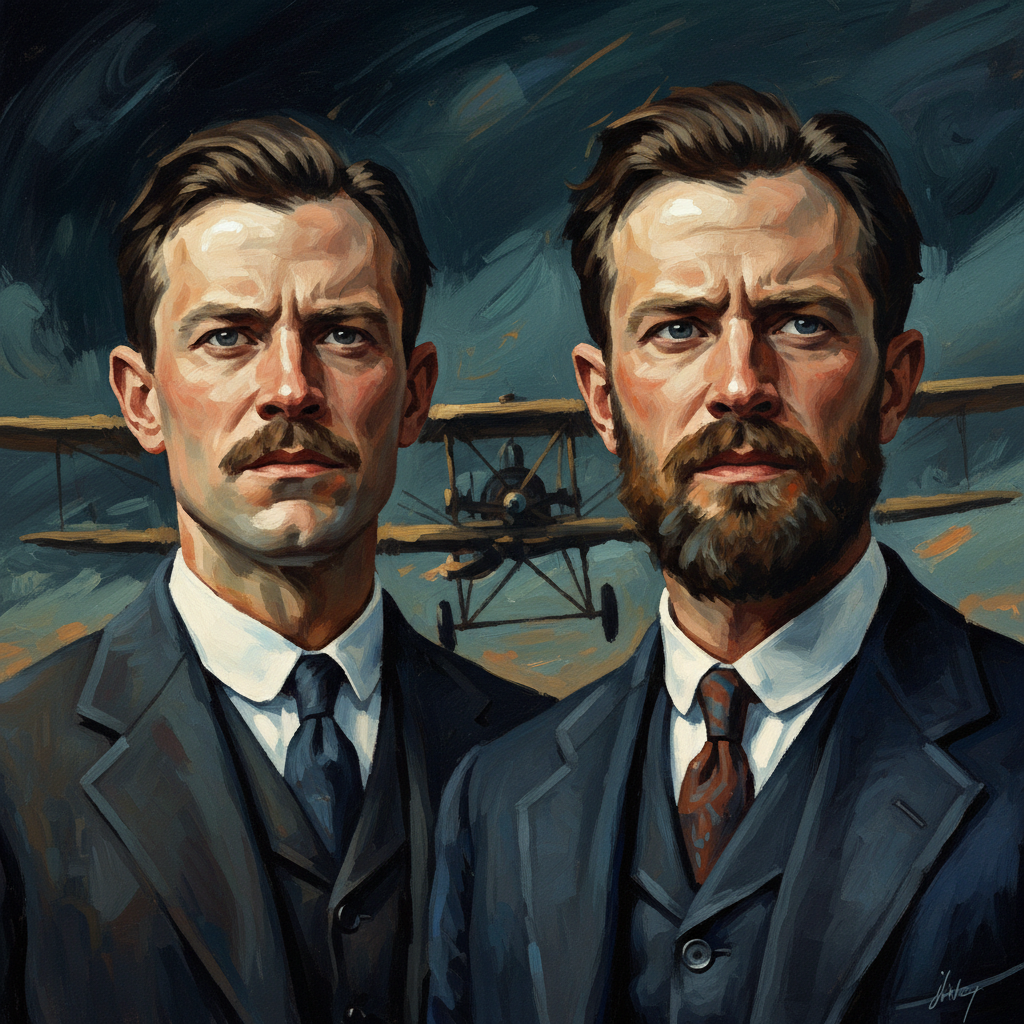
Wright Brothers (Orville & Wilbur) — "We are not content to walk upon the ground."
We are not content to walk upon the ground.
We are not content to walk upon the ground.
Click any product to generate a realistic preview. Up to 3 at a time.
* Initial load can take up to 90 seconds — revising the preview in another color is nearly instant.
"It is not necessary to be a genius to be an inventor."
"The fact that the machine has not failed in any material part is a source of great satisfaction."
"The machine is now quite stable in the air and can be controlled with ease."
"The flying machine is a thing of the future, and it is a thing that will change the world."
"Our confidence in the ability of men to fly has not been shaken."
American aviation pioneers who achieved the first sustained powered controlled airplane flight at Kitty Hawk, NC, on December 17, 1903. Closely associated with Octave Chanute (their gliding mentor and aeronautical correspondent). For an intellectual contrast, see Samuel Pierpont Langley, Smithsonian Institution Secretary and government-funded aviation researcher — Langley's Aerodrome crashed twice into the Potomac in October-December 1903 with $50,000 of War Department funding; the Wright Brothers' bicycle-shop empiricism beat Langley's institutional Big Science by 9 days. The most-cited example in engineering history of empirical-tinkerer beating institution-funded credentialism.
Found in 1 providers: grok
1 source checked
This line declares a refusal to accept the ordinary limits of human movement. Walking, the default mode of getting around, is dismissed as insufficient. The speakers want more than what the earth naturally offers. They are restless with the boundaries nature imposed on people and determined to push past them, reaching for motion through the air itself rather than settling for footsteps across solid ground like everyone before them did.
Orville and Wilbur ran a bicycle shop in Dayton, Ohio, but neither cycling nor walking satisfied their ambition. They spent years studying gliders, wing warping, and propeller design until their December 17, 1903 flight at Kitty Hawk lasted twelve seconds. That refusal to stay grounded literally defined them: self-taught engineers who rejected expert consensus that powered flight was impossible, and who kept crashing, rebuilding, and testing until the Wright Flyer actually lifted.
The turn of the twentieth century was an age obsessed with conquering distance. Railroads had shrunk continents, automobiles were replacing horses, and Marconi had sent wireless signals across the Atlantic in 1901. Scientists like Samuel Langley publicly failed at powered flight, and newspapers mocked the idea. Yet industrial confidence was surging, and two Ohio bicycle mechanics working without university backing or government funding proved that ordinary tinkerers could still crack problems the establishment had declared unsolvable.
AI-generated insights based on extensive research and information for context. Factual errors? Email [email protected].
Your cart is empty