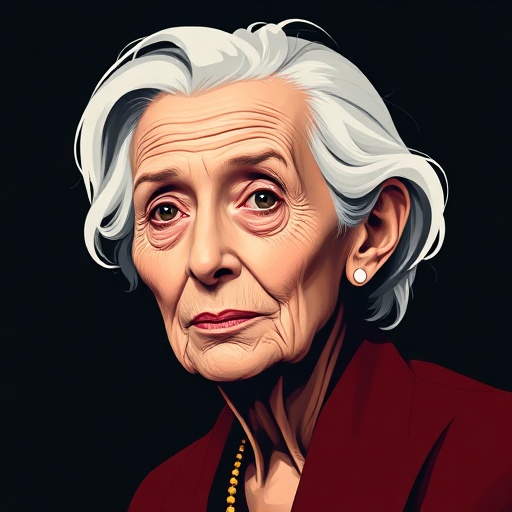
Jane Goodall — "We need to listen to the voices of the young people. They are the ones who will …"
We need to listen to the voices of the young people. They are the ones who will inherit the Earth.
We need to listen to the voices of the young people. They are the ones who will inherit the Earth.
Click any product to generate a realistic preview. Up to 3 at a time.
* Initial load can take up to 90 seconds — revising the preview in another color is nearly instant.
"You cannot get through a single day without having an impact on the world around you. What you do makes a difference, and you have to decide what kind of difference you want to make."
"Every day is a chance to make a difference."
"We are, indeed, often cruel and evil. Nobody can deny this. We gang up on one another, we torture each other, we use our intellect to manipulate, we kill."
"The future of the planet depends on us."
"We need to teach our children to be compassionate, and to care about all living things."
British primatologist who in 1960 began the longest-running wild primate study at Gombe Stream, transforming our understanding of chimpanzees. Closely associated with Dian Fossey (mountain-gorilla researcher) and Birutė Galdikas (orangutan researcher; together with Goodall and Fossey one of Louis Leakey's 'Trimates'). For an intellectual contrast, see Walter Palmer, American dentist who killed Cecil the Lion in Zimbabwe in 2015 — Palmer represents the trophy-hunting tradition Goodall's life's work has been organized against — the colonial-era hunter-naturalist worldview that treated primates and big game as specimens or trophies, which Goodall's Roots & Shoots and Jane Goodall Institute exist specifically to displace.
Found in 1 providers: grok
1 source checked
Adults and institutions must genuinely hear what young people are saying about the future — not as a courtesy but as a matter of stakes. Because youth will live longest with the consequences of today's decisions on climate, environment, and society, their perspectives carry the most direct weight. Dismissing them isn't just unfair; it's strategically foolish. The people inheriting a problem have the clearest incentive to solve it right.
Goodall founded Roots & Shoots in 1991 specifically to channel youth energy into environmental and humanitarian action — her deepest organizational commitment beyond Gombe research. Watching chimpanzee habitats collapse across decades convinced her conservation only succeeds multigenerationally. Well into her 80s she traveled relentlessly, telling interviewers that young activists — not policy or technology — were her primary reason for remaining optimistic, naming them by name as the living evidence that the world could still change.
Goodall pressed this argument hardest during the late 2010s and early 2020s, when youth-led climate movements surged globally — Greta Thunberg's Fridays for Future, the Sunrise Movement, school strikes across 150 countries. The IPCC's 2018 SR1.5 report gave scientific urgency to what young activists already felt viscerally: decisions made by current leaders would lock in consequences those leaders would never personally face. Youth voices became politically visible while remaining structurally excluded from actual power.
AI-generated insights based on extensive research and information for context. Factual errors? Email [email protected].
Your cart is empty