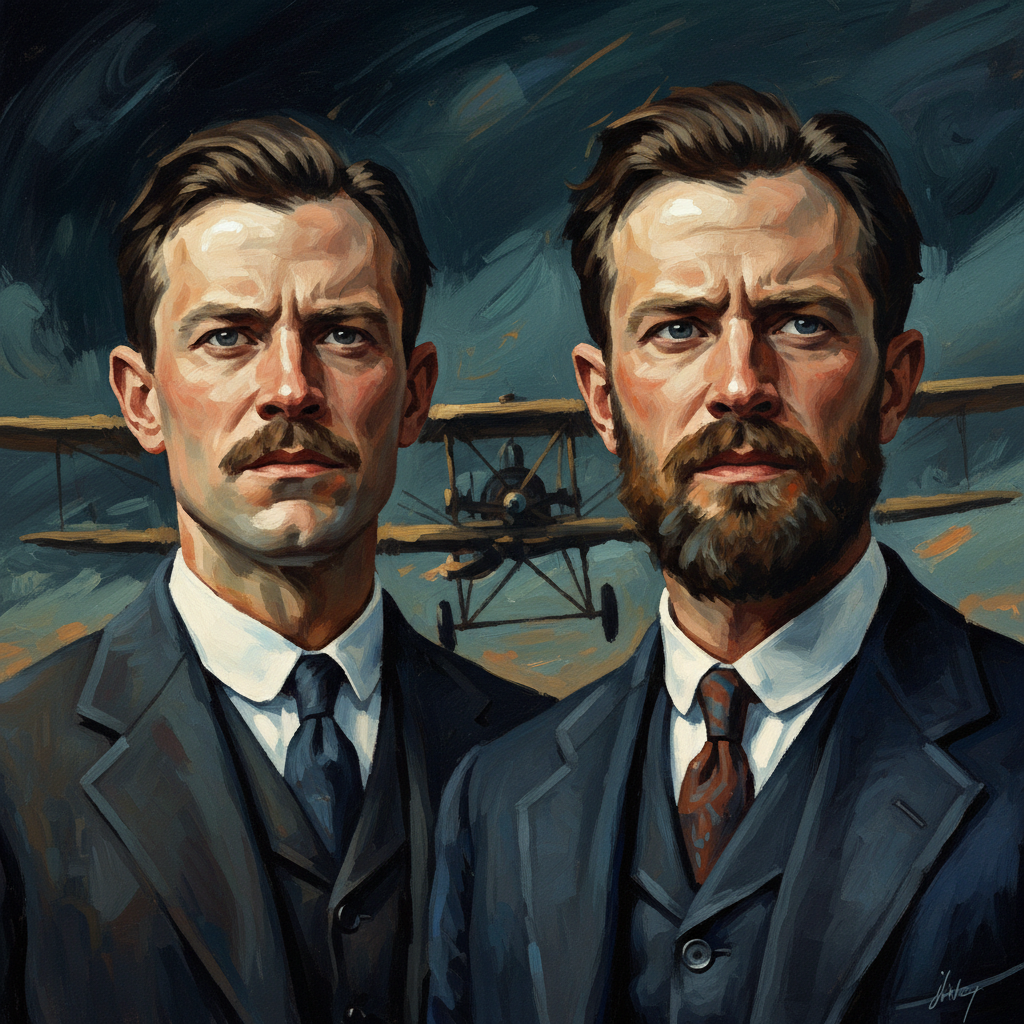
Wright Brothers (Orville & Wilbur) — "We thought that we had solved a problem, but we had only created a new one."
We thought that we had solved a problem, but we had only created a new one.
We thought that we had solved a problem, but we had only created a new one.
Click any product to generate a realistic preview. Up to 3 at a time.
* Initial load can take up to 90 seconds — revising the preview in another color is nearly instant.
"We had taken up the invention of the flying machine as a sport."
"When one comes to increase the size of the craft, the possibility rapidly fades away. This is because of the difficulties of carrying sufficient fuel. It will readily be seen, therefore, why the Atlan…"
"We have been making daily flights, and the machine is working perfectly."
"The air, like the sea, is an untamed element."
"We could hardly wait to get up in the morning."
American aviation pioneers who achieved the first sustained powered controlled airplane flight at Kitty Hawk, NC, on December 17, 1903. Closely associated with Octave Chanute (their gliding mentor and aeronautical correspondent). For an intellectual contrast, see Samuel Pierpont Langley, Smithsonian Institution Secretary and government-funded aviation researcher — Langley's Aerodrome crashed twice into the Potomac in October-December 1903 with $50,000 of War Department funding; the Wright Brothers' bicycle-shop empiricism beat Langley's institutional Big Science by 9 days. The most-cited example in engineering history of empirical-tinkerer beating institution-funded credentialism.
Attributed to Orville Wright, likely a summary of their iterative process.
Date: c. 1900s
Food & DrinkFound in 1 providers: grok
1 source checked
Solving one problem rarely ends the journey — it reframes the next challenge. Every breakthrough exposes new complexities that weren't visible before. This captures how progress actually works: not as a clean finish line, but as a chain of escalating obstacles. In modern terms, it's like fixing one bug only to surface three more, or developing a new technology only to face unforeseen consequences no one anticipated.
The Wright Brothers' entire aviation journey embodied this truth. After solving lift with wing-warping and achieving powered flight at Kitty Hawk in December 1903, they faced new problems: insufficient engine power, structural fragility, and poor controllability in real conditions. Former bicycle mechanics, they approached each problem methodically — their notebooks document a cascade of compounding engineering challenges. Solving flight didn't end their work; it revealed how much remained unsolved.
The early 1900s marked the height of the Industrial Revolution's second wave — inventors worldwide raced to conquer flight. Competitors including Samuel Langley, backed by government funding, had failed publicly. The era believed technology could solve humanity's grand challenges, yet each invention — the automobile, telegraph, steam engine — spawned unforeseen social and safety problems. The Wright Brothers' insight captured what that optimistic age was only beginning to learn.
AI-generated insights based on extensive research and information for context. Factual errors? Email [email protected].
Your cart is empty