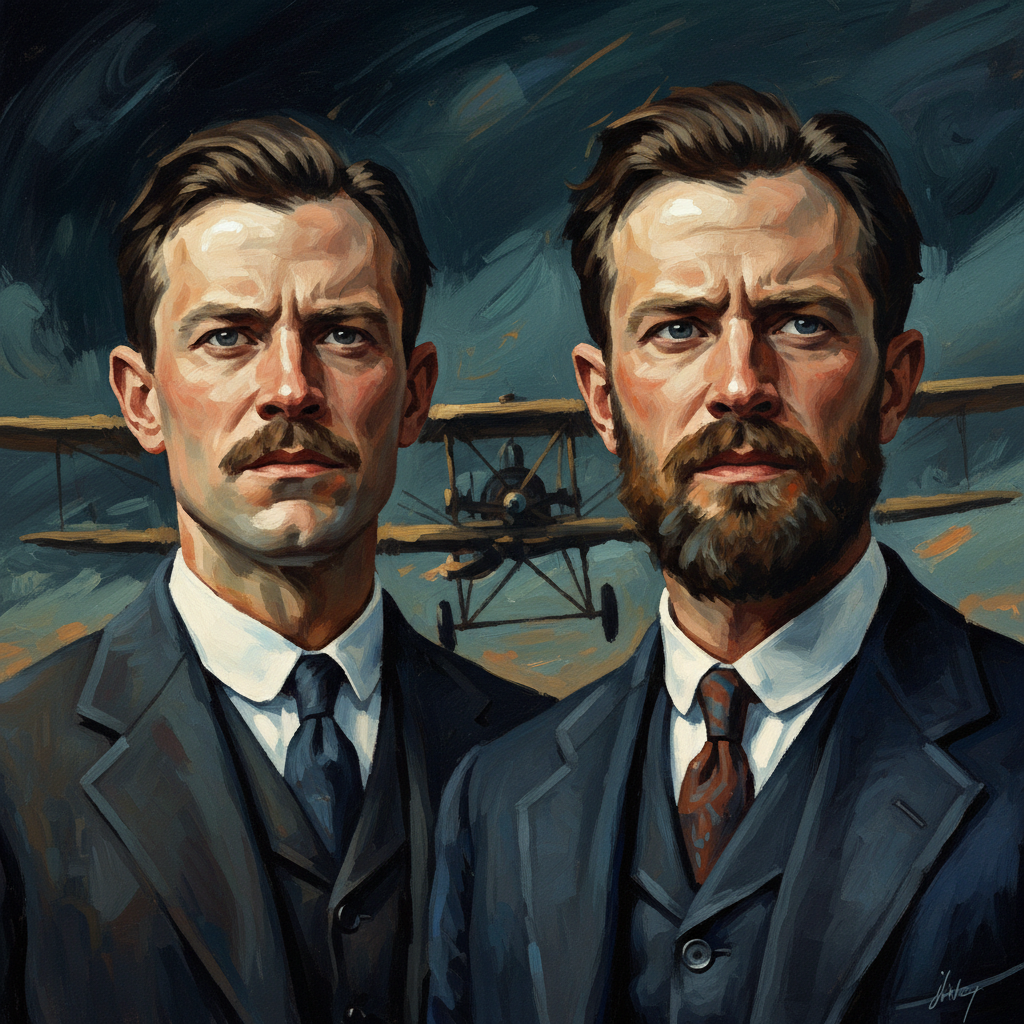
Wright Brothers (Orville & Wilbur) — "We were not looking for fame, but we were looking for knowledge."
We were not looking for fame, but we were looking for knowledge.
We were not looking for fame, but we were looking for knowledge.
Click any product to generate a realistic preview. Up to 3 at a time.
* Initial load can take up to 90 seconds — revising the preview in another color is nearly instant.
"We have hopes of making a flight of considerable length before long."
"The desire to fly is an idea handed down to us by our ancestors who, in their monotonous lives, looked enviously on the birds soaring freely through space, at full speed, on the wings of the wind."
"We do not believe that the difficulties are insurmountable, and we are confident that we shall yet succeed."
"If birds can glide for long periods of time, then why can't we?"
"We do not intend to fly for money, but for the love of the art."
American aviation pioneers who achieved the first sustained powered controlled airplane flight at Kitty Hawk, NC, on December 17, 1903. Closely associated with Octave Chanute (their gliding mentor and aeronautical correspondent). For an intellectual contrast, see Samuel Pierpont Langley, Smithsonian Institution Secretary and government-funded aviation researcher — Langley's Aerodrome crashed twice into the Potomac in October-December 1903 with $50,000 of War Department funding; the Wright Brothers' bicycle-shop empiricism beat Langley's institutional Big Science by 9 days. The most-cited example in engineering history of empirical-tinkerer beating institution-funded credentialism.
Attributed to Orville Wright, reflecting their scientific motivation.
Date: c. 1900s
GeneralFound in 1 providers: grok
1 source checked
The speaker is saying their goal was never celebrity or public recognition. What drove them was a genuine desire to learn and understand something new. They pursued their work out of curiosity and the satisfaction of figuring out how something could be done, not because they wanted attention, applause, or the rewards that come with being famous for an accomplishment.
The Wright brothers ran a Dayton bicycle shop and taught themselves aeronautics through obsessive experimentation, building their own wind tunnel and lift tables when existing data proved wrong. They shunned publicity for years after Kitty Hawk, refusing demonstrations until patents were secured. Neither married nor chased wealth; Wilbur died of typhoid in 1912 and Orville lived quietly in Dayton until 1948, preferring workshops to stages.
The turn of the 20th century was an age of gentleman inventors, industrial prizes, and newspaper spectacle. Rivals like Samuel Langley drew federal funding and front-page coverage for crashes into the Potomac. Edison and Tesla had turned science into celebrity. Against that backdrop, two self-funded brothers from Ohio methodically solving three-axis control represented an older craftsman ethic surviving into the era of mass media, patents, and corporate-scale invention.
AI-generated insights based on extensive research and information for context. Factual errors? Email [email protected].
Your cart is empty