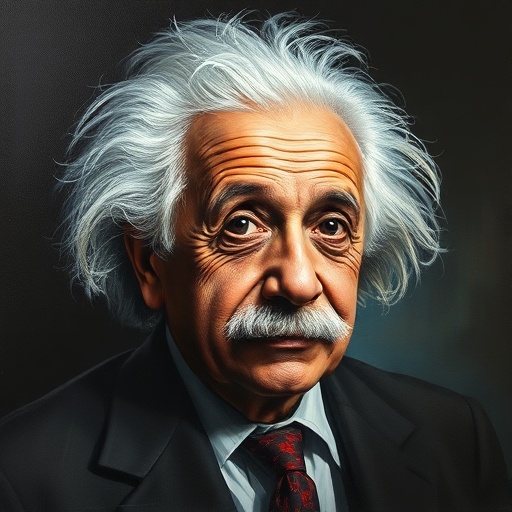
Albert Einstein — "Weakness of attitude becomes weakness of character."
Weakness of attitude becomes weakness of character.
Weakness of attitude becomes weakness of character.
Click any product to generate a realistic preview. Up to 3 at a time.
* Initial load can take up to 90 seconds — revising the preview in another color is nearly instant.
"I see only with deep regret that God punishes so many of His children for their numerous stupidities."
"The greatest scientists are artists as well."
"The human mind has first to construct forms, independently, before we can find them in things."
"The word God is for me nothing more than the expression and product of human weaknesses."
"Imagination is more important than knowledge. For knowledge is limited, whereas imagination embraces the entire world, stimulating progress, giving birth to evolution."
Found in 1 providers: grok
1 source checked
If you allow yourself a weak mental stance—passivity, defeatism, intellectual laziness, or moral compromise—that attitude eventually hardens into your character. You are what you repeatedly think and tolerate. A person who consistently accepts poor reasoning, avoids difficult truths, or surrenders to convenience doesn't just make bad choices occasionally; they become someone who does. Attitude is the mold; character is what sets inside it.
Einstein lived this principle directly. Working as a patent clerk while developing special relativity, he refused to abandon his convictions under academic dismissal. When Nazi Germany declared his work 'Jewish physics,' he maintained integrity and fled rather than capitulate. As a vocal pacifist and civil rights supporter in America, he chose principled positions over convenient ones. His uncompromising intellectual and moral attitude was inseparable from the character that made his contributions possible.
Einstein's era made attitudinal weakness catastrophically visible. European democracies' 1930s appeasement of Hitler showed exactly what he warned: accommodating attitudes toward fascism hardened into institutional collapse. Scientists who stayed silent during Nazi purges, intellectuals who rationalized compliance—weak attitudes became moral ruin. The atomic bomb's development further raised urgent questions about scientific responsibility. In this climate of totalitarianism, conformity pressure, and moral testing, Einstein's insistence on mental backbone was necessity, not abstraction.
AI-generated insights based on extensive research and information for context. Factual errors? Email [email protected].
Your cart is empty