Richard Feynman — "What do you care what other people think?"
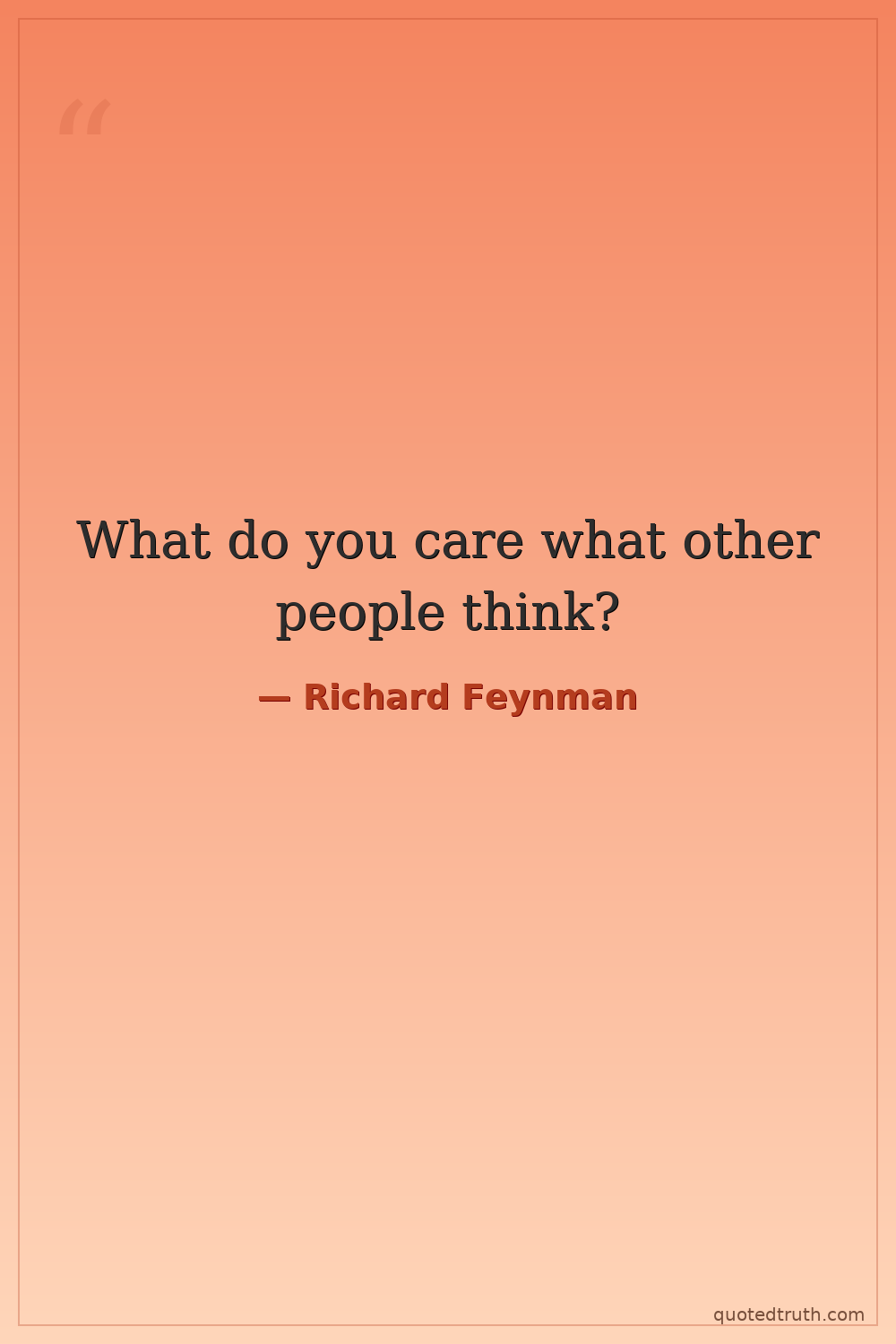
What do you care what other people think?
What do you care what other people think?
Click any product to generate a realistic preview. Up to 3 at a time.
* Initial load can take up to 90 seconds — revising the preview in another color is nearly instant.
"Fiddling is the answer. Experimenting is fiddling around. It's not an organized program, elegance — it's impossible. I noticed it."
"Mathematics is not a science, but a language. It's a tool for science."
"If you're going to be a scientist, you don't need to be a genius. You just need to be able to work hard and be curious."
"I object to having my fun regulated."
"I have a theory that the universe is a great big safe, and that there's a combination to open it. But the combination is locked up in the safe."
American theoretical physicist who shared the 1965 Nobel for QED, developed Feynman diagrams, and wrote the Feynman Lectures on Physics. Closely associated with Julian Schwinger (co-Nobelist for QED) and Murray Gell-Mann (Caltech rival and Eightfold-Way physicist). For an intellectual contrast, see Deepak Chopra, physician and quantum-mysticism author — Feynman's Caltech 'cargo cult science' commencement address is the precise template for what he saw as misuse of physics terminology — Chopra-style appropriation of quantum vocabulary for metaphysical claims is the canonical example of what Feynman called 'fooling yourself'.
Found in 1 providers: grok
1 source checked
Stop letting others' opinions govern your choices, behavior, or self-worth. Authentic living means following your own curiosity, values, and judgment rather than managing how you appear to the crowd. The quote rejects the anxiety of social approval and the self-censorship it breeds. Your own honest assessment of what is right, true, or worth pursuing matters more than the judgment of people who have no stake in your actual life or work.
Feynman's first wife Arline coined this phrase and he adopted it as a personal code. He lived it visibly: resigning from the National Academy of Sciences over its pointless politics, dunking an O-ring in ice water before cameras while NASA officials deflected blame, picking locks at Los Alamos for fun, playing bongos in strip clubs. His Nobel-winning quantum electrodynamics work came from ignoring conventional formalisms and following his own diagrammatic intuition against skepticism from senior physicists.
Feynman worked through Cold War America, when conformity was a survival strategy. McCarthyism punished intellectual independence; security clearances made dissent at national labs genuinely dangerous; academic hierarchies rewarded deference over honesty. The 1986 Challenger disaster crystallized the cost of the opposite instinct — NASA groupthink and institutional pressure suppressed engineers' safety warnings for months. Feynman's blunt O-ring demonstration on live television showed exactly what refusing to care what people think looks like in practice.
AI-generated insights based on extensive research and information for context. Factual errors? Email [email protected].
Your cart is empty