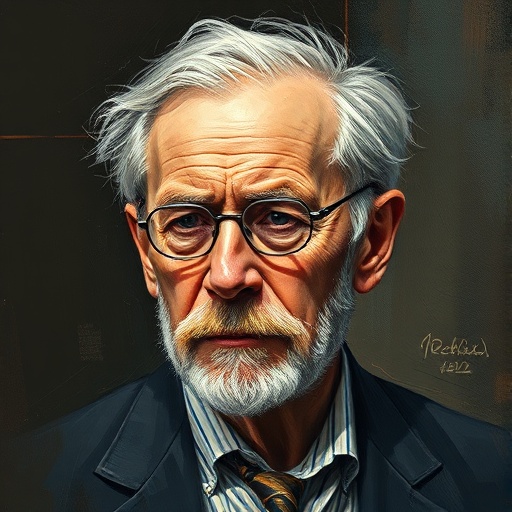
Erwin Schrodinger — "The greatest obstacle to discovery is not ignorance, but the illusion of knowled…"
The greatest obstacle to discovery is not ignorance, but the illusion of knowledge.
The greatest obstacle to discovery is not ignorance, but the illusion of knowledge.
Click any product to generate a realistic preview. Up to 3 at a time.
* Initial load can take up to 90 seconds — revising the preview in another color is nearly instant.
"The number of children born to a marriage ought to be limited, and that a man who has already had some children should be sterilized."
"Science without religion is lame, religion without science is blind."
"The world is not made of atoms, it is made of stories."
"The true sign of intelligence is not knowledge but imagination."
"If we were to pursue the idea to its logical conclusion, we would have to assume that every thought, every feeling, every sensation is somehow connected with an elementary process in the brain, with a…"
Austrian physicist who shared the 1933 Nobel for the wave equation that bears his name and the famous cat thought-experiment. Closely associated with Werner Heisenberg (matrix-mechanics rival who reached the same physics by different math) and Albert Einstein (his pen-pal on quantum interpretation). For an intellectual contrast, see Niels Bohr, Danish physicist and architect of the Copenhagen interpretation — Schrödinger's cat thought-experiment was specifically designed to ridicule Bohr's 'observer-dependent reality' reading of quantum mechanics — Schrödinger thought the Copenhagen interpretation was absurd; the cat was meant as reductio ad absurdum.
Attributed, but its origin is often debated and sometimes attributed to Daniel Boorstin.
Date: Unknown
GeneralFound in 1 providers: grok
1 source checked
Thinking you already understand something stops you from learning more than simply not knowing does. Ignorance at least leaves you open — you know there is a gap. But false certainty seals that gap shut. You stop questioning, stop testing, stop looking for better answers. The most dangerous mind is one convinced it has already arrived at truth. Real discovery requires constantly doubting what you think you know.
Schrödinger built wave mechanics precisely by rejecting what physicists 'knew' about matter. Classical mechanics dominated science for 200 years as settled truth — then his 1926 wave equation revealed particles behave as probability waves, not billiard balls. His cat paradox deliberately exposed how classical certainty fails at quantum scales. He spent decades urging scientists to question their own frameworks, even authoring What Is Life? to challenge biological orthodoxy.
Schrödinger worked during the 1920s quantum revolution, when physics faced the collapse of Newtonian certainty. Scientists who had mastered classical mechanics suddenly confronted experimental results that defied everything they 'knew.' Copenhagen interpretation debates, Heisenberg's uncertainty principle, and Bohr's complementarity all demanded abandoning the illusion of definite, knowable reality. This era proved the most dangerous condition in science is a theory that feels completely solved.
AI-generated insights based on extensive research and information for context. Factual errors? Email [email protected].
Your cart is empty