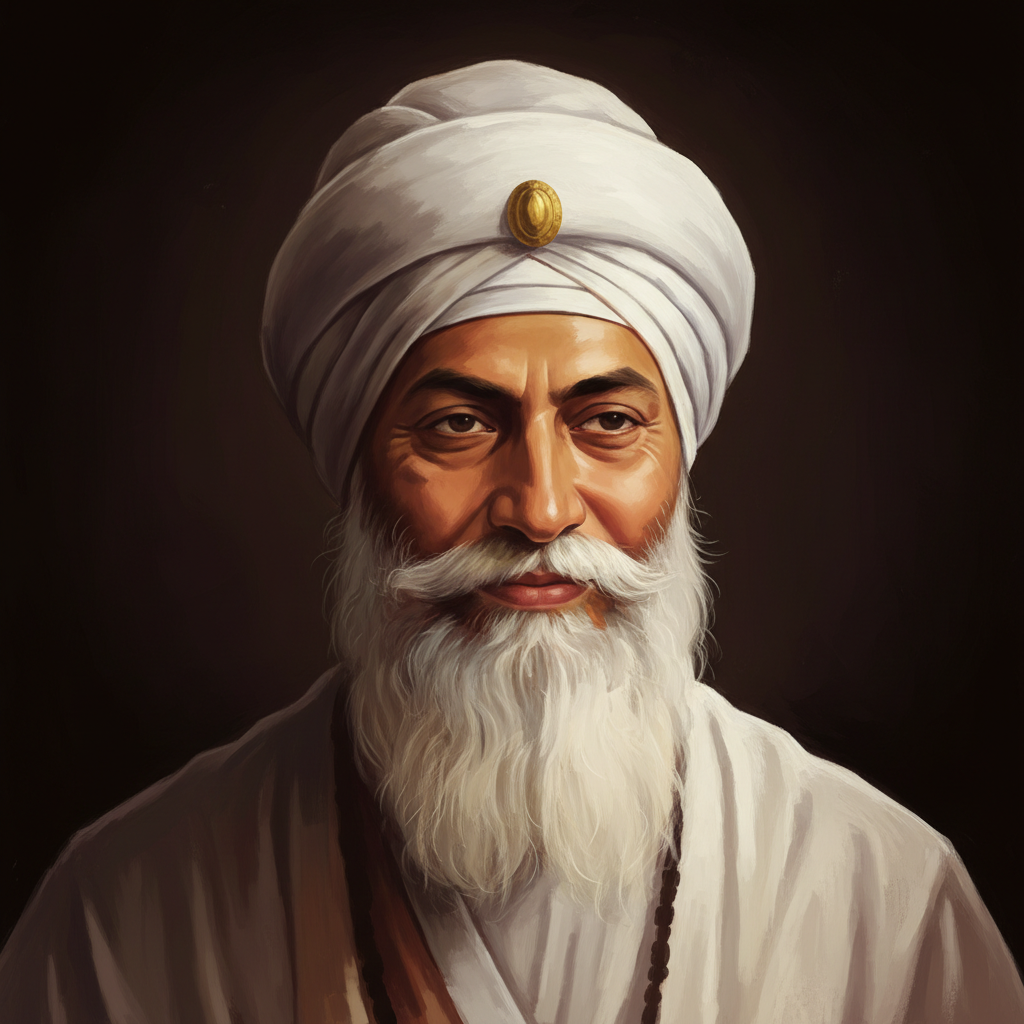
Guru Nanak — "Realization of Truth is higher than all else. Higher still is truthful living."
Realization of Truth is higher than all else. Higher still is truthful living.
Realization of Truth is higher than all else. Higher still is truthful living.
Click any product to generate a realistic preview. Up to 3 at a time.
* Initial load can take up to 90 seconds — revising the preview in another color is nearly instant.
"The body is the field, the mind is the farmer, good deeds are the seeds, and God's Name is the water. Cultivate it well, O peasant, and you shall reap salvation."
"The blessings of God are for all, without discrimination."
"If a person bathes at sixty-eight holy places, but does not cleanse their mind, what good is it?"
"There is but one God. And sometimes, He has a very subtle sense of humor."
"Speak only that which will bring you honor."
Founder of Sikhism and the first of the Ten Sikh Gurus, whose teachings of one universal God and rejection of caste shaped Punjab. Closely associated with Kabir (mystical poet whose verses appear in the Sikh Guru Granth Sahib). For an intellectual contrast, see Brahmanical orthodoxy, the Hindu caste-and-ritual establishment of his era — Sikhism was founded as a deliberate alternative to both Hindu ritual hierarchy and Islamic exclusivism — Nanak's universalism was a structural rejection of caste and priestly mediation.
Found in 1 providers: gemini
1 source checked
Understanding what is true ranks above wealth, status, ritual, or intellectual achievement. But grasping truth mentally still falls short of the highest human act: consistently living by it. The quote creates a deliberate hierarchy — comprehension is valuable, yet daily moral practice, honesty in conduct, and integrity in action surpass even profound insight. Knowledge that never transforms behavior is incomplete. What you do repeatedly matters more than what you believe abstractly.
Guru Nanak (1469–1539) built Sikhism on Sat — Truth — as a literal name of God, making truthful living an act of worship, not just ethics. He rejected Brahmin ritual authority, caste privilege, and performative piety throughout his Udasi journeys across South Asia, Central Asia, and Arabia. He consistently modeled simplicity and honest labor, famously working as a farmer at Kartarpur in his final years, embodying exactly the 'truthful living' this saying elevates above doctrine.
Nanak lived amid intense Hindu-Muslim tension, rigid Brahmin caste stratification, and Mughal conquest — Babur invaded India during his lifetime. Institutional religion on both sides prioritized ritual correctness, scriptural recitation, and clerical hierarchy over personal moral conduct. Corrupt clergy extracted obedience from illiterate populations. Against this backdrop, declaring that lived integrity outranks doctrinal knowledge or ritual observance was democratically radical, bypassing priests entirely and placing spiritual authority inside ordinary daily behavior.
AI-generated insights based on extensive research and information for context. Factual errors? Email [email protected].
Your cart is empty