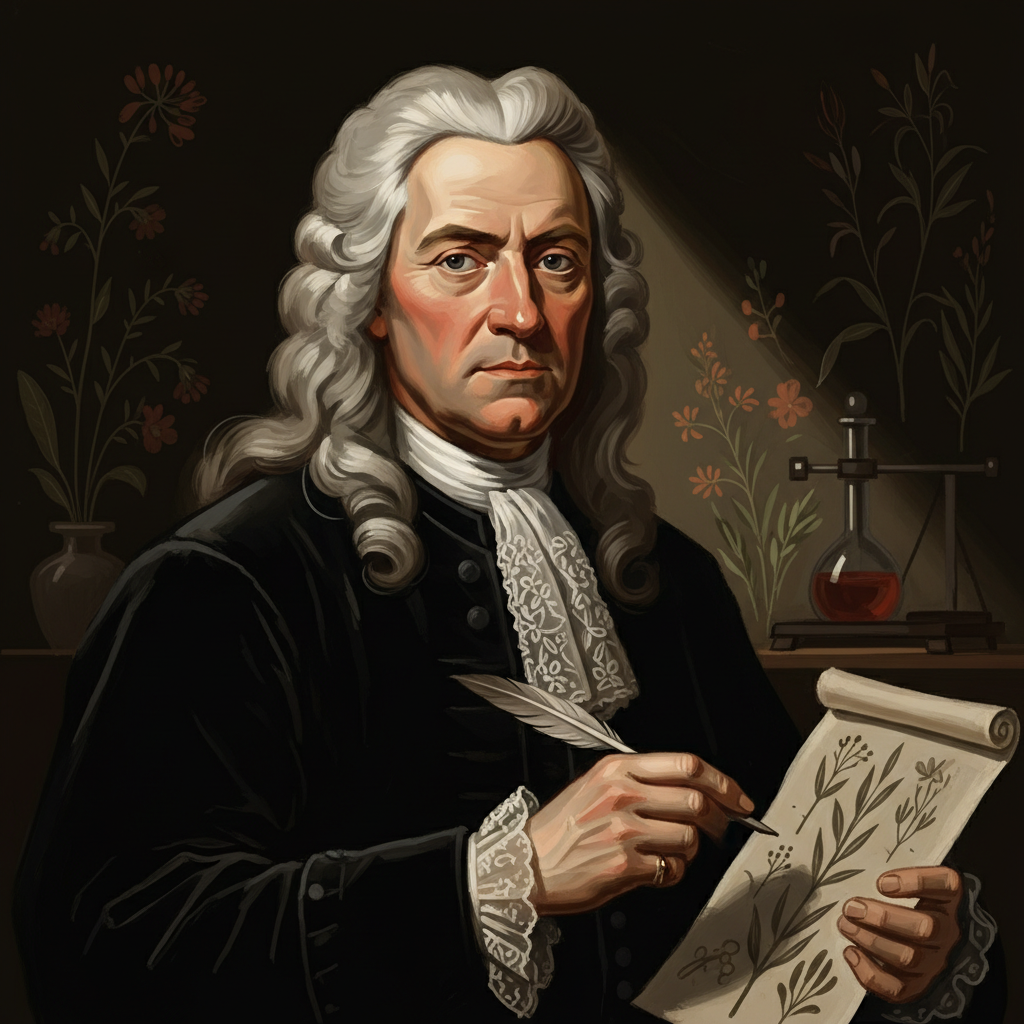
Carl Linnaeus — "When all the thoughts are concerning one thing and the person loses interest in …"
When all the thoughts are concerning one thing and the person loses interest in other things, the melancholy begins.
When all the thoughts are concerning one thing and the person loses interest in other things, the melancholy begins.
Click any product to generate a realistic preview. Up to 3 at a time.
* Initial load can take up to 90 seconds — revising the preview in another color is nearly instant.
"The first step in wisdom is to know the things themselves; this notion consists in having a true idea of the objects; objects are distinguished and known by classifying them methodically and giving th…"
"Nature is never exhausted; she has always new wonders for our admiration."
"The Earth's Creation is the glory of God, as seen from the works of Nature by Man alone."
"It is not the business of a botanist to know all the plants, but to know how to find out what they are."
"A plant is a living being, but it cannot feel."
Swedish botanist and the father of modern taxonomy whose Systema Naturae (1735) introduced binomial nomenclature for naming all species. Closely associated with Joseph Banks (British naturalist who carried Linnaean classification on Cook's voyages). For an intellectual contrast, see Comte de Buffon, French naturalist and Histoire Naturelle author (1749-1788) — Buffon explicitly attacked Linnaean fixed-categories taxonomy as artificial and rejected the binomial system; his gradualist, environment-shaped natural history was the explicit alternative. Anticipates the fixed-species-vs-evolution debate Darwin would later resolve.
A psychological observation on the nature of obsession and its link to melancholy.
Date: 18th Century
PhilosophicalFound in 1 providers: gemini
1 source checked
When a person becomes consumed by a single obsession and withdraws from broader life, depression takes root. Total fixation—whether on grief, failure, or even passion—narrows the mind until nothing else holds appeal. Mental health requires varied engagement with the world; tunnel vision of thought signals the beginning of a dangerous emotional decline.
Linnaeus devoted his life to classifying all of nature, an all-consuming intellectual mission that often isolated him. He suffered documented episodes of depression and physical illness from overwork. This observation likely emerged from personal experience—recognizing how his own singular obsession with taxonomy could border on unhealthy fixation, straining his relationships and health.
In 18th-century Europe, melancholy was a recognized medical concept rooted in humoral theory, viewed as excess black bile affecting scholars and thinkers especially. The Enlightenment era celebrated singular genius and deep specialization, yet physicians increasingly noted that obsessive scholarly devotion produced psychological breakdown. Linnaeus wrote amid this tension between intellectual ambition and mental wellbeing.
AI-generated insights based on extensive research and information for context. Factual errors? Email [email protected].
Your cart is empty