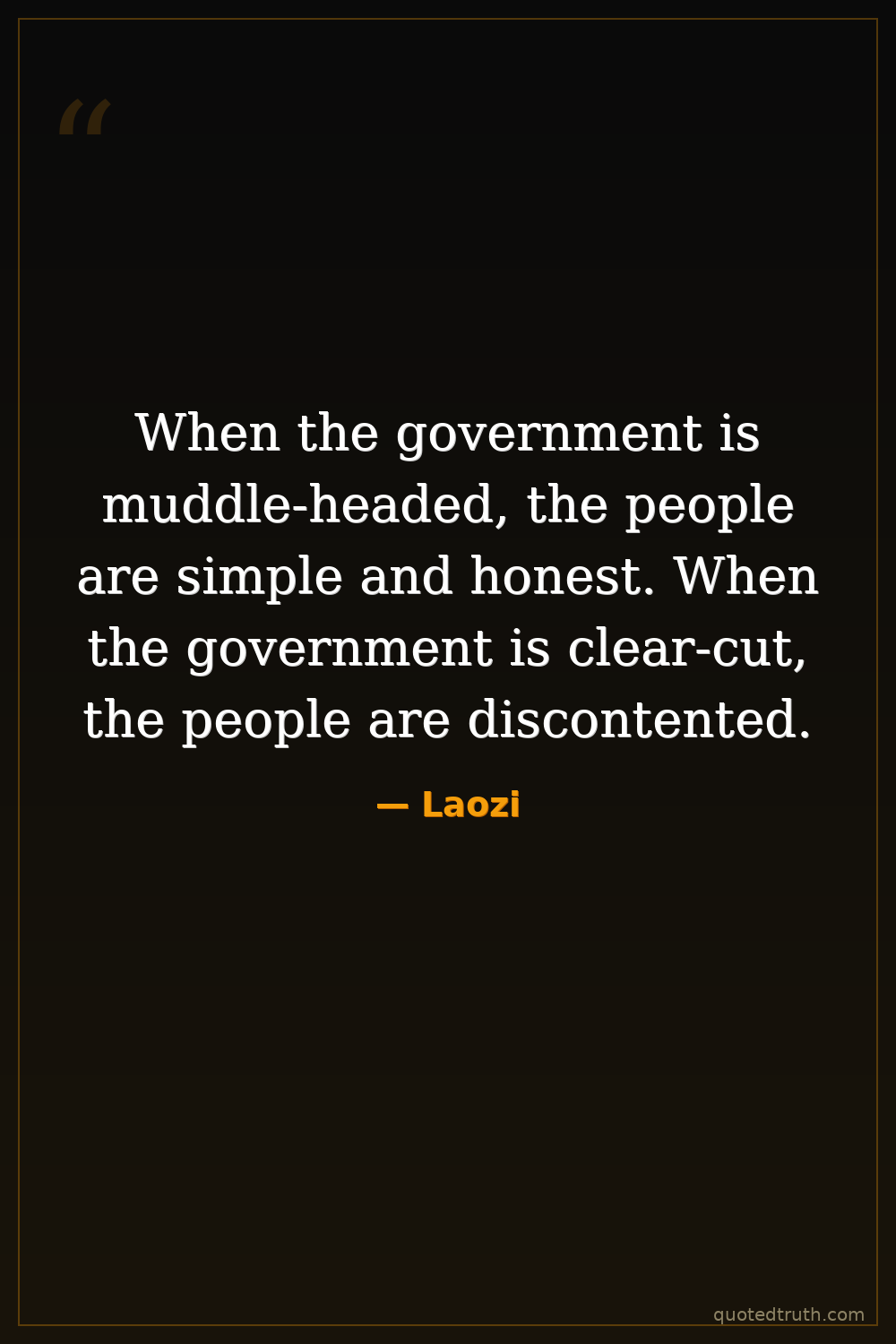
Laozi — "When the government is muddle-headed, the people are simple and honest. When the…"
When the government is muddle-headed, the people are simple and honest. When the government is clear-cut, the people are discontented.
When the government is muddle-headed, the people are simple and honest. When the government is clear-cut, the people are discontented.
Click any product to generate a realistic preview. Up to 3 at a time.
* Initial load can take up to 90 seconds — revising the preview in another color is nearly instant.
"He who knows that enough is enough will always have enough."
"Truthful words are not always beautiful; beautiful words are not always truthful."
"The more laws and ordinances are promulgated, the more thieves and bandits there will be."
"When the government is lazy and careless, the people are unspoiled; when the government is efficient and smart, the people are discontented."
"If you would take, you must first give, this is the beginning of intelligence."
Reputed founder of Taoism and author of the Tao Te Ching, whose wu wei (effortless action) shaped East Asian philosophy. Closely associated with Zhuangzi (later Taoist who extended Laozi's framework). For an intellectual contrast, see Confucius, near-contemporary Chinese sage of social ritual and duty — Confucius systematized social order through ritual and hierarchy; Laozi argued that all such systems were the disease, not the cure — the two founding poles of Chinese moral philosophy.
Found in 1 providers: grok
1 source checked
Loose, hands-off government lets ordinary people live naturally, keeping them content, sincere, and unpretentious. But when rulers impose sharp rules, detailed laws, and constant oversight, people become anxious, cunning, and resentful. Over-regulation breeds the very problems it tries to prevent, because strict control teaches citizens to scheme, compare, and complain. Less interference often produces healthier, more honest communities than aggressive management does.
Laozi, traditionally a keeper of royal archives in the Zhou court, watched bureaucracy expand and grow brittle. His core teaching of wu wei, or effortless non-interference, argues that the sage-ruler governs least and achieves most. This saying distills that conviction: virtue flows from simplicity, not from elaborate statutes. It mirrors his withdrawal from official life and his preference for quiet, natural order over ambitious administrative engineering.
Laozi lived during the late Zhou dynasty, an age of collapsing feudal authority sliding toward the Warring States period. Rival lords multiplied taxes, conscripted peasants, and issued harsh legal codes to squeeze more power from shrinking territories. Competing schools, including early Legalists, pushed ever stricter control. Against this backdrop of heavy-handed rule and constant warfare, Laozi's praise of muddle-headed, minimal government was a pointed critique of the micromanaging statecraft devastating ordinary Chinese life.
AI-generated insights based on extensive research and information for context. Factual errors? Email [email protected].
Your cart is empty