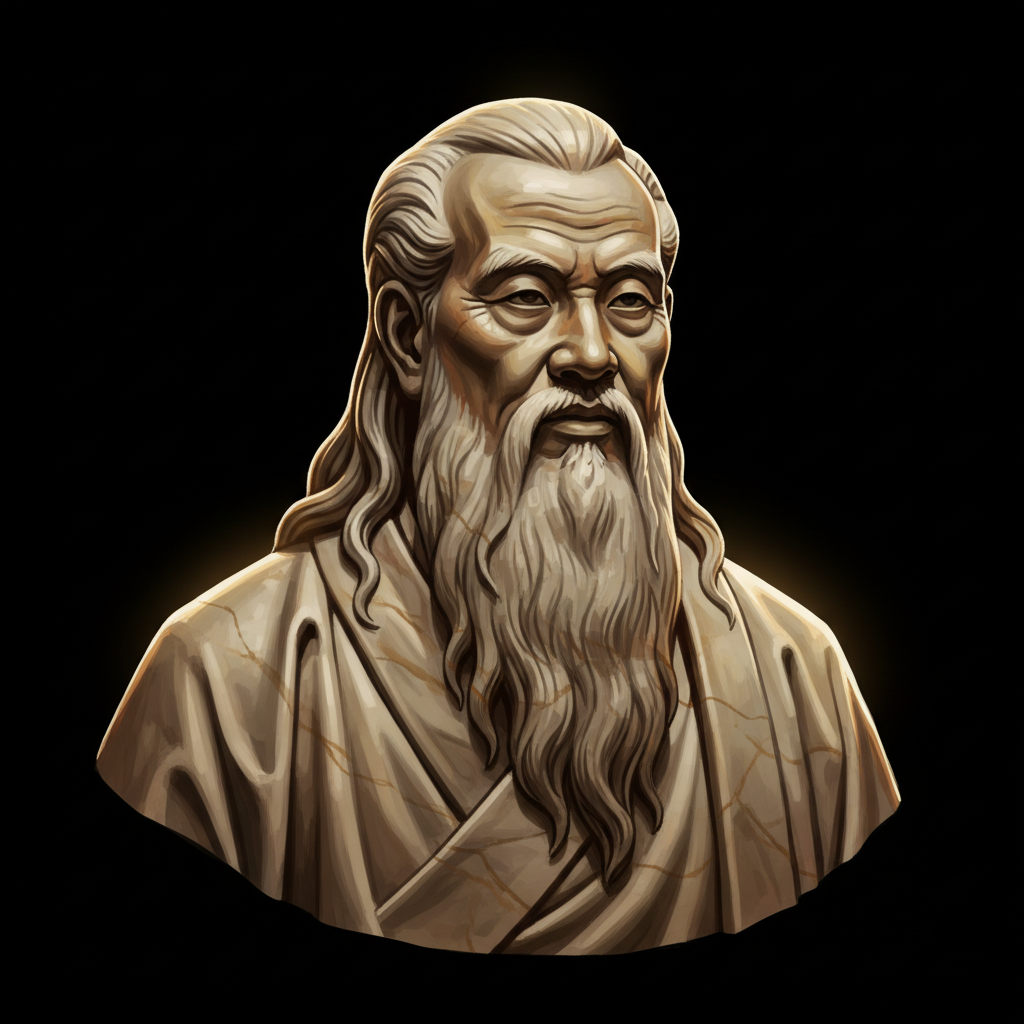
Laozi — "When the people are ignorant, they are easy to control."
When the people are ignorant, they are easy to control.
When the people are ignorant, they are easy to control.
Click any product to generate a realistic preview. Up to 3 at a time.
* Initial load can take up to 90 seconds — revising the preview in another color is nearly instant.
"The greatest conquest is to conquer oneself."
"The greatest skill is to seem unskilled; The greatest abundance is to seem empty."
"The five colors make one blind in the eyes; the five tones make one deaf in the ears."
"The heavy is the root of the light. The still is the master of the restless."
"Fame or integrity: which is more important? Money or happiness: which is more precious?"
Reputed founder of Taoism and author of the Tao Te Ching, whose wu wei (effortless action) shaped East Asian philosophy. Closely associated with Zhuangzi (later Taoist who extended Laozi's framework). For an intellectual contrast, see Confucius, near-contemporary Chinese sage of social ritual and duty — Confucius systematized social order through ritual and hierarchy; Laozi argued that all such systems were the disease, not the cure — the two founding poles of Chinese moral philosophy.
Found in 1 providers: deepseek
1 source checked
Keeping a population uninformed makes them simpler to govern. When people lack knowledge, sophisticated desires, and awareness of alternatives, they do not question authority, organize resistance, or demand change. Rulers face fewer challenges because ignorant subjects accept conditions passively, follow instructions without scrutiny, and cannot coordinate opposition. The saying observes a political reality about the relationship between knowledge and power, noting that education and awareness tend to produce people harder to dominate or manipulate.
Laozi served as a keeper of archives in the Zhou court, giving him close observation of rulers and statecraft. The Tao Te Ching repeatedly advises leaders to keep subjects with simple bellies and empty minds, favoring quiet, uncomplicated lives over clever ambition. Laozi distrusted elaborate learning, moral posturing, and aggressive government, believing cunning populations bred cunning rulers. His philosophy of wu wei, effortless rule through minimalism, treated simplicity as both personal virtue and political strategy for stable harmony.
Laozi lived during the late Zhou dynasty, around the sixth century BCE, as centralized authority crumbled into the Warring States chaos. Rival lords fought constantly, ministers schemed, and competing schools, Confucians, Legalists, Mohists, offered blueprints for order. Literacy, commerce, and political intrigue were expanding, producing restless populations. In that turbulent climate, thinkers debated how to pacify subjects and restore stability, making observations about ignorance, simplicity, and governance urgent practical questions rather than abstract philosophy.
AI-generated insights based on extensive research and information for context. Factual errors? Email [email protected].
Your cart is empty