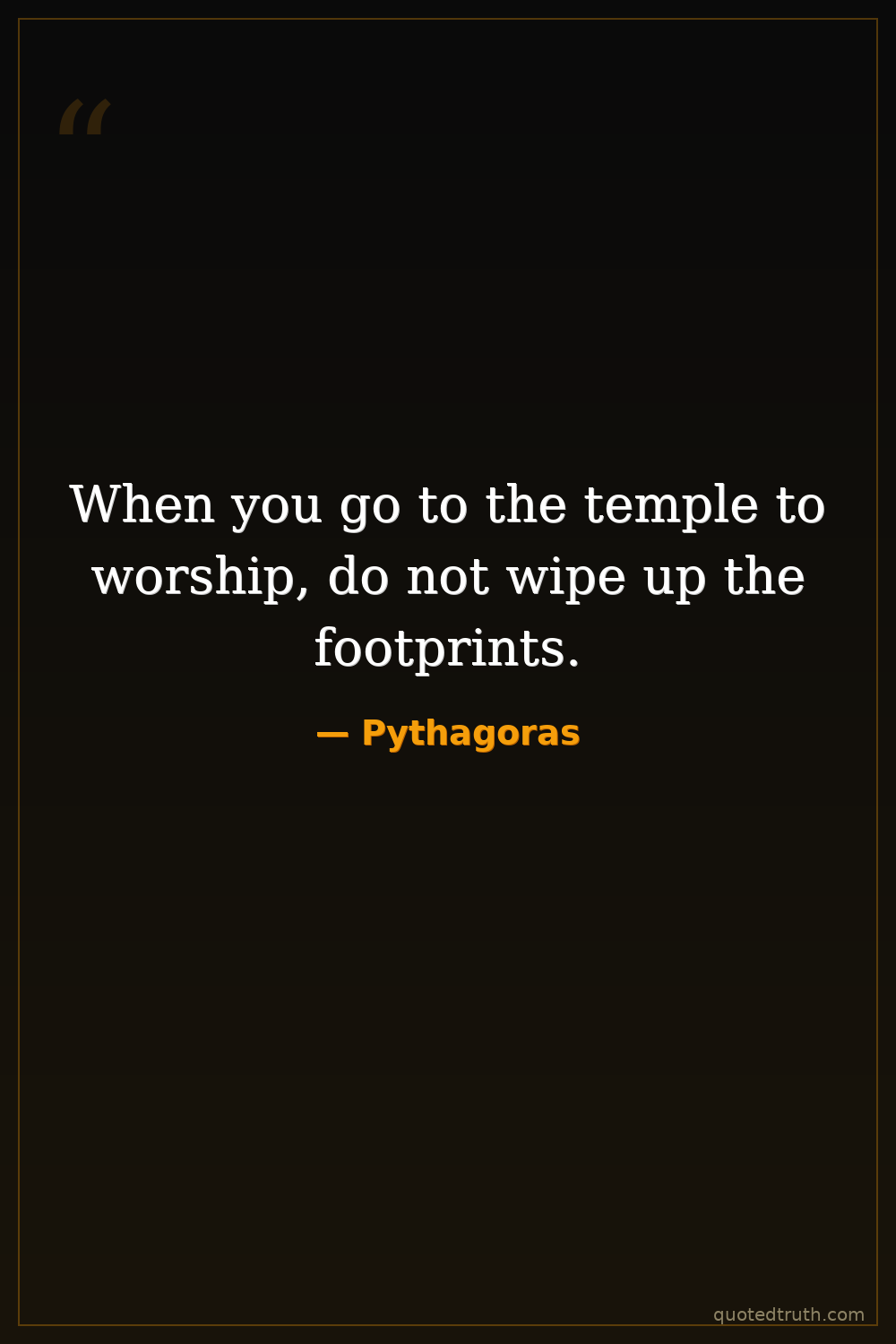
Pythagoras — "When you go to the temple to worship, do not wipe up the footprints."
When you go to the temple to worship, do not wipe up the footprints.
When you go to the temple to worship, do not wipe up the footprints.
Click any product to generate a realistic preview. Up to 3 at a time.
* Initial load can take up to 90 seconds — revising the preview in another color is nearly instant.
"Above the cloud with its shadow is the star with its light."
"None can be free who is a slave to, and ruled by, his passions."
"The soul is a self-moving number."
"Don't put a god's image on a ring."
"Don't wipe up a mess with a torch."
Greek philosopher and mathematician whose school in Croton combined geometry (the Pythagorean theorem), number-mysticism, and a religious-vegetarian way of life. Closely associated with Thales of Miletus (earlier pre-Socratic and the first philosopher). For an intellectual contrast, see Heraclitus, pre-Socratic Greek philosopher of flux — Heraclitus called Pythagoras 'the chief of swindlers' — among the founding insults of the philosophical-rivalry tradition. Their 'all is flux' vs 'all is number' poles still organize the philosophy of mathematics today (Platonist vs anti-realist).
Another 'symbol,' possibly meaning to avoid erasing the memory of past good deeds or to not be overly concerned with trivialities.
Date: c. 570 – c. 495 BC
ShockingFound in 1 providers: grok
1 source checked
Preserve the sacred traces left by those who came before you in worship. Footprints near a temple mark the passage of devoted people; erasing them disrespects their reverence. More broadly, do not obliterate signs of piety or inherited tradition. Honor the evidence of communal devotion. This is one of Pythagoras's symbolic akusmata — aphorisms with layered meaning — urging mindfulness of the sacred and respect for the footsteps of those who walked the path of worship.
Pythagoras was not only a mathematician but the leader of a strict religious brotherhood in Croton, Greece. He taught metempsychosis — the soul's transmigration through lives — and demanded ritual purity from followers. His akusmata were symbolic rules governing sacred behavior. This saying reflects his deep reverence for religious observance and his insistence that his community honor the divine with complete attention and care, not careless indifference to what others had consecrated.
In 6th-century BCE Greece, temples were the literal homes of gods — sacred precincts requiring ritual purity before entry. The concept of miasma, or ritual pollution, governed public life: even accidental impurity could offend the divine. Pythagorean communities in Magna Graecia blended Greek polytheism with Orphic mystery traditions, creating unusually rigorous codes of conduct. Preserving temple-ground sanctity, down to physical traces left by worshippers, reflected this era's intense preoccupation with correct ritual and divine favor.
AI-generated insights based on extensive research and information for context. Factual errors? Email [email protected].
Your cart is empty