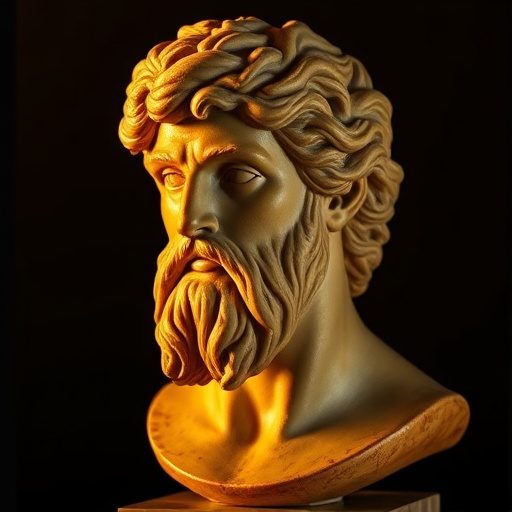
Pythagoras — "The soul is a self-moving number."
The soul is a self-moving number.
The soul is a self-moving number.
Click any product to generate a realistic preview. Up to 3 at a time.
* Initial load can take up to 90 seconds — revising the preview in another color is nearly instant.
"Geometry is knowledge of the eternally existent."
"There is geometry in the humming of the strings. There is music in the spacing of the spheres."
"There is geometry in the humming of the strings."
"A fool is known by his speech, and a wise man by silence."
"Abstain from the flesh of beasts that die of themselves."
Greek philosopher and mathematician whose school in Croton combined geometry (the Pythagorean theorem), number-mysticism, and a religious-vegetarian way of life. Closely associated with Thales of Miletus (earlier pre-Socratic and the first philosopher). For an intellectual contrast, see Heraclitus, pre-Socratic Greek philosopher of flux — Heraclitus called Pythagoras 'the chief of swindlers' — among the founding insults of the philosophical-rivalry tradition. Their 'all is flux' vs 'all is number' poles still organize the philosophy of mathematics today (Platonist vs anti-realist).
A highly abstract and distinctively Pythagorean concept of the soul.
Date: c. 570 – c. 495 BC
ShockingFound in 1 providers: grok
1 source checked
The quote claims consciousness has a mathematical structure and drives itself without external force. In ancient Greek thought, 'number' wasn't just a quantity — it was the underlying pattern governing all reality. Calling the soul a number means it operates by intrinsic laws of harmony and proportion. 'Self-moving' sets it apart from inert matter: the soul generates its own activity. Together: the mind is a self-organizing, numerically ordered force that propels itself through existence.
Pythagoras built an entire philosophical system around numbers as the bedrock of reality. He also taught metempsychosis — the soul's migration through multiple bodies — which requires the soul to be durable, autonomous, and self-propelled. Describing the soul numerically unifies both pillars of his worldview: the mathematical order of the cosmos and the immortal, journeying soul. His Brotherhood practiced ascetic discipline to purify the soul, consistent with viewing it as a higher-order, self-governing entity.
In 6th-century BCE Greece, Pre-Socratic thinkers were debating what fundamental substance underlies reality. Simultaneously, Orphic mystery religions preached soul transmigration and cosmic justice across lifetimes — ideas Pythagoras absorbed and mathematized. Greek city-states were grappling with questions of personal agency and responsibility. A self-moving soul carried enormous weight: individuals were not puppets of fate but self-directed actors. Placing number at the soul's core made morality and cosmic order mathematically inseparable.
AI-generated insights based on extensive research and information for context. Factual errors? Email [email protected].
Your cart is empty