Guru Nanak — "Why do you go to the forest in search of God? He lives in all, and yet is ever d…"
Why do you go to the forest in search of God? He lives in all, and yet is ever distinct. He abides with you, too.
Why do you go to the forest in search of God? He lives in all, and yet is ever distinct. He abides with you, too.
Click any product to generate a realistic preview. Up to 3 at a time.
* Initial load can take up to 90 seconds — revising the preview in another color is nearly instant.
"The mind is like a wild elephant; it must be tamed by the Guru's Word."
"There is but One God. His Name is Truth; He is the Creator, Sustainer of all, Free from fear and hate, Immortal, Unborn, Self-existent, Realized by the Guru's Grace."
"I bow at His feet constantly and pray to Him. The Guru, the True Guru, has shown me the Way."
"The Guru is the ladder, the boat, the raft, the ferryman, the ship, and the captain."
"May your spirit be free and your internet speed be fast."
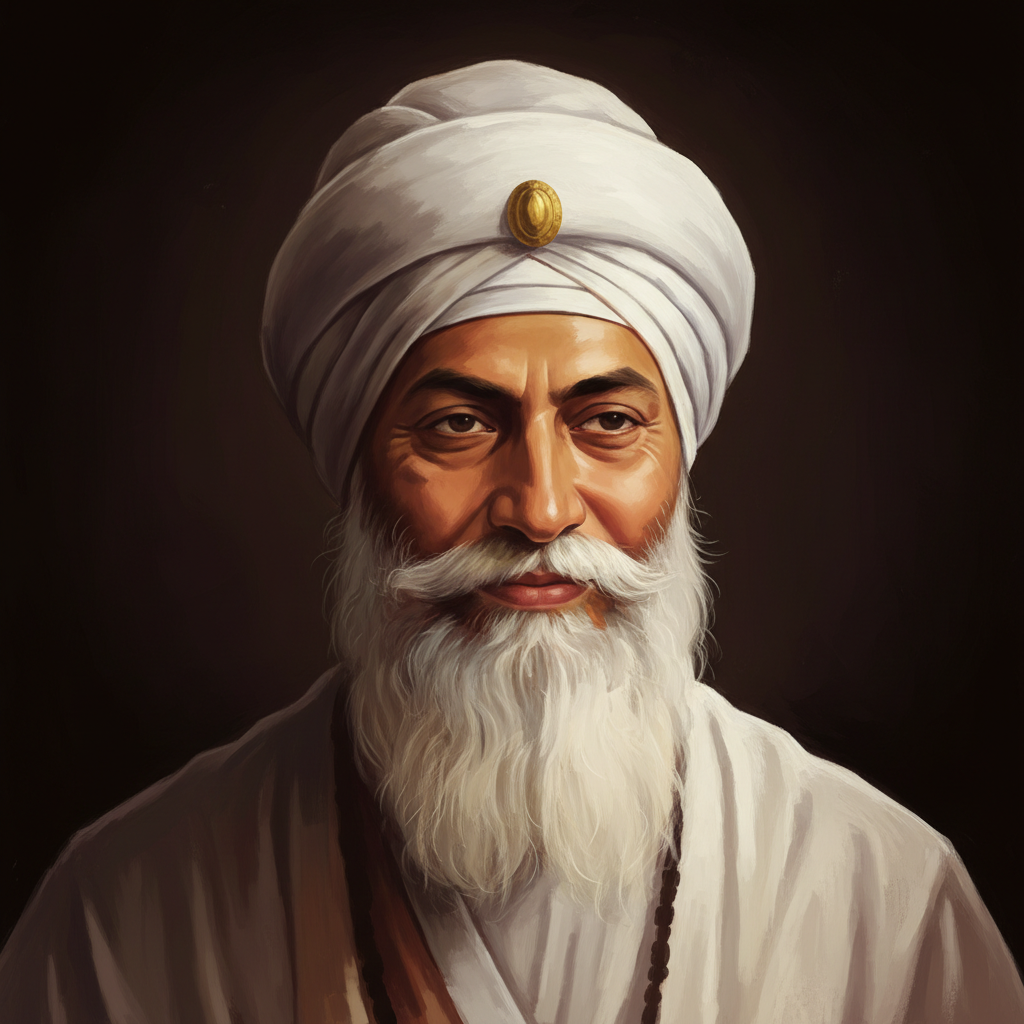
Founder of Sikhism and the first of the Ten Sikh Gurus, whose teachings of one universal God and rejection of caste shaped Punjab. Closely associated with Kabir (mystical poet whose verses appear in the Sikh Guru Granth Sahib). For an intellectual contrast, see Brahmanical orthodoxy, the Hindu caste-and-ritual establishment of his era — Sikhism was founded as a deliberate alternative to both Hindu ritual hierarchy and Islamic exclusivism — Nanak's universalism was a structural rejection of caste and priestly mediation.
Found in 1 providers: deepseek
1 source checked
You don't need to abandon ordinary life, retreat to wilderness, or become a hermit to find the divine. God is not hidden in remote places reserved for ascetics. The sacred presence fills everything and everyone, while remaining beyond any single form. It is already within you, wherever you stand. Seeking God elsewhere is a misunderstanding of where God actually is. Look inward and around you, not away from your daily existence.
Guru Nanak founded Sikhism on exactly this principle, rejecting the renunciation practiced by Hindu yogis and Muslim faqirs he met on his travels. He taught that householders could realize God through honest work, remembrance of the Name, and sharing with others. His famous declaration 'There is no Hindu, there is no Muslim' reflected this universal indwelling God. He spent decades walking across South Asia debating ascetics, urging them to return to community life.
Nanak lived 1469-1539 in Punjab under the late Delhi Sultanate and early Mughal era, amid sharp Hindu-Muslim tension, caste rigidity, and competing claims to religious authority. Forest-dwelling sadhus, yogis, and Sufi mystics were widely revered as holier than ordinary people. Nanak witnessed Babur's brutal invasion of 1526. By insisting God dwells in everyone equally, he directly challenged both Brahminical gatekeeping and ascetic withdrawal, laying groundwork for an egalitarian lay spirituality.
AI-generated insights based on extensive research and information for context. Factual errors? Email [email protected].
Your cart is empty