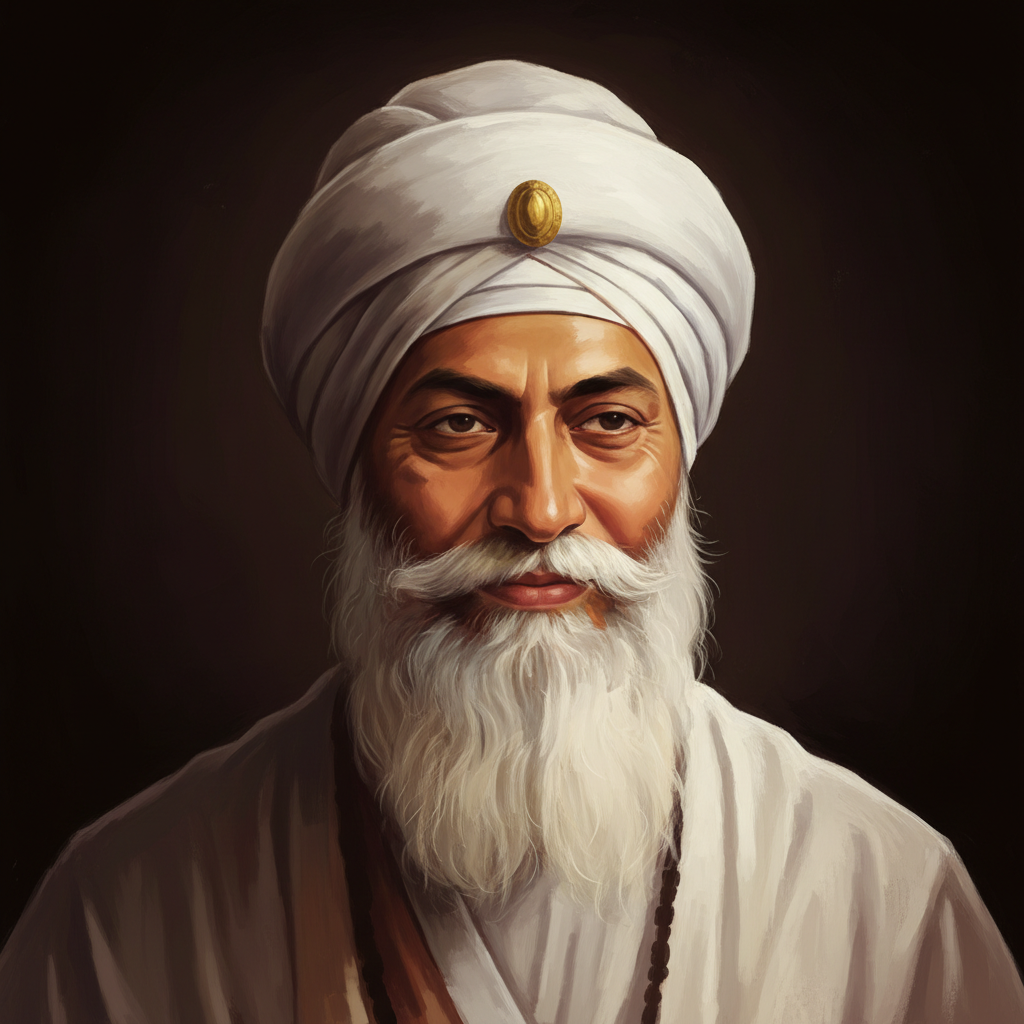
Guru Nanak — "Without the Naam, life is a waste."
Without the Naam, life is a waste.
Without the Naam, life is a waste.
Click any product to generate a realistic preview. Up to 3 at a time.
* Initial load can take up to 90 seconds — revising the preview in another color is nearly instant.
"The greatest pilgrimage is to the temple of one's own heart. And sometimes, that temple needs a good cleaning."
"That one plant should be sown and another be produced cannot happen; whatever seed is sown, a plant of that kind even comes forth."
"He alone is a Brahmin who knows God."
"One cannot comprehend Him through reason, even if one reasoned for ages."
"Bathing in holy rivers alone cannot wash away sins of injustice and greed; the most important thing is not ritual purity, but purity of words and deeds."
Founder of Sikhism and the first of the Ten Sikh Gurus, whose teachings of one universal God and rejection of caste shaped Punjab. Closely associated with Kabir (mystical poet whose verses appear in the Sikh Guru Granth Sahib). For an intellectual contrast, see Brahmanical orthodoxy, the Hindu caste-and-ritual establishment of his era — Sikhism was founded as a deliberate alternative to both Hindu ritual hierarchy and Islamic exclusivism — Nanak's universalism was a structural rejection of caste and priestly mediation.
Found in 1 providers: grok
1 source checked
This saying argues that a human life spent ignoring the divine name — the conscious remembrance of God — amounts to squandered time, no matter how much wealth, status, or pleasure it accumulates. Without that inward practice, the outer achievements are hollow. Real living, in this view, begins when a person continually recalls and internalizes the Creator, making every breath meaningful rather than merely passing through existence collecting possessions, rituals, or reputation.
Guru Nanak, founder of Sikhism, built his entire teaching around Naam Simran — remembrance of the divine name — as the path open to every person regardless of caste, gender, or creed. He rejected empty ritualism, pilgrimages, and priestly mediation in favor of inner devotion paired with honest work and sharing. This quote distills his core message: a life lacking conscious connection to the Formless One, however outwardly successful, is spiritually bankrupt.
Nanak lived in Punjab (1469–1539) during the early Mughal conquest, when Hindu caste hierarchy and Islamic orthodoxy both pressured ordinary people through ritual, tax, and clerical gatekeeping. Pilgrimages, sacrificial rites, and rote recitation were sold as salvation. Against this backdrop, insisting life without inner Naam is wasted was radical: it bypassed Brahmins, mullahs, temples, and mosques alike, handing spiritual access directly to farmers, women, and low-caste laborers who had been excluded.
AI-generated insights based on extensive research and information for context. Factual errors? Email [email protected].
Your cart is empty