Martin Luther — "You are not yet a master of the Scriptures. You will find that out when you try …"
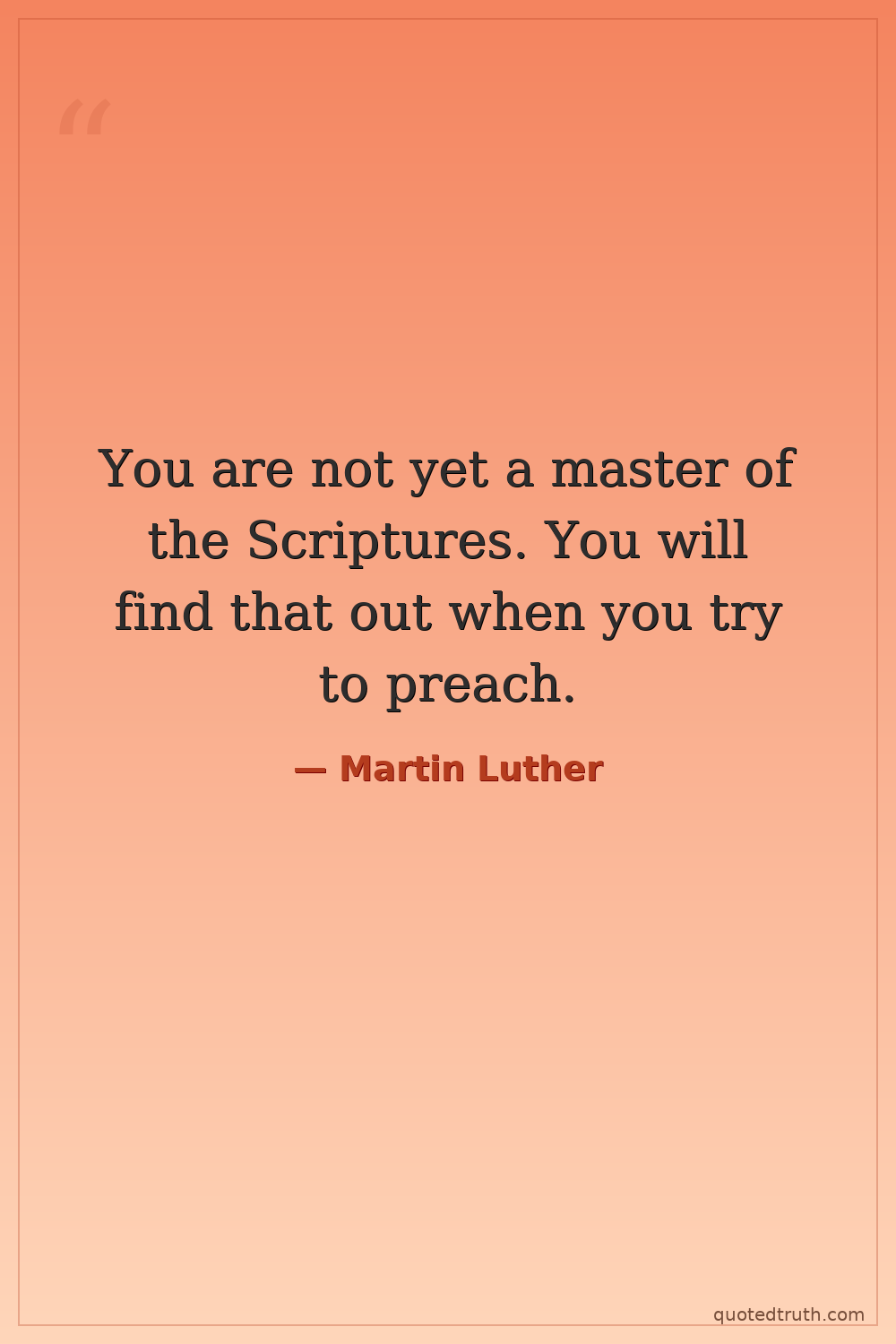
You are not yet a master of the Scriptures. You will find that out when you try to preach.
You are not yet a master of the Scriptures. You will find that out when you try to preach.
Click any product to generate a realistic preview. Up to 3 at a time.
* Initial load can take up to 90 seconds — revising the preview in another color is nearly instant.
"Melanchthon is a miserable little worm of a man."
"I have often tried to be angry with the devil, but I cannot; he is such a merry knave."
"First, to set fire to their synagogues or schools and to bury and cover with dirt whatever will not burn, so that no man will ever again see a stone or cinder of them. This is to be done in honor of o…"
"The Turks are the rod of the wrath of the Lord our God."
"What does not kill me makes me stronger."
German theologian whose 95 Theses (1517) launched the Protestant Reformation and broke the Catholic Church's monopoly on Western Christianity. Closely associated with Philipp Melanchthon (Lutheran systematizer) and John Calvin (later Reformer who built on Luther's break). For an intellectual contrast, see Pope Leo X, Renaissance pope (1513-1521) — Leo X's indulgence sales triggered Luther's break and Leo excommunicated him in 1521 — Luther's entire Reformation is structured as a direct answer to the indulgence-funded Vatican Leo represented.
Found in 1 providers: grok
1 source checked
Studying scripture in private feels like mastery, but the moment you have to explain it to others, your gaps appear. Teaching exposes what reading alone hides. Until you've stood up and tried to make a text clear to a real audience, you don't actually understand it as well as you think. Real comprehension is tested by the demand to communicate, not by quiet familiarity with the words on the page.
Luther was a Bible professor at Wittenberg and a constant preacher who delivered thousands of sermons. He translated the New Testament into German so ordinary people could read it. His own pulpit work taught him that lecturing on doctrine and preaching to congregations were different disciplines. The remark reflects his pastoral humility: even a trained theologian discovers his weaknesses only when forced to make scripture intelligible to listeners who need it to land.
In early-1500s Europe, scripture was locked in Latin and mediated by clergy, and most preaching was formulaic. Luther's Reformation insisted that the Bible belonged in the vernacular and that pastors must actually expound it, not recite it. Printing presses spread sermons rapidly, raising the bar for clarity. Against that backdrop, telling a would-be scholar that the pulpit, not the study, is the true test of mastery struck at both Catholic clericalism and lazy Protestant pride.
AI-generated insights based on extensive research and information for context. Factual errors? Email [email protected].
Your cart is empty