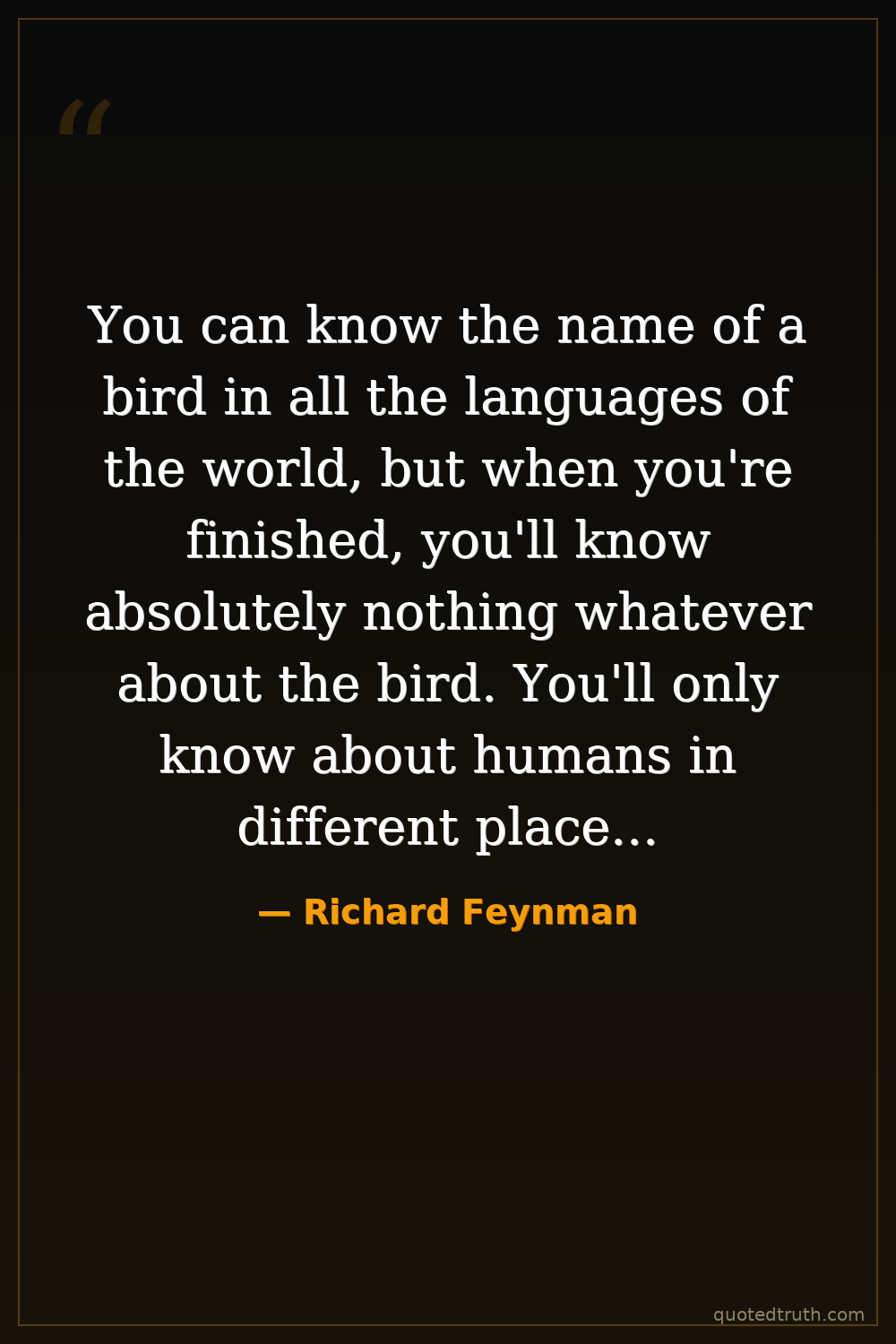
Richard Feynman — "You can know the name of a bird in all the languages of the world, but when you'…"

You can know the name of a bird in all the languages of the world, but when you're finished, you'll know absolutely nothing whatever about the bird. You'll only know about humans in different places and what they call the bird. So let's look at the bird and see what it's doing—that's what counts.
Richard Feynman — Richard Feynman Modern · Quantum electrodynamics

Get This Quote & Author's Image Illustrated On:

Click any product to generate a realistic preview. Up to 3 at a time.
* Initial load can take up to 90 seconds — revising the preview in another color is nearly instant.

Kitchen

Apparel

Other

About Richard Feynman (1918-1988)

American theoretical physicist who shared the 1965 Nobel for QED, developed Feynman diagrams, and wrote the Feynman Lectures on Physics. Closely associated with Julian Schwinger (co-Nobelist for QED) and Murray Gell-Mann (Caltech rival and Eightfold-Way physicist). For an intellectual contrast, see Deepak Chopra, physician and quantum-mysticism author — Feynman's Caltech 'cargo cult science' commencement address is the precise template for what he saw as misuse of physics terminology — Chopra-style appropriation of quantum vocabulary for metaphysical claims is the canonical example of what Feynman called 'fooling yourself'.

Details

From 'The Pleasure of Finding Things Out'

Date: 1981 (published)

Shocking

Verification

Unverifiable

Found in 1 providers: grok

1 source checked

Understanding this quote

What it means

Memorizing labels and terminology gives the illusion of knowledge without actual understanding. True knowledge comes from observing how things actually behave and work, not from cataloguing what different cultures call them. Names are human conventions; reality is what demands your attention. Look at the thing itself rather than the words surrounding it.

Relevance to Richard Feynman

Feynman built quantum electrodynamics by stripping physics down to observable phenomena, rejecting formalism for its own sake. He famously challenged colleagues who hid behind jargon, and his Caltech lectures prioritized deep intuition over memorized formulas. His father taught him this lesson in childhood, showing him birds and insisting names meant nothing compared to behavior.

The era

Post-WWII science education exploded in scale, producing graduates who could recite equations but lacked physical intuition. The Cold War arms race created pressure to appear knowledgeable quickly, rewarding credential-gathering over genuine inquiry. Feynman was reacting against a university culture increasingly dominated by rote learning, standardized tests, and prestige signaling over authentic scientific curiosity.

AI-generated insights based on extensive research and information for context. Factual errors? Email [email protected].
Your Cart

Your cart is empty